Wednesday, May 17, 2006
Nativity name change
Jeffrey Overstreet and Peter Chattaway are both reporting that Catherine Hardwicke's nativity film is now going to be called The Nativity Story. I'm not sure I like the change. It just makes it sound a little bit more twee than plain old Nativity. Perhaps I'll get used to it by the time the film comes out.

David and Bathsheba (1951)
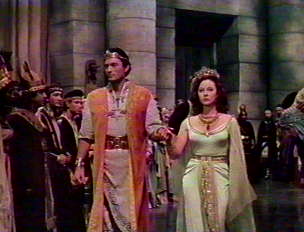 Generally speaking, Bible films from the (second) golden era of the 50s and 60s were all about spectacle. It didn't matter if the dialogue was corny, and the characterisations were fairly thin, so long as the film looked sumptuous, and re-affirmed Christian America that the values they cherished were all related to the bible. There were a few notable exceptions of course; films that probed a bit deeper, and were more challenging than campy classics such as Samson and Delilah. But few films were prepared to eschew scenes of huge battles and debauched orgies to focus on the stories at hand.
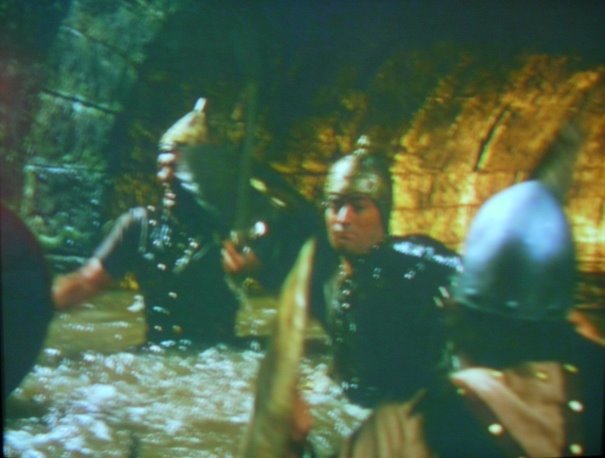
In that sense then, David and Bathsheba (1951), starring Gregory Peck and Susan Hayward, is distinctly different. Admittedly the film is bracketed by the briefest of fights, and does contain a seemingly out of place exotic dancer scene, but both of these play a notable part in the psychological exploration that the film lays before us.
Initially, Peck's David seems to be a disappointment. As usual, Peck is attractive, heroic, and yet emotionally guarded. The result is a David that lacks the passion of the famed psalmist, or of the unwavering confidence of the shepherd boy who slew a giant. In fact, the first time viewer may wonder if this is going too be the most secular bible film ever produced. Is it simply an excuse to bring together two of Hollywood's handsomest actors?
 Thankfully, there is far more going on here. The low key portrayal of faith in the first part of the film reflects not a lack of interest on the part of director Henry King, but David's estrangement from the faith of his childhood. His responsibilities, his loveless marriages, the death of his best friend, and no doubt his time fleeing Saul have blunted his relationship with God, and left him feeling distant from him. His early incursion into enemy territory betrays an internal crisis as he strives for the life of excitement he has left behind. Visually his old life in the open countryside is contrasted with his new life trapped in his new place of work, the palace. It's no surprise then that he first spies Bathsheba when taking in the fresh breeze afforded by the roof of his palace, nor that their relationship only really becomes emotionally intimate when they escape to the country. Indeed thematically, Bathsheba is, indirectly, his route back to God.
That is not to say that their relationship is bathed in glory. The film shows both David and Bathsheba as culpable for both their adultery and for the subsequent death of Bathsheba's husband Uriah. In an era when often film-makers attempted to redeem biblical characters and turn the story around, so that even Salome was dancing to save John the Baptist, it is happy to popularise the weakness of one of the Hebrew bible's favourite heroes.
 Nevertheless, it does soften the blow somewhat. Whilst David wastes no time in getting acquainted with Bathsheba, we learn it is she who had deliberately put herself in his view. Furthermore Uriah is painted as a criminally disinterested husband, spending only 6 nights with his wife in 7 months, and refusing to visit her when he is strongly encouraged to by his hero David. Even the exotic dancer mentioned above fails to stir in him a great deal of interest. Furthermore, David's fatal instructions to Joab are, to a great extent, based on Uriah's own wishes and martyr complex. As David observes "His dreams of glory are his wife in tears".
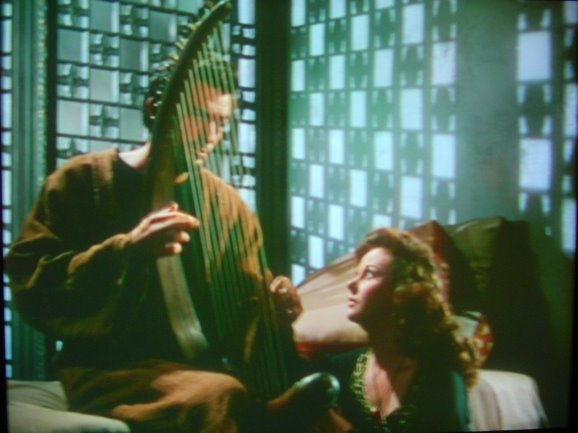
As with the biblical accounts, David and Bathsheba's adultery leads to God's judgement, the subsequent death of their child, and their exposure by the prophet Nathan (although as the scene guide shows these two incidents are in reverse order here compared to the scriptural account). The result is that the people recognise that the drought they have been suffering is a result of David and Bathsheba's sin and they are eager to punish them according to the law. David meanwhile has been forced by Bathsheba to glimpse into his past and re-enact his relationship with God. His performance of Psalm 23 is strangely emotionless and stoic. Yet as it ends on "and I will dwell in the house of the Lord forever" it is like something clicks inside David and he returns, not to face the people inside the city but to face God in the tabernacle which remains outside it. Therein, David both confesses his weakness, but also pleads with God for mercy - mercy which has been in little supply so far. Earlier David was clearly deeply disturbed by the death of Uzzah as he reached out to prevent the ark from falling. Yet now his plea culminates in him repeating the action, forcing God to decide whether to continue as he did previously, or become more merciful.
 What is remarkable about the film is that God responds to David's almost suicidal attempt to receive God's mercy. As David touches the ark, lightening strikes and David's life flashes before his eyes, yet this is not David's death by electrocution, but his resuscitation. As Babington and Evans note "David has moved God by his superior perception of him to a phase of higher activity". The trip into David's youth complete, David's release from his spiritual drought is mirrored by Israel's release from their physical drought as the rain finally pours down declaring David's forgiveness to his subjects.
 It is noticeable that whilst David and Bathsheba is primarily a biblical epic it also touches on a variety of other genres and other films in particular. Most notably the film recalls another Peck film, the psychoanalytical thriller, Spellbound (1945) by Alfred Hitchcock. There, Peck's character is emotionally estranged, partly as a result of the death of his actual brother. There to the film culminates in a revelation of the past which provides drive and direction for the future as it restores the hero to wholeness.
Yet the film also reflects genre's such as Film Noir (Bathsheba as a femme fatale, the murder of a husband, a cover up, and the dark brooding interiors), and Romance (especially the picnic scene in the countryside). Modern viewers may also find some points of comparison with the recent Brokeback Mountain with it's tale of a forbidden love found in an unlikely place that goes far beyond the depth of relationship the film's protagonists are able to find elsewhere. In both films the lead characters are driven to more desperate actions due to the unbearable pressure the wider society puts upon them. The notable difference is that both David and Bathsheba recognise that they have crossed a line in their adultery.
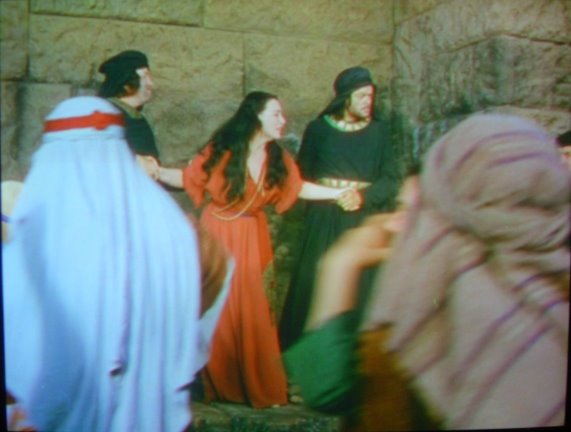 Ultimately however, the film seems to support David's scepticism and unease with the current revelation of God, and points to a future, greater revelation of God in the form of one of David's descendants. Most notably this is highlighted in a scene where an adulteress (dressed appropriately in red) is stoned, very much in the style of John 8:2-11. Yet here there is no reprieve, David is compromised and does not intervene even though the audience's familiarity with the Johannine story makes his inaction unbearable. The tension created by this scene, occurring as it does so shortly after the equalling troubling death of Uzzah, forms the question that dominate the film. Is God forgiving and merciful? Whilst its final resolution gives an emphatic yes, it also points beyond this story to the greater act of love and forgiveness that was to come.
See also my scene guide for this film
Tuesday, May 16, 2006
David and Bathsheba (1951) Scene Guide
 I briefly discussed David and Bathsheba back in March on its DVD release, and thankfully my wife knew me well enough to get it for my birthday, so we sat down to watch it on Saturday. I'll publish a review for it tomorrow hopefully, but for the meantime, here is the scene guide:
War with the Ammonites - (2 Sam 11:1)A Few Notes
[extra-biblical episodes] - (ref to 1 Sam 18:7)
God rejects David's temple plans - (2 Sam 7:1-7)
David and Michal - (loosely 1 Sam 19:11-17; 25:44)
David and Bathsheba commit adultery - (2 Sam 11:2-4)
[extra-biblical episode]
Death of Saul & Jonathan recounted - (1 Sam 31:1-6)
[extra-biblical episodes]
Ark brought to Jerusalem (2 Sam 6:1-5)
Uzzah dies touching the ark (2 Sam 6:6-7)
Bathsheba declares her pregnancy - (2 Sam 11:5)
David brings Uriah's home - (2 Sam 11:6-13)
David arranges Uriah's death - (2 Sam 11:14-17)
Joab's account of Uriah's death - (2 Sam 11:18-25)
Famine in Israel (2 Sam 21:1)
David questions Uzzah's death - (2 Sam 6:8)
Absalom's starts a conspiracy - (2 Sam 15:1-6)
David marries Bathsheba - (2 Sam 11:26-27)
David and Bathsheba's son dies - (2 Sam 12:15-23)
Nathan confronts David - (2 Sam 12:1-10)
[extra-biblical episode]
David plays his harp - (Psalm 23)
[extra-biblical episodes]
[Flashback]
Samuel anoints David - (1 Sam 16:1-13)
David and Goliath - (1 Sam 17:1-51)
I've tried to include allusions where I could (e.g. 1 Sam 18:7), but I suspect I have missed a number of others. In particular, David's final prayer in the tabernacle is doubtless crammed with them. However, it isn't a single complete unit - more a patchwork quilt affair.
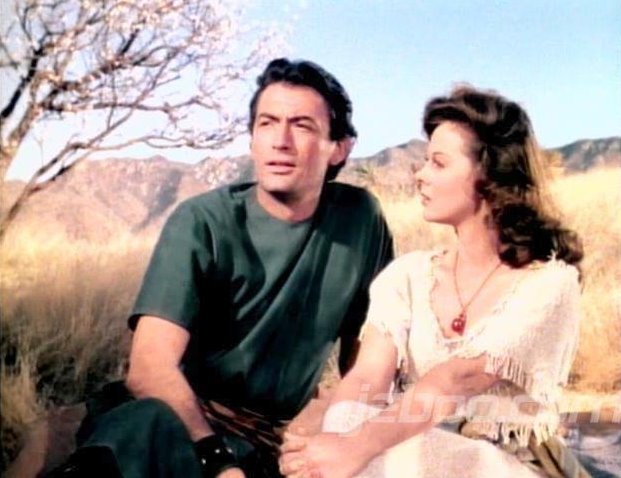 Although the film inserts a few extra-biblical scenes, such as David and Bathsheba going on a picnic in the desert (!) it generally stays fairly closely to the text, although it embellishes the various incidents significantly to make the film last almost two hours. In particular, extra dialogue between David and the other major players (Michal, Bathsheba and Uriah) is inserted. It is noticeable that other than the opening scene, and a brief telling of David and Goliath, there are no battle scenes - very unusual for a 50s biblical epic.
One of the strengths of the film is the way it stresses the time difference between the young David, and the fallen king of these stories. Its often hard to imagine how this gulf grew - even though we find people moving towards faith and drifting away from it quite frequently in real life.
Monday, May 15, 2006
Winifred Jean Page
 I don't usually do personal "stuff" on this site, but this is a worthy exception. Yesterday I heard my Granny, Jean Page had died aged 88. She was an incredible woman whose high spirits, warmth and wonderful sense of humour mean that she will have touched the lives of pretty much everyone she came into contact with.
She was born in Grimsby, Lincolnshire in 1917 to Ray and Ethel Barrett who moved to Althorne, Essex two years later. She had a sister, Yvonne, and two brothers Charles and William. She was always very sporty, winning a medal aged 17 for a yachting race across the North Sea to Heligoland (off the North East German coast) which enabled her to become the youngest ever female member of the Royal Ocean Racing Club (you had to have completed an ocean race to become a member).
She was also a great tennis player, winning a number of trophies in her youth, and continuing to play at her local club St. Chad's until she was 70. She had a hip replacement operation the following year. That didn't prevent her, however, from taking a ride in a hot air balloon on a visit to Egypt - one of her many recent trips around the world.
She married (Cuthbert) Ernest Page on 23rd April 1938, and they had five children, Stephen (28/2/1939), Cath (5/8/1942), Andrew (3/12/1948), Julia (born and died in 1958), and Pippa (2/5/1960). Ernest died in 1988, shortly after their 50th Wedding anniversary.
 Writing this, it's hard to think of anyone who had more zest for life, joy, generosity and warmth than Granny. Laughter was always present at family gatherings, even this Easter bringing the house down with her entry in our spur of the moment "guess the game" game. She will be sadly missed, but joyfully remembered.
I thought I'd end with the first and last verses of what I remember her once calling her favourite hymn, Charles Wesley's Love Divine, All Loves Excelling
Love divine, all loves excelling,
Joy of heaven to earth come down;
Fix in us thy humble dwelling;
All thy faithful mercies crown!
Jesus, Thou art all compassion,
Pure unbounded love Thou art;
Visit us with Thy salvation;
Enter every trembling heart.
Finish, then, Thy new creation;
Pure and spotless let us be.
Let us see Thy great salvation
Perfectly restored in Thee;
Changed from glory into glory,
Till in heaven we take our place,
Till we cast our crowns before Thee,
Lost in wonder, love, and praise.
Friday, May 12, 2006
Terminator and Jesus
Just came across this yesterday - a spoof trailer for Terminator and Jesus.
 It's based around the central observation that the sacrifice at the heart of the Christian gospel is essentially kind of illogical, and whilst it doesn't really intend itself to be taken that seriously there are a couple of observations I'd like to share.
Firstly, I'm reminded of the parallels with Spock's sacrificial death in Star Trek: The Wrath of Khan. There, Spock, who I assume would think roughly in the same way as the Terminator, sees the bigger picture and bases his decision, logically, on that. (This is notably different from the Terminator's own self-sacrifice at the end of Terminator 2). Here, however, under a narrower set of orders (to preserve the life of Jesus), Jesus's actions make no sense to him. I guess he's not the first person to struggle with that.
Secondly, the film highlights a theological / humorous point I've seen made elsewhere (by Lee and Herring's Sunday Heroes) about the role of Judas, who, as both films claim, Jesus actually needed to betray him. Lee and Herring are, unsurprisingly, a little more cynical about this. I think, though, that both miss the point. From a historical point of view Jesus died because it was politically expedient for him to. So had Judas not betrayed him, it is highly likely that his opponents would have found a way.
As for the film itself, whilst it was mildly amusing, I'm getting a little weary of popular culture's conviction that stuff like this is utterly hilarious. "Look it's someone in a sheet and a beard NOT being holy". Side-splitting. I guess there's just something in the triteness of films like this that I just feel uncomfortable with (and I say that as someone who's a big fan of Life of Brian - in fact it's probably because I'm a fan of Life of Brian).
For anyone who is interested, there's another Lee and Herring Sunday Heroes episode here, although some may find this offensive.
 It's based around the central observation that the sacrifice at the heart of the Christian gospel is essentially kind of illogical, and whilst it doesn't really intend itself to be taken that seriously there are a couple of observations I'd like to share.
 Firstly, I'm reminded of the parallels with Spock's sacrificial death in Star Trek: The Wrath of Khan. There, Spock, who I assume would think roughly in the same way as the Terminator, sees the bigger picture and bases his decision, logically, on that. (This is notably different from the Terminator's own self-sacrifice at the end of Terminator 2). Here, however, under a narrower set of orders (to preserve the life of Jesus), Jesus's actions make no sense to him. I guess he's not the first person to struggle with that.
Secondly, the film highlights a theological / humorous point I've seen made elsewhere (by Lee and Herring's Sunday Heroes) about the role of Judas, who, as both films claim, Jesus actually needed to betray him. Lee and Herring are, unsurprisingly, a little more cynical about this. I think, though, that both miss the point. From a historical point of view Jesus died because it was politically expedient for him to. So had Judas not betrayed him, it is highly likely that his opponents would have found a way.
As for the film itself, whilst it was mildly amusing, I'm getting a little weary of popular culture's conviction that stuff like this is utterly hilarious. "Look it's someone in a sheet and a beard NOT being holy". Side-splitting. I guess there's just something in the triteness of films like this that I just feel uncomfortable with (and I say that as someone who's a big fan of Life of Brian - in fact it's probably because I'm a fan of Life of Brian).
For anyone who is interested, there's another Lee and Herring Sunday Heroes episode here, although some may find this offensive.
Thursday, May 11, 2006
Abraham - Scene Guide
 Yesterday I posted a review for Abraham, having written a few initial thoughts on Monday. Anyone interested in a second opinion might want to read Peter Chattaway's review originally written for Christian Info. News, back in July 1996. Peter's got a better grasp of the history of that period than me, and so he's a little more critical of the historical errors he sees.
Anyway, here is the scene guide for the film
Part 1
Extra-biblical episodes (loosely Genesis 11:26-32)
Call of Abram - (Gen 12:1-3)
Abram and Sarai leave Haran - (Gen 12:4)
Extra-biblical episodes
Altar built at Bethel - (Gen 12:7)
Clash with the Amorites - (Gen 12:6)
Famine in the land - (Gen 12:10)
Sarai given to Pharaoh - (Gen 12:10-16)
Extra-biblical episode
Pharaoh falls ill and expels Abram - (Gen 12:17-20)
Abram allied with Mamre the Amorite- (Gen 14:13b)
Abram and Lot separate - (Gen 13:5-18)
Lot captured - (Gen 14:11-12)
Part 2
Abram recounts Tower of Babel - (Gen 11:1-9)
Abram rescues Lot - (Gen 14:13-16)
Abram and the king of Sodom - (Gen 14:17)
God's covenant with Abraham - (Gen 15:1-20)
Abram and Melchizedek - (Gen 14:18-20)
Hagar and Sarai - (Gen 16:1-16)
Covanent of Circumcision - (Gen 17:1-27)
The Three Visitors - (Gen 18:1-15)
Abraham bargains for Sodom - (Gen 18:16-33)
Sodom sins and is destroyed - (Gen 19:1-28)
Birth of Isaac - (Gen 21:1-7)
Hagar and Ishmael sent away - (Gen 21:8-14)
Extra-biblical episode
Hagar and Ishmael in the desert - (Gen 21:15-21)
God tests Abraham - (Gen 22:1-19)
A Few Notes
It's noticeable that the film takes 50% of its runtime on just two and a half chapters (and even then only 2 verses from the half). By contrast the second half of the film covers seven and a half chapters worth of narrative.
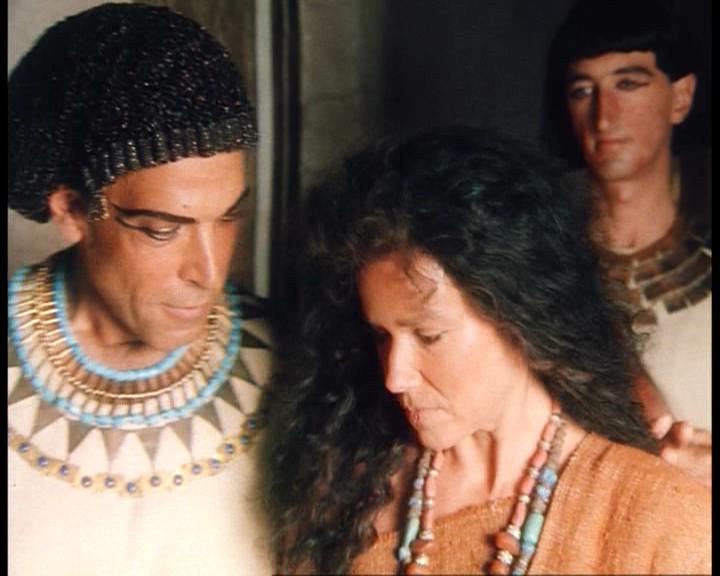 The only major incident not included in this film is that from Gen 20 where Abraham again tries to pass of Sarai as his sister. This may well be because some scholars consider this to be an alternative version of the same story. Such an interpretation certainly seems to make Abram's repeated disowning of his wife more understandable. That said, the differences are also significant - differences of location, the man in question, the way Abimelech hears from God rather than getting a disease first, and the way Abraham prays for Abimelech's wife and slave girls at the story's end. This last incident is one of my favourites in the whole story. Sarah is still without her own son, at this point, which must have pained both her and Abraham. Yet Abraham finds the strength to lay these feelings aside and pray for Abimelech's wife and slave girls that they would receive the miracle that has eluded Abraham and Sarah all these years. I wonder how many times Abraham must have prayed this prayer for his own wife?
By contrast to it's exclusion of the Abimelech story, the film does include each of the occasions when God speaks to Abraham, even though there is some repetition here also.
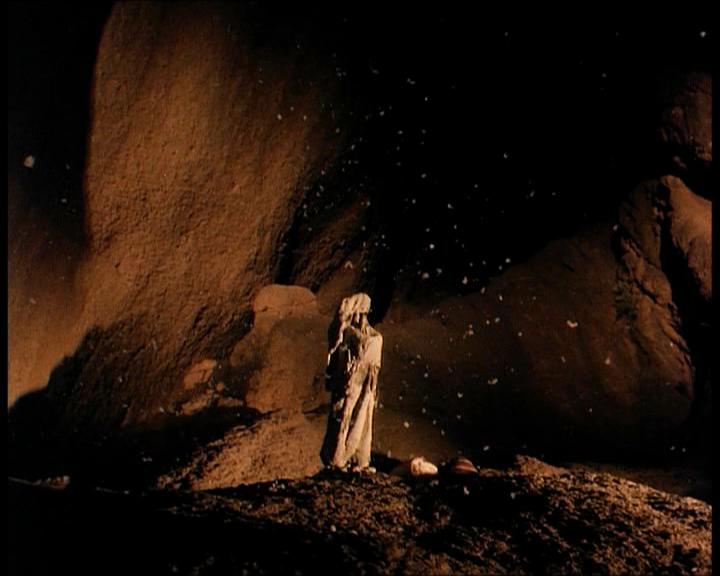 Finally, its interesting how the portrays the crimes of Sodom. these are first depicted early on after Abraham rescues Lot, when some sort of homosexuality is awkwardly displayed. This is repeated once the two angels visit the city. However, the crime itself, still seems to be the more likely scriptural interpretation of "attempted gang rape". In some ways, then, the film wants to have it's cake and eat it, neither offending the homosexual community by showing homosexual acts as the sin that condemns Sodom, whilst failing to remove the suggestion that homosexual acts were a part of the problem. Reading this on a deeper level, this resultant linking of homosexuality to gang rape is potentially far more offensive than either of those on its own. It's also interesting how the film shows Lot's wife turning into a pillar of salf (right). This is shown but receives very little comment. There's some subtle suggestion that what happens to Sodom is linked to volcanic activity, but this is never explicitly shown or stated.
Apologies - wrong titles
Oops. I made a bit of a mistake with my titles yesterday. Yesterday's post was a review of the Abraham film - not the scene guide, and so should have been called a review (obviously). The scene guide is actually getting published today (above). Apologies for any confusion.
Matt
Matt
Subscribe to:
Posts (Atom)