Showing posts with label Documentaries. Show all posts

Monday, April 25, 2011

The Story of Jesus (BBC)

This Easter's biggest piece of religious programming was BBC1's two-part documentary The Story of Jesus.

In a break from what has become the standard format for such documentaries, rather than having one (usually photogenic) expert both narrating and interviewing other experts, this programme was narrated by David Suchet (Poirot, minus the accent) but the on-screen camera work was performed by nine different scholars who occasionally met to pass on the baton to the next there were other experts involved as well (I counted 19-20 in total) but these nine had a far greater screen time than their counterparts. After years of seeing the same, increasingly tired, old format, it was good to see a new approach being tried and the hand-overs, which took a bit of getting used too, were an effective way of moving things on.

Part 1 of the series began by looking at the textual evidence for the gospels and their reliability. Tom Wright was very much to the fore here, explaining how the earliest scraps of the scriptures and far more contemporary with the originals than other written sources from the time.

After that Simon Gathercole was introduced and he guided us through the nativity story. There's talk of Herod and the Magi and rather than giving an astrological answer to questions about the Star of Bethlehem, a textual one is given: it's evoking a quotation from Numbers 24:17 "a star has come out of Jacob". The discussion begins to be illustrated with dramatised footage and it's rather good. The lighting, filters and film stock result in high quality footage and the choice of predominantly near / middle-eastern actors (or those of near / middle eastern descent) gives an extra sense of realism. Mary here is perhaps the most convincing looking Mary I've seen, and her performance is pretty decent as well.

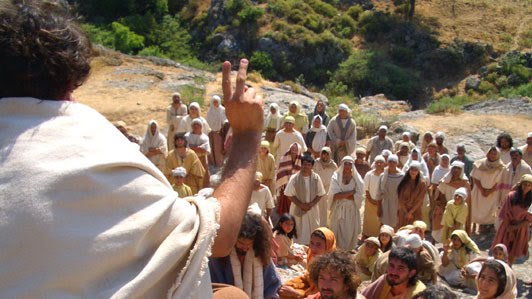
The impressive casting also extends to Jesus himself, played by Big Book Media's Selva Raslingam who is almost as far from the traditional Hollywood Jesus as one can get. Having been taken briefly through archaeological finds in Sephoris and Nazareth by James Strange we come to Jesus' ministry. There's talk of John the Baptist (featuring nicely-restrained use of time-lapse photography), and the symbolism that flows out of the story of the Wedding at Cana. We're told that there are two Greek words translated as "miracle", one of which means "sign". In the story of the Wedding at Cana the miracle is called Jesus' first "sign" and alludes to passages from the prophets predicting that water flowing down the mountains will turn to wine. Greg Carey is leading things through now and he highlights the abundance theme in many of the miracles, pointing to God's new kingdom, a place of abundance. There's a brief mention of the roughly contemporary Jewish miracle worker Honi. The first episode comes to a close with Greg Carey discussing the Transfiguration and it's perhaps the first time that the dramatised footage has been a little disappointing.

Whilst from a narrative angle part two picks up from more or less where the opening episode left off, thematically things are very different. It's the turn of Obery Hendricks to present now and his focus is very much on Jesus' radical, political message, rather than this spiritual one. There are small sections on the synagogue at Magdala, and his parables and teaching, and then we're into the events of Holy Week.

The leading expert for this section is Ben Witherington III, although occasionally the location footage oscillates between him and Helen Bond (whose focus is mainly on Jesus' death). It's here that the information being presented is most well known, and as a result least interesting for those who know the subject well. This isn't improved by limiting the viewpoints that are expressed to produce a reasonably conservative position. This is as much in the editing of the experts' soundbites as their viewpoints. Bond is not nearly as conservative as Witherington, but the quotations that are left don't really demonstrate the difference. There's also no more sceptical voices such as that of John Dominic Crossan who claims (incorrectly in my opinion) that most of what is contained in the passion narratives is prophecy being historicised.

Finally we return to Wright again who nicely summarises his defence of the bodily resurrection of Jesus. People in those days knew that dead people stayed dead, Jesus undoubtedly died because the Romans were expert executioners and that when first century Jews talked about resurrection they solely meant bodily resurrection. Suchet wraps things up, though his closing summary is rather poor. Overall however, this is a solid introduction to Jesus' life, handsomely photographed (barring the flyovers of models which were a bit distracting) and well acted, defly providing a traditional view of the story of Jesus and his extraordinary life.

Wednesday, March 16, 2011

BBC2's The Bible's Buried Secrets

I'd somehow not really caught on that there was about to be a new Bible related documentary being broadcast on BBC2, despite reading Doug Chaplin's two posts and even commenting on one of them. I should also point out that this is not simply a re-hashed version of 2008's PBS documentary of the same name. Here's my review
====================

The Bible's Buried Secrets is the latest in a long line of modern BBC documentaries about the Bible going back to Son of God a decade ago. Like the 2001 series The Bible's Buried Secrets has been produced by Jean-Claude Bragard who also worked on The Miracles of Jesus, Moses and Mary.

This series starts with David and Solomon and presenter Francesca Stavrakopoulou starts off by asking "Can we even talk about a historical David at all?" There are a few introductory preview clips before Stavrakopoulou sums up what the programme will be about. "Is the biblical account of King David true, and what are the consequences if it isn't?"

As usual with this type of documentary the presenter tours round the relevant locations switching between speaking to experts and monologuing into the camera. Thankfully though Stavrakopoulou avoids the all too typical manner of presenting the programme as if she hadn't a clue about what she's just been told. Just as well given Charlie Brooker scathing dismantling of the modern day documentary in last Tuesday's final instalment of "How TV Ruined Your Life". Instead she played it smart, allowing the archaeologists to speak for themselves and then discretely offering her disagreements once they were off camera.

Such an approach typifies the technical quality of the programme. It was nicely shot, clearly argued and well structured, working through the different historical layers of archaeologists before Stavrakopoulou delivered her own conclusion.

Stavrakopoulou's journey starts in Gath in conversation with Aren Maeir. The Philistines he tells us weren't barbarians they were actually very cultured and we have found remains of their cities. If the Bible's history is correct then we would expect similar finds in Israel.

This is followed by a summary of the work of Yigael Yadin whose work in the middle of the last century concluded that biblical archaeology confirms the narratives found in the Hebrew Bible. Yet whilst Yadin's view were dominant going into the 1970s, his work was eventually re-evaluated, and shown to be rather limited. Israel Finkelstein takes up the story from there. Yadin's finds were significantly later than he calculated. The film rather skims over things here, and it leaves me with more questions than answers, which I suspect might pass many other viewers by.

Stavrakopoulou alternates between experts in and out of agreement with a simple reading of the texts. After Finklestein comes Yosef Garfinkel at Khirbet Qeiyafa which he describes as "biblical Pompeii". The large city gates are an indicator of some form of semi-complex statehood. But there are questions about the dating and so Stavrakopoulou investigates the evidence that it was Omri, not David, who was responsible for much of the building in the region from that time. This section includes discussion of the Tel Dan Stele which refers to the "house of David" but she remains rather sceptical.

After that diversion it's back to Jerusalem where Doron Spielman claims to have found David's fortress after taking a closer look at 2 Samuel 5:17. Finkelstein dismisses Spielman's whole approach but doesn't offer a great deal of evidence to explain why the site definitely isn't related to David.

Stavrakopoulou's penultimate interview is with Baruch Halpern. Halpern is clearly of great importance. Not only does he get to have a nice meal at the King David Hotel (geddit?) rather than having to explain his theories in a dusty archaeological site, but we also see Stavrakopoulou getting dolled up beforehand. It's the most disappointing moment in the whole programme and undermining her credibility as a scholar. We never saw Robert Beckford doing his hair or Jeremy Bowen trimming his moustache, so why this? We get that Stavrakopoulou is far better looking than the average Biblical Scholar; there's really no need to show us her doing her make-up. Doing so just gives further support to what many will have suspected: that she was chosen to front the series primarily because she's good looking. It's a shame to undermine her academic intelligence and skills as a presenter in such a, well, pre-historic fashion.

That said, interviewing Halpern inside does make a modicum of sense, as he discusses how to read the texts rather than simply deal with the archaeological evidence in a black and white fashion. Halpern's argument is that the type of warts-and-all material we have on David seems unlikely to be entirely fabricated. It's unlikely that someone would make a mythical character quite so flawed.

Ultimately things conclude rather disappointingly. Stavrakopoulou dismisses Halpern's theories, preferring to advance her own. The Mesha Stele tells us about the exploits of the Israelite king Omri, almost entirely ignored by the biblical authors. It was he, not David, that expanded the kingdom and built many of the structures we find in Northern Israel (though the identity of builder of the Jerusalem structures is not explained). It was the southern nation (Judah) that wrote the history and they largely expunged the prowess of Omri and invented a series of myths about their own great, expansionist king - David. As a theory it's not entirely satisfying to me. Why was the builder of Jerusalem's fort not named in the Bible and elevated to mythical status? Isn't it likely that the now carbon dated seeds found at one of the structures simply show that the site was still in use a century or so later?

This being the BBC things have to end on an ambiguous note, and as usual there are comments (this time from Yonathan Mizrachi) about how the archaeological evidence or lack thereof shouldn't be used to stake a political claim for the land and Stavrakopoulou concludes rather weakly that what's important is that its the "meaning of the story that has proved so resilient" and so on. It feels very token, somewhat like the unconvincing endings to various production code era Hitchcock films.

Whilst, based on the evidence I've seen here, I disagree with the film's conclusions, it's nevertheless one of the better made and better presented religious documentaries I've seen in recent years, and, aside from that one particular disappointing moment it respects its audience and doesn't talk down to them, covering a good deal of ground in just under an hour. Next week Stavrakopoulou will explore the possibility the God may have been assigned a wife.

Tuesday, April 27, 2010

Channel 4's Jesus Christ Movie Star Available on YouTube

Way back in 1992 I caught the end of a documentary about Jesus films as part of Channel 4's Easter schedule. At the time I regretted missing the rest of it, and remember being intrigued by Jesus of Montreal. It was the first time I had heard of the film, although it would be eight more years until I finally got to see it.

Fourteen years later Channel 4 revisited the subject, broadcasting The Passion, Films, Faith and Fury presented by Robert Beckford and included two excerpts with me. Participating in that documentary got me thinking about trying to track down the older one. The problem was that all I could remember was th subject matter, the approximate year and Jesus of Montreal. I also seemed to recall Baryy Norman's involvement but that seemed to clash with the idea that it was on Channel 4. Eventually I worked out that it must have been Jesus Christ Movie Star from Channel 4 in 1992, but any attempts to get hold of it failed.

Then yesterday when Неделковски Ѓорѓи let me know that some wonderful person has posted it up on YouTube. It's in six parts (due to the way YouTube do things) and runs for just short of an hour. There are a couple of bits missing, presumably due to someone not starting the video again after the advert break, but the only major omission is (I presume) the section on Jesus Christ, Superstar, which is ironic given the programme's title.

The documentary itself was actually quite good, with interviews with those involved in all of the recent major Jesus films: Max von Sydow, George Stevens Jr., Enrique Irazoqui, David Greene, Lew Grade, Robert Powell, Terry Jones, Martin Scorsese, Willem Dafoe and Denys Arcand. There were also a couple of experts: Harvey Cox (Harvard) and Sheila Johnston (then of The Independent now of The Telegraph) and it was narrated by Ian McShane who has a bit of experience with Bible films himself.

For an hour long documentary it covers quite a lot of ground, and there are some real gems in the interviews. It was also apparent that someone had actually worked quite hard on McShane's script. There were a number of fine turns of phrase, perhaps all the more notable because of the relative paucity of well-crafted words in most documentaries today.

I was also pleased to see a bit of footage from a film I was not at all familiar with, James B. Sloan's Barabbas from 1935. It prefigures 2001's The Cross and the film about Mohammed The Message with it's use of Point of View shots in order to comply with a ban on showing Jesus on screen.

I'm not sure how long this film will remain up for, as it's not on the official Channel 4 YouTube Channel. That's good news for those outside of the UK as they will be able to watch it, but it's possible that 4 might ask for it to be taken down at some point. It is of course well within their rights to do so, but it would be a little churlish if they never intended to make it available in another format, so lets hope not.

Friday, April 9, 2010

The Day Jesus Died

(This is about the recent BBC doc. and not the 1980 TV movie)
The last few years has seen a considerable amount of debate over the meaning of Jesus' death, but even so it was surprising to see the BBC exploring the issue, let alone in such a fashion that was (largely) content to discuss the subject within a Christian framework.

The programme was presented by Bettany Hughes, who recently starred in an episode of Channel 4's The Bible: A History. Hughes was clear about the influence Christianity has had on her and was joined by 4 of the most important figures in the British church - Rowan Williams, John Sentamu, Tom Wright and Vincent Nichols. Each only appeared once, but as part of quite a lengthy interview exploring a single aspect / interpretation of the work of the cross. This gave the documentary a good structure held together with the narrative of how these differing interpretations emerged through history.

The opening section of the film, however, relied on scholars outside the church - Jewish expert Dr. Ed Kessler and Muslim cleric Dr. Musharraf Hussain. Kessler and Hussain explained how their faiths view the crofss as shameful rather than something to be celebrated. Having recently become aware of just how frequently the motif of "the shame of the cross" occurs not only in Paul, but in other New Testament writers, it would have been nice to see this angle explored, but that is very much a minor quibble. As it is Kessler and Hussain's comments raise a key question, given that the cross was considered so shameful, why did it become so central to Christian Faith.

And so Hughes takes us through the explanations of Pope Gregory and Gregory of Nyssa, of Anselm and Abelard, the reformation and the modern era, ending with a discussion of Moltmann's suffering God. This section was perhaps the film's strongest section: the use of John Sentamu, who suffered under Idi Amin in Uganda, adding poignancy to Moltmann's already moving story. It's also rare to such the work of such a scholar explored in this way.

As with all documentaries these days there are a few stylistic quibbles (must the usually learnéd presenters of these programmes always act as if they themselves are on a journey of discovery?), but overall it was well presented, clearly argued, and nicely illustrated (although I did note some footage reused from other programmes such as The Miracles of Jesus). I've only recently become aware of Hughes' work, but on the basis of the two programmes I've seen and an interview with the BBC on Loose Ends, I have to admit I'm becoming a bit of a fan.

=====

There are a couple of other reviews of the programme at Peripatetic Learning and The Convo Blog.

Tuesday, March 30, 2010

National Geographic's Documentary Series on the Plagues and Jesus

I cam across news of this one thanks to an article in the Daily Telegraph called "Biblical Plagues Really Happened". It turns outs this new "evidence" was based on a National Geographic's Documentary Series on the Biblical Plagues which is airing this Easter. Ican't quite work out from National Geographic's web site how many episodes there are to this series, or how many of them have aired already. There are three Blog posts entitled Biblical Plagues Part 1: Tales of Terror, Biblical Plagues Part 2: The River of Blood and Biblical Plagues Part 3: Science Behind the Plagues, all of which end by saying "Don't miss Biblical Plagues: The First Curses and The Final Torments, this Monday starting at 9P et/pt!" but when you click on them they suggest the programmes run one after another on Sunday starting at 11A(M?).

It appears though that there's very little new in this documentary. I first came across the idea of the plagues being some sort of chain reaction over ten years ago. There might be some new information in this (perhaps that they were triggered by a sudden prolonged dry spell) but the core of the theory (including the possibility that a volcano was responsible, go a long way back.

Personally, while I used to be attracted to such theories, I find them a little too neat these days. It seems reasonable to me that a series of events may have lain behind the Exodus, but whther there were exactly ten plagues which occurred exactly as the final text of Exodus records seems a little unlikely / unimportant to me, particularly given the different sources behind the plagues seem to recall fewer in each instance (as far as I recall).There are also a number of other National Geographic documentaries showing through April from their "Mysteries of the Bible" series, including The Birth of Jesus, Jesus the Man, Jesus: the Healer and Jesus the Preacher which all air on Good Friday (2nd April), and one on Revelation that airs on Easter Monday (5th). Parts of these seem to be available to view online (even in the UK) though most of them seem to be repeats.

Tuesday, March 9, 2010

The Bible: A History, Part 7

Sunday saw the final entry in Channel 4's The Bible: A History, a series which has varied in quality, as well as in approach, but ended on a reasonably high note thanks to Robert Beckford's examination of the book of Revelation.

Beckford has been 4's primary religious presenter over the last decade, charting his quest to revise the Pentecostal faith of his upbringing, and to propose instead a less literal reading of the Bible which nevertheless remains a book with an important message for today.

As with other programmes in the series, this entry begins by looking at some of the traditional takes on the book, including William Blake and modern day fundamentalists. But it also looks at the sad tale of the Branch Dividians at Waco. I would have preferred a little more clarity as to the differences between the Dividians and the Pentecostal church which he visits, though it's there for those with an ear to hear. However, it also includes a compelling interview with one of the survivors of the Waco siege, who bizarrely still justifies some of what happened that day.

Throughout the programme there's a good deal of discussion as to the enduring imagery of Revelation, both by people like Blake, but also in popular contemporary culture, but Beckford's quest is to move away from these images of death and destruction to find something that speaks to us today.

As usual there are a range of interviewees to help him on his journey including a somewhat uncomfortably posed Mark Goodacre, Christopher Rowland and Martin Palmer who considers Beckford's quest a "fool's errand". Goodacre does a good job of putting the book in its historical context. Meanwhile Beckford has travelled to Patmos and is shown the traditional location given to John's vision by a Greek Orthodox priest. (Incidentally, priests from the Orthodox church have featured very prominently in this series, particularly given that there are so few Orthodox Christians in the UK).

After Patmos it's on to America, and the Pilgrim Fathers intent on creating a place that reflected the end of Revelation, but who found themselves supposedly "battling Satan" in the Salem Witch Trials 70 years later. Prof. Paul Boyer provides the background and finds similar rhetoric in today's post-9/11 world. Beckford turns instead to the Brixton riots, the time when he could begin to realise that the Bible in general and Revelation in particular can be "profoundly political". There's a brief look at the Diggers Revolution and the Civil Rights Movement.

And it's here that we meet arguably the programme's most compelling interviewee, Prof. James Coen (spelling undoubtedly wrong, but there was no caption). Coen, who was active in the 60s draws out the way that King and others harnessed the imagery of Revelation to bring about an end to injustice, and the battle between good and evil.

Another group adopting the text in a similar way is those protesting about Climate Change and there's some footage taken from a Climate Change rally featuring horsemen of the apocalypse intercut with a discussion with school children as to whether such an approach is justifiable.

Beckford's personal emphasis seems very much on the closing chapters of Revelation, and the inspired images found therein which link to the very start of the Bible and the Garden of Eden. It's this that is the focus of his closing monologue - a strong argument for a non-literal reading of the text which sides with the oppressed in the hope of creating a new Heaven and a new Earth.

Like last weeks episode on Paul I find myself broadly in agreement with the arguments presented, although I would have liked to see the way the imagery of the Roman Empire relates to the images in Revelation drawn out a little more. But there was little here that stood out as being weak or irrelevant and it made a strong case for the enduring influence of the book today.

Monday, March 1, 2010

The Bible: A History, Part 6

Having courted controversy with last week's look at Jesus Channel 4's The Bible: A History moved onto safer ground this week with a look at St. Paul. Not that it wasn't controversial in it's own way - it was - but a largely unknown historian's look at the man responsible for the spread of Christianity was always going to raise fewer eyebrows than Gerry Adams' take on the Prince of Peace.

The historian in question was Tom Holland a prize-winning author who has specialised in classical history. His controversial point was that far from being an authoritarian oppressor, he was actually the archetypal liberator. "Look to the make the world fairer today" Holland explained in a tantalising introduction "and you owe a debt of gratitude to Paul". It was a point repeated as the programme began to draw to a close. It is Paul who has been most influential on western thinking not Darwin, Marx or Freud.

The problem is that aside from this introduction and conclusion, the middle of the programme struggles to flesh out Holland's point. He makes passing reference in his opening statement to how the ancient Romans and Greeks saw inequality as a virtue, but didn't really demonstrate the point any further. This comes, I think, from the "all things to all men" nature of programmes such as these. Before it could get onto subtler issues like this, the programme needed to explain who Paul was where he came from etc.. It was the right choice, but it did leave Holland's key point a little a little lacking in weight.

That said, Holland did explore two of the areas where Paul's reputation is blackest - his comments on women and homosexuals. Personally I find the criticism Paul gets in these areas distinctly lacking in context. Ancient thinkers will always be from a different culture than our own, and thus when their values are held under such scrutiny hundreds or thousands of years later we are, of course, not going to agree with every word. But I agree with Holland that such statements as "There is neither Jew nor Greek, slave nor free, male nor female, for you are all one" (Gal 3:28) were utterly revolutionary, and to criticise Paul for failing to see the full extent to which his line of thinking goes is to be gravely uninformed.

Holland does go on to tackle those two issues in particular, finding himself in a gay bar to explore Paul's attitude to homosexuality, before talking to a female New Testament lecturer about Paul's attitude to women.

Holland approaches these two issues differently. In the first case he argues that while Paul, like his culture, prohibited homosexuality, he was always very "flexible" in his thinking. He was always challenging his own prejudices, and this too is something he has passed onto the western world. "His aim is always to push against the limits of preconceptions in the name of equality and love" Holland explains. In other words, had he had the time to work these thoughts through, or had he been born into our culture, he probably would not have spoken out against homosexuality as he did.

In honesty, whilst it may be a fair point, it also overlooks a lot of key evidence. Far from being disapproved of in classical culture, sex between males was rife, though only in certain contexts, few, if any, of which bear any similarity to what we think of today when we talk about homosexuality. Secondly, quite what Paul is speaking against is never that clear - at least not once you get into the original Greek. Again, I guess this was a time issue, but it would have been nice to see a little more explanation of this point, given Channel 4's typical audience.

What's interesting is that the programme took a very different angle on the question of women's rights. Rather than re-applying the same arguments, which would not have been inappropriate, he talks to Paula Gooder who explains that some of the letters traditionally attributed to Paul were probably not written by him, including 1 Timothy with it's rules telling women to learn in silence, and forbidding them to teach. It's the perspective I came around to a number of years ago. These statements seem just too greatly opposed to Paul's words (as above) and his actions, working with women teachers, greeting women apostles and so on. Personally I think both issues hang on the translation of hapax legomenon which seem to weigh against the thrust of Paul's words, actions and lines of thinking, but I digress.

Having explored Paul's conversion and his ideas about taking the gospel to the gentiles earlier in the programme, it ends by looking at his death, taking the view that Paul was killed in the Neronian persecution of the early 60s AD. There was no mention of alternative theories, but again this is probably because of time constraints. That said Holland did refer to a legend in which Paul's freshly severed head bounces three times forming a spring of water in each place it hit the ground.

It's hard to sum up my feeling about this episode. In many ways it was one of my favourites. I agreed with almost everything it said, which always leaves one well disposed towards something, and particularly appreciated Holland's attempt to rehabilitate Paul, by explaining his cultural context and the impact his thought has had on 21st century thought. At the same time there were a few extraneous moments (like the footage from Holland's visit to speaker's corner) which should have been cut in favour of fleshing out some of the more important arguments.

Next week, it's the final episode of the series when Robert Beckford takes a look at Revelation. Given Beckford's track record, not to mention his personal history, I have high expectations.

Monday, February 22, 2010

The Bible: A History, Part 5

As I mentioned whilst reviewing last week's instalment of The Bible: A History my review of this week's entry has been posted at rejesus.co.uk (as well as a preview piece I wrote a fortnight ago).

I do have a few additional points to add. Firstly, as with previous episodes there were clips from various Bible films. I struggled to recognise most of those from last week's episode, so it was a relief to fair rather better this week. The excerpts were mainly from Life and Passion of Jesus Christ , The Living Bible series and The Living Christ series with another shot from The Westminster Passion Play (at a guess).

Secondly, it seemed a bit ambitious for the programme to take on the whole of the Jesus story, and this left certain elements feeling a little up in the air. For example, the discussion about Jesus' birthplace not being Nazareth has featured in numerous documentaries over the years and didn't really add a great deal to proceedings. It was useful to see Helen Bond giving him some pointers, I suppose, as it gave his visit to the Holy Land some context and legitimacy, but there were various moments which felt like they didn't really fit.

For me, I think, this was the strongest episode so far, and I do find Adams and his faith fascinating. One point that did grate however, was when he talked about his faith being private. I think it loses that aspect when you go on camera to talk about it.

Next week it's historian Tom Holland looking at Paul. Hopefully he will continue the series' recent good run of form.

Edit: John Crace of The Guardian clearly disagrees with me.

Thursday, February 18, 2010

The Bible: A History, Part 4

On a personal level I found Sunday's fourth entry in The Bible: A History the most enjoyable so far. As you'd expect from its title, Daughters of Eve moved away from the format of the previous 3 programmes (all of which focussed on only one part of the Bible) to survey a range of woman from the Bible. As you'd expect, presenter Bettany Hughes started by looking at Eve, before moving on to examine Deborah, Bathsheba, Jezebel, Mary, Salome, Lydia and, most surprisingly, the second Jezebel from the book of Revelation. Along the way she spoke to various female scholars who gave us extra insights into the biblical text.

I stress my personal enjoyment of the programme because for someone a little bored of the conventional takes on these characters, and comfortable with the possibility of bias in the biblical text, it was nice to have something a bit more interesting to think on. The attempted redemption of Jezebel for example is something I'm still thinking about and weighing even a few days later. And it was interesting to hear that some parts of Jewish tradition, and I stress the some, consider the woman of Genesis 1 not to be Eve but a different woman entirely, Lilith.

The potential problem with all this is, I think, that this wasn't just a programme made for me and my ilk, but a broadcast programme on a national TV channel. Biblical literacy is low enough amongst the church, let alone the general populace, and I guess I'm a little uncomfortable with the weight given to some of these more obscure theories. And, as Doug Chaplin points out, it's strange that Ruth and Esther didn't get talked about, though sparing us another alternative take on Mary Magdalene was definitely a smart move.

Having said all that, perhaps this isn't really too much of a problem; after all how many people are really going to turn to Channel 4 expecting a traditional take on anything? In fact, Channel 4 has done so many religious history programmes in this demythologising style that the majority of those tuning in are perhaps likely to be those open to alternative takes on these stories.

What I did appreciate about the programme was the way it stuck to being about biblical history. Whereas the previous three programmes had used the Bible as a springboard for exploring their own agendas, this one (whilst undoubtedly still driven by Hughes's agenda) felt like it stuck closely to its core subject matter. Perhaps this is because Hughes is a historian, hence her agenda is a re-reading of the history advertised in the programme's title. There's seemingly no change of gears when her agenda comes to the fore. In contrast, Widdecombe is a law maker, once she gets onto her own agenda it is far more obvious.

The other key strength of the programme was that Hughes came at it with a conviction that the Bible does, actually, indicate the strength of some of its heroines. Augustine may have obscured Eve, but the same church elevated Mary. Jezebel may be castigated for her show of female strength, but Deborah is praised for it. Bathsheba's reputation may only be slightly mitigated once we understand her context, but Lydia's is clearly strengthened once we understand hers.

So all in all, whilst I have a few qualms about the programme's balance, it was certainly the strongest entry so far, and one which I'd like to watch again to pick up some of the subtleties of what was said. Next week Gerry Adams will launch the series' New Testament section with a look at Jesus. I'll be reviewing that one fairly soon afterwards at rejesus.co.uk where I currently have a piece previewing the Adams episode.

Thursday, February 11, 2010

The Bible: A History, Part 3

Having previously dispatched Creation and Abraham, Channel 4's The Bible: A History finally arrived at The Ten Commandments on Sunday. Tory MP Anne Widdecombe was hosting this particular instalment - a call to return to the values of the Ten Commandments in our society today.

Widdecombe's always been a quirky character. During the last Tory government she was unpopular for being something of a battleaxe and slated for her bad dress sense and terrible hair. Whilst I begrudged her politics I secretly admired the way she didn't seem to care too much about how she looked. In honesty, she just looked like a typical woman of her age, but as was the case with Susan Boyle, to appear "normal" in front of the TV cameras is apparently shocking.

Anyway she held onto her seat and served for a while in the Shadow Cabinet before retiring to the backbenches. As the Labour government's popularity started to wane, her popularity has seemed to grow a little (albeit with a new hairstyle), and I was beginning to admire her, not least because, much as I disagree with many of her views, she practises what she preaches and seems to have integrity. It was no surprise that she was one of the few politicians to come up smelling of roses in the recent expenses scandal. Her Christianity has always been important too her and has seemingly shaped her views.

The programme started with an overview of the Moses story, featuring some choice clips from DeMille's 1956 film. This was intercut with various commandments flashing up on screen and Widdecombe bemoaning how the Decalogue has slipped out of fashion in the last few years.

Next up was an interview with Exeter University's Francesca Stavrakopoulou. She presented ideas such as the non-existence of Moses, the exaggerated numbers of Israelites in the Bible, and that the Torah may not have been written by Moses, but it was all disappointingly brief. Stavrakopoulou hadn't even had the chance to utter the words "documentary hypothesis" before Widdecombe dismissed her theories, brushing aside her arguments in manner that suggested she wasn't going to listen to a word of it.

Widdecombe was similarly brusque with atheists Christopher Hitchens and Stephen Fry. The segment was introduced by footage from their recent Oxford debate, but quickly moved on to their one-to-one conversations afterwards. It's difficult to see what the programme makers were trying to do with this section. The major part of the Hitchens interview was taken from the end of their conversation, as he was quite literally walking out. Walking out rarely makes anyone look good, but including it and very little else it also made Widdecombe look bad. Was this the only part of the interview where she held her own even remotely?

Fry was a slightly different matter. Widdecombe was never going to fair well against a national treasure such as Fry, but his familiar affability was largely absent. There was something distinctly odd about seeing the usually mild mannered Fry describing the law of Moses as "hysterical rantings" in a fashion that could be described as as both something of a rant and somewhat hysterical.

But that said, Fry raised the better points. Yes, "Thou shalt not kill" is laudable, but the Ten Commandments are a mixed bunch. Widdecombe seemed to be pushing for them to be enshrined in law, but never acknowledged the potential difficulties this might involve. For example, how could "do not covet" be policed? And does Widdecombe really want a society where it is against the law to worship any God but the God of Christians and Jews? That is far more extreme than I could have imagined. Is this what she actually thinks or has she just not thought it all through?

Interspersed with all this was some interesting background information regarding Alfred the Great basing the first English law on the commandments, and a 17th century Puritan revival in Dorchester, but again these segments seemed a little odd. I enjoyed hearing about Alfred but couldn't help wondering why the academic they wheeled out to discuss a fairly insignificant point was given quite so much time. And the Puritan revival story made me wonder again what, exactly it was that Widdecombe is hoping for. A return to Puritanism?

If she's to get her wish then she is going to have to become a lot more persuasive than she was in this outing. I couldn't help but be reminded of a criticism levelled at another middle-aged woman similarly devoted to the Commandments from DeMille's 1923 version of The Ten Commandments. "You're holding a cross in your hand but you're using it like a whip."


Lastly, for those interested, it would appear that Clayboy's Doug Chaplain broadly shares my opinion on this programme.

Monday, February 1, 2010

The Bible: A History, Part 2

Following on from Howard Jacobson's look at Creation in last week's The Bible: A History was Rageh Omar's look at Abraham, and the three monotheistic faiths that all trace their roots back to him.

It was familiar territory for Omar, brought up a Muslim in nominally Christian country (the UK), who has explored relationships between Christians, Muslims and Jews in various other documentaries before.

Whilst the production values were similarly high as in the first programme in the series, it felt somewhat more tangential than the opening instalment. It was certainly interesting enough in its own way, but it felt less to do with the Bible per se and more to do with two religions that follow it and a third that doesn't. Even then though, I didn't feel I came away with a greater understanding of what the Qu'ran has to say about Abraham.

There was some interesting material - the overview of Sumerian culture towards the start of the programme, and the way in which the story of Abraham may have spoken to the Jews exiled in Babylon in the 6th century - but these felt like the exception rather than the rule.

None of which is to say that the relationship between the three faiths isn't important. It is, massively so. But it didn't really feel like this was a show about the Bible that talked about related issues; more a show about one of those issues that happened to mention the Bible.

In fairness, it's become clear to me now that this criticism could also be levelled at the first programme, with the major difference being arguably only my own interest one issue as against the other. So it will be interesting to see how next week's programme - Anne Widdecombe's look at Exodus and the Ten Commandments - fits with this trend.

The preview at the start and end of this week's offering promises Widdecombe's exploring how God's big ten came to underpin Western law, as well a confrontation with an angry sounding Stephen Fry (in which Widdecombe can surely only come out looking second best). It shall be interesting how much this programme actually ends up being to do with the Bible, not least because Widdecombe is the first Christian in this series to be presenting an episode.

Incidentally, under the 4 on Demand page for each episode numerous viewers have offered their own thoughts on the programme. As you might expect there is more than a little ranting from some quarters.

Tuesday, January 26, 2010

The Bible: A History, Part 1

I didn't have time to watch the first instalment of Channel 4's new series The Bible: A History on Sunday, but having just caught it this morning I thought I would post a few initial impressions.

Overall I thought it was a great start to the series, with Howard Jacobson, a Jewish Atheist who wants to believe, doing a great job with his interviews, and being open about his own, seemingly shifting, perspectives. I'm actually intrigued to know what atheist's are making of this programme. It seemed to me, at least, that Richard Dawkins was given a fair chance to put his case across, but perhaps there are supporters of Dawkins who are crying "foul".

Christians, however, can have few such complaints. Those from the creationist perspective, whilst obviously disagreeing with most of what the programme had to say, were certainly well represented by Greg Haslam. It's tempting for programme makers to wheel in a nut job to represent 6-day creationists, but Haslam is well thought of within the broader Christian community and comes across well in the interview, even if he failed to persuade either Jacobson or myself.

There were also interviews with Jewish leaders from across the spectrum. Jonathan Sachs from the more liberal end of the Orthodox Jewish community, and Jacobson's own brother-in-law - a rabbi with firm belief in a 6-day creation.

Jacobson gives a good platform to the more literal minded believers before moving on to those who take a more symbolic interpretation of the creation stories, and juxtapose that with science and religious belief. John Polkinghorne was particularly interesting in this respect, and clearly gave Jacobson food for thought (although there is always a certain amount of contrivance with all these documentaries, as the journey of the presenter is, in itself, an engaging narrative - like the creation story itself it doesn't have to be 100% as it happen in order for it still to be "true".

The historical background was also provided in a very accessible, yet sufficiently detailed manner. Again those that hold to Mosaic authorship of Genesis will object, but really only a percentage of evangelical scholars hold to this position (and as these scholars get more specialised the percentage tends to move towards a later date). But in fairly nimble fashion the programme lays out evidence for polytheism relatively late in Israel's history, the exile of the Jews to Babylon and the effect on the Jewish faith, and the reform / development of Jewish faith that took place in that period resulting in a more textual faith.

There was one excellent quote by Jacobson, explaining why he was uncomfortable with the "new atheists" but I didn't manage to get it down. Perhaps some other time.

Doug Chaplain has also reviewed the programme.

Next week it's Rageh Omar looking at the story of Abraham and how it relates to the three Abrahamic faiths.

Monday, January 18, 2010

Start Date for The Bible: A History

According to Channel 4's website for The Bible: A History, the first in the series is going to air at 7pm on Sunday 24th January, with a repeat at 4am on Friday 29th January. The opening instalment is Howard Jacobson's look at creation, and there more on that episode on the website.

I assume that this programme is then going to go out weekly, in order such that Anne Widdecombe's take on The Ten Commandments will air on the 31st January.

Wednesday, January 6, 2010

Helen Bond, Gerry Adams & Jesus

Channel 4's website for their early 2009 series The Bible: A History still isn't telling us when the series will start. Meanwhile, over at The Bible and Interpretation blog, Helen Bond discusses her experiences on the series in her role as Gerry Adams' mentor during his trip to the Holy Land. She concludes:
Gerry’s background helped to illuminate for me certain aspects of Jesus’ life in a way that discussions with academics often has not. I’m not advocating giving up reading scholarly work, but true diversity of participation in Jesus studies involves discussion with a far greater variety of perspectives than are currently heard.
It's a fascinating piece and one I'd recommend reading even if you won't be able to watch the series.

Thanks to Mark Goodacre for the highlighting this.

Monday, December 21, 2009

The Bible: A History7 Part Channel 4 Series Featuring Gerry Adams

Didn't have time to tag this onto Saturday's post about religious telly over the Christmas period, but Mark Goodacre mentioned this a couple of weeks ago so I've been meaning to post it ever since.

Channel 4 is to screen a seven part series called The Bible: A History. Like their earlier series Christianity: A History, each episode will feature a public figure from a variety of backgrounds who will examine the history of a certain part of the Bible "from their own, very personal, perspective".

As I mentioned in the title, the name grabbing all the headlines is Sinn Fein leader Gerry Adams. Having been brought up in an era when his voice was not even permitted to broadcast, it seems extraordinary that he will now be fronting his own show looking at Jesus' message of forgiveness.

Other names include Anne Widdecombe (who also featured in Christianity: A History), former BBC correspondent Rageh Omaar (Miracles of Jesus), Howard Jacobson (pictured above), Bettany Hughes and Robert Beckford. Mark Goodacre has been a series consultant and will appear in Beckford's episode on Revelation.

Channel 4's website for the programme includes an interview with Anne Widdecombe about the programme. There's also an article about the programme on the BBC website. There's nothing yet on the production company's website, Pioneer Productions.

Friday, December 26, 2008

Review:Star of Bethlehem

Kicking off the Christmas programming was the BBC's documentary Star of Bethlehem looking at the theories behind what the "star" really was. Whilst this ias a different film than the one which soul - ache suggests "appears to have been started by an evangelical attorney ", it's introductory section sounds no less loony - "was it (the star) caused by a nuclear explosion in outer space"? There's a quick quotation from Matthew 2 and we're off.

From the off there's no talk of "wise men", "the three kings" or, as my daughter has been putting it, the "three wise king men". Instead the more accurate "magi" is used. There's a quotation from Philo, and some discussion about Zoroastrian astrologers. We go into the mistakes made by Dionysius in making the Gregorian calendar, and its implications - Jesus was born sometime before 4BC, and so we need to look for an astronomical event that occurred around then.

The first theory given is that the "star" was actually a comet. It fits the date but the portents would have been taken as a bad sign, it's popularity is simply put down to an early-ish Christian painting.

The next theory is that the "star" was a planet, but before fully explaining it there's a pause to look at who the magi were. Clarifying that they were not kings, but astrologers/astronomers, and suggesting that they came from Persia. There's an initially nifty effect here, highlighting a wall painting in the Roman catacombs, and converting the shadowy figures into Persian CGI characters. But the CGI characters are only marginally better fashioned than the catacomb sketches, and their overuse quickly begins to grate.

The theory itself is that the astronomical event in question was Jupiter and Saturn converging. This combined with their entry into the Pisces region in the sky, and their temporary reverse motion in the sky would have marked out a significant event. It not only fits the timescale, but also suggests the two phase movement from Persia to Jerusalem and then Jerusalem to Bethlehem. Astronomer Prof. David Hughes is to the fore here and even calls it his theory at one point.

The third theory is that a lunar occultation occurred and is championed by Michael Molnar. It's quickly passed over, without even taking time to explore some of its weaknesses. Instead we're introduced to Rick Larson who suggests that a copyist error has misdirected those looking for astronomical oddities in the pre-4 BC period. According to Larson, Herod actually died in 1 A.D. and just before this there is a convergence of Jupiter and Venus, and to top it all, the star stops on December 25. Again there's no counter evidence, but it all seems a little too like Larson had been trying to find the answers he'd already decided upon.

It's the proponent of the final theory, the European Space Agency's Mark Kidger, who does most to deconstruct all the theories above. Yes, Kidger argues, seeing these occurrences in the sky would be interesting and possibly even significant. But would they really be important enough to justify a 600 mile trip? Kidger argues not. Instead these events were just the warm up acts to the real "star" of Bethlehem, and it turns out that it's this fifth theory that is the attention-grabbing one mentioned at the start. But, disappointingly, it turns out that it's simply a dramatically bloated description of a supernova. The effects are similarly over the top as we see a CGI created exploding star again and again. And Kidger's theory comes across as no more plausible than any of the others.

Where Kidger is correct is that there were numerous such events in such a small timeframe which, in turn suggests that perhaps none of them were actually that significant. And the problem with this and a number of similar documentaries looking at the Star of Bethlehem is that they tend to completely overlook the possibility that the star was simply a literary device. It is, of course, entirely possible that the arrival of the magi made such an impact on Mary that this story was known in the early church. But it's also possible that Matthew was simply trying to make a statement about Jesus's significance - for example that he was lord over the rich and powerful, or ruler of the whole world. And regardless of the questions surrounding this event's historicity it's its symbolic significance that causes Matthew to include it in his gospel. After all, none of the other gospel writers see fit to include it (although it may not have been known to all of them). Furthermore this is the only group of Jesus's visitors that Matthew seeks to talk about, which raisies the question as to why he thinks this event is so significant.

Sadly the documentary is so caught up in its scientific speculation it fails to really tell us why Matthew thought it was important. And given just how... many... times it emphasises that astrology and astronomy were, at that time, essentially the same thing, it's certainly a most serious oversight.

Theological comments were provided by Joanna Jepson, Claire Foster, Phil Greetham and, to an extent I suppose, Rick Larson. Larson, David Hughes, Michael Molnar, Brian Cox, Richard Stevenson, Christopher Walker and Mark Kidger gave the astronomical information. Star of Bethlehem will be available for a few more days on BBC iPlayer for those in the UK.

Thursday, November 27, 2008

Review: The Bible's Buried Secrets

The relationship between archaeology and the Bible has evolved massively over the last hundred or so years. Back then people set out to verify the biblical accounts with the results of their digs, and as archaeology was still a relatively young science, early signs were very positive. People like William Albright found what they were looking for and the Biblical Archaeology movement grew out of the work of these initial pioneers.

However, as archaeology matured as a discipline it was clear that things were not as simple as they had first appeared. If the early pioneers had dug where they thought Jericho was, and found a city whose walls had indeed been destroyed, then that had been taken of proof of the accounts in Joshua of Jericho's destruction. But when evidence started to emerge that this had perhaps occurred around 1550BCE rather than significantly later, what then? What do we make of the biblical accounts of what happened?

Such is the question at the heart of Gary Glassman's documentary The Bible's Buried Secrets. Running at close to two hours it looks at the historicity of the Old Testament in the light of the findings of archaeology and textual criticism. Even before it aired on PBS last week certain groups had sought to protest about it, refusing to listen to the evidence it presented before making their judgement.
The programme itself focuses on two main parts of the Bible - the Torah and the conquest under Joshua; and the joint kingdom of David and Solomon when the glory of Israel was said to be at its peak. It then goes on to address some secondary issues such as the movement from polytheism into fully fledged monotheism.

Historical evidence relating to the earliest part of the Bible is fairly scant, however. As the programme rightly says, there's nothing at all that helps us corroborate the Abraham story. But there is the Merneptah Stele (c.1208BC), perhaps the first piece of evidence aside from the Bible which confirms Israel's existence, not to mention the discovery of the Zayit Stone which suggests that the written Hebrew alphabet goes back to at least 950BC. Both get a good airing here. There's also passing mention of the lack of evidence (thus far) of hundreds of thousands of people wandering in the Sinai desert for 40 years, but, surprisingly no mention of the various inscriptions mentioning the Habiru/Apiru.

All of which brings us to the evidence of Joshua's conquest. As noted above, there's evidence of a destroyed city wall at Jericho, and the programme also tells us about similar findings at Ai and Hazor. But, as the programmes talking heads tell us, the dating of these walls is 1550 BCE, 2200BCE and 1200BC respectively, meaning that, at best, only one of these destructions can be credited to Joshua (although personally, I find it strange that anyone would be keen to 'credit' such atrocities to one of God's followers anyway).The programme puts forward an alternative theory; since the evidence from Hazor suggests that it fell not because of outside sources but from internal revolt - the have-nots deposing their overlords in the upper city - and there is good reason to think that this was not just happening in Hazor but all over Canaan, perhaps it is these proletariat Canaanites who ultimately became the Israelites. But it's a little unclear, however, whether the evidence really supports such a theory or whether this is just a convenient story to fill in the gaps in the archaeological record.

The documentary then turns its attention to the question of how these freshly liberated Canaanites happened upon their monotheistic beliefs. Citing evidence of a God YHW from Midian, the theory is put forward that a group of Canaanites escaped from Egypt, got converted into followers of YHW and travelled through Midian, and, in turn, became the greatest exponents of their new found religion. But as a theory it raises more questions than it answers. Why did the Canaanites go to Midian in the first place instead of straight 'home'. And, having settled in Midian long enough to adopt their religion, why did they then move on? And how did they escape from the Egyptians? And how is this any better as a theory than the one where a charismatic leader returns from Midian because he thinks his new found God has told him to lead his people to freedom?

There significantly less such speculation in the second part of the documentary which jumps to the time of David and Solomon. First up is the 1993 discovery of the Tel Dan Stele, an inscription referring to the house of David (making David the earliest Biblical character to have been mentioned outside of the Bible). There's further finds relating to David as well. Eilat Mazar is interviewed about her claim to have discovered David's palace. It proves to be the film's most controversial moment as it unpacks the basis of Mazar's claim (based on Albright's dating methodology), but then turns to carbon dating to debunk her theory, before ultimately stating that the majority of archaeologists support Mazar's claims.Such disagreements are largely absent from this documentary, indeed not one of the talking heads attempts to assert the infallibility of the Bible, or attempts to dispute the fact that much of the Old Testament narrative in uncorroborated. Whilst, I suppose, that leaves it open to a charge of being one-sided, it actually proves to be a wise choice. Liberated from having to devote valuable screen time from such debates it's able to lay out the evidence its audience to consider, rather than having everything bogged down in arguments that are rooted in theology rather than archaeology.

With the debate over whether or not Mazar has found David's palace left up in the air, The Bible's Buried Secrets moves on to look at Solomon. It establishes that three matching gates houses probably were built during his era and discusses the significance and design of his temple. There's a brief mention of the Israelites worship of idols alongside the worship of God before it's time to move on to Solomon's descendant Josiah. Having previously introduced us to the "J" and "E" sources, we're now told about the discovery of Deuteronomy and the "D" source.

Yet strangely, the programme informs us, it was not the rise of piety under Josiah's reforms that ushered in a more faithful period of monotheism, but a time of national disaster - the destruction of Solomon's temple in 586BCE. This caused a reform of Judaism and the realisation that it was the Israelites polytheism that had lead to their downfall. In one of several dramatisations, we're shown Ezra, less than 50 years after the fall of the temple, reading the Torah to his people and instructing them to follow it as their ancestors never did. The dramatisations are actually fairly few and far between. Visually speaking the film much prefers turning classic illustrations of the biblical stories and sliding different elements of them around to give the impression of a 3D image. But the film's real triumph, visually at least, is the range of on-site footage taken from the very sites that are being discussed. This really gives a feel for the subject matter being discussed and brings it home far more.

There's also a great range of experts on show - 28 by my count (not including the unlikely choice of Liev Schreiber as narrator)1, and the different excerpts are kept fairly punchy without things feeling too rushed. In fact Glassman's directing is well disciplined, never allowing one section of his ocerall narrative to outstay its welcome. Instead subtitles point those viewers wanting to find out more in the direction of the official website where more detailed articles await them.

Not everything is quite as rosy. The dramatic reconstructions never seemed, to me at least, particularly believable, and, at certain points, as is inevitable with a project with such a large scope, some of the more complex issues were over simplified. And of course, occasionally, though to its credit it is only occasionally, the film sensationalises things a little too much - after all much of this information has been around for decades now.But of course, to many of the film's viewers, much of this will be new. And for a mainstream documentary aimed at non-experts The Bible's Buried Secrets does a commendable job exploring the historical evidence behind part 1 of the world's number 1 best seller.

====

The Bible's Buried Secrets is currently available to view online.

1 - The 28 are - William G Dever, Peter Machinist, Thomas Cahill, David Ilan, Michael Coogan, Ron E Tappy, Lawrence Stager, Manfred Bietak, Carol Meyers, Amnon Ben Tor, Hani Nur El-din, Sharon Zuckerman, Israel Finkelstein, Avraham Faust, Donald Redford, Gila Cook, Amihar Maza, Elisabeth Boaretto, Gabriel Barkai, Jodi Magnus, Eilat Mazar, P. Kyle McCarter, Joan Branham, Eric M Meyers, Andrew Vaughn, Shayne JD Cohen, Lee I Levine and Ephraim Stern

Wednesday, November 19, 2008

Jim West and Others on The Bible's Buried Secrets

My Dad had a stroke in the early hours of Sunday morning so I've been away for a few days. It's no longer life threatening, but he has temporarily lost the use of the left side of his body. Thankfully he's already making good progress even though it may mean that for the second year in a row a member of the Page family will spend Christmas in hospital. Hopefully, he'll get out before then. Time will tell.

Anyway, as a result I've not yet had a chance to watch The Bible's Buried Secrets or write any kind of review. Thankfully Jim West blogged the event live and has also linked to an article on the film in The Christian Post.

Elsewhere, James F. McGrath has posted a few of his thoughts at Exploring our Matrix. He also links to blog posts on this documentary from Alan Boyle, Paleojudaica, NT Wrong, Biblia Hebraica, Thaddeus Nelson and The Archaeological Review.

I'll hopefully catch this one shortly and hope to offer my own thoughts in time for next month's Biblical Studies Carnival.

Wednesday, November 12, 2008

More on The Bible Buried's Secrets

It's under a week until PBS's The Bible Buried's Secrets airs on 19th November and there are a number of things to report. Firstly there are a number of clips available online, including a 3 minute preview and two excerpts on YouTube (Did God Have a Wife? and Recreating the Temple).

The official website also seems to have grown in size, with ten relatively substantial articles looking at the individual issues raised in the film, as well as some soundbites from different clergy, some behind the scenes videos and a teacher's guide.It also appears that more will appear online after the programme has aired. Eventually this link will allow you to watch the whole programme online and a few days after that we'll also be able to view the transcript. There's also meant to be a facebook page for it, although all I could find earlier was a group protesting about the programme and urging congress to stop funding them. They link to an article at the Orlando Sentinel which appears to be down now, but it may be the same article that Jim West linked to earlier. There, the Sentinel's TV critic Hal Boedeker calls it "low-key, detailed and scholarly".

And speaking of scholars, Nova have set up an "ask the experts" feature where people can email in questions and a selection will be answered by a panel consisting of Carol Meyers (Duke), William Dever (University of Arizona) and Stonehill College's Michael Coogan.
I'm looking forward to seeing this, though I'm not sure what I'll make of it. Much of it I am already familiar with, and both Boedeker's comments and the effort that has gone into the website suggest that this will be a serious effort to engage with the various issues surrounding the historicity of the Old Testament.

Thursday, October 9, 2008

The Bible's Buried Secrets

Jim West has the latest in his series of posts about a forthcoming Bible documentary on PBS. The Bible's Buried Secrets is due to air on November 18th at 8pm.

The "temporary landing site for this film has a preview video which suggests that this will cover similar territory to Robert Beckford's Channel 4 documentary Who Wrote the Bible and that the slant will be somewhat similar. Indeed this quote from the landing site practically even mentions that film's title!
A powerful exploration of science, scripture, and scholarship, The Bible's Buried Secrets examines the most pressing issues in biblical archeology: Who actually wrote the Hebrew Bible? Is there a real historical core to stories of Abraham, Moses and the Exodus, and King David, a warrior and writer of psalms, and his son, Solomon, who built the great temple in Jerusalem? And beyond the question of historical authenticity, what is the deeper meaning of these stories and why do they resonate today? Provocative new answers emerge from the program's investigation of decades of literary research and archeological investigation in the Near East.