Showing posts with label Life and Passion of Jesus Christ. Show all posts

Sunday, December 18, 2011

Nativity Scenes Revisited - Part 2:Life and Passion of Jesus Christ

Having started with Pasolini's nativity scene a few days ago, I thought we'd go back to the beginning and look at The Life and Passion of Jesus Christ. My kids have watched silent films before, mainly Buster Keaton, so it wasn't so much of an education. That said the real advantage for them of watching this film was that it kind of predates intertitles, or rather it still has title cards, but not the cards which tell you what the characters are saying. In many ways this is very good for young kids who know the story, but wouldn't necessarily grasp the dialogue, and it helps me talk get used to the idea of interpreting film, and thinking about what they watch.

The other thing it gave me the chance to talk to them about was the fact that moving images are in fact a series of still images. I didn't go too far with this one, but as Nina asked some very interesting questions about the black and white to colour process here, it was a good chance to talk about hand colouring and how laborious that was because it was frame by frame and so on.

To my mind it"s still rather unclear about which parts of this film emerged when. In the early days the content of this film wasn't fixed in the way that is universal today. There was a catalogue of the available tableaux (scenes) that distributors/theatre owners could choose from, so the content of this film was fluid from the start, which explains why there are so many versions of this film available today, in very different cuts, some scenes hand coloured by nuns, some not, and so on. And this film appears to have been doing the rounds for a long time. Parts of the material appear to date from the nineteenth century, one widely available version of the film with a few sound effects dates from 1933 (I seem to recall. Don't quote me on that).

One of the reasons I mention that is because whilst the date of this film is usually cited as around 1905 (give or take a few years) some of the techniques are quite advanced. Take for example the faded in appearance of the angel to Mary. My knowledge of early techniques is limited to things like double exposures, shielding and so on, but I don't know how exactly they get the angel to fade in so smoothly. Feel free to fill me in below!

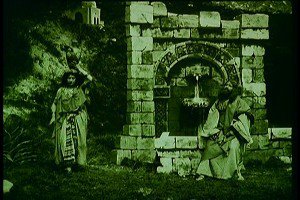
Likewise when the wise men (who have previously been filmed using a blue filter) arrive in the stable (hand coloured), there is a certain amount of camera panning here (very rare in its day, perhaps one of the earliest example?) and for a while it's unclear how the two colour styles are going to resolved. In the end the right hand side of the screen is filtered blue whilst the coloured characters against the black and white background are on the left. It's an ugly shot, but it's fascinating seeing the filmmakers wrestle with these questions, develop processes, and develop solutions, even if they are not entirely satisfactory a hundred years later. It breaks our visual code, but was, in a way, part of creating such a visual code to begin with.

I was also reminded in watching these scenes about something I've been meaning to say since seeing this film in a proper cinema a couple of years ago: Pathé have placed their logo on a number of the film's sets. I'm not sure whether this was merely crass advertising, or some form of early copyright (meaning that either the film, or the sets could be easily identified in case someone tried to use them without permission), but it seems Incredibly crass here. Less noticeable on the small screen, but certainly obtrusive when seen in a cinema,

I mentioned a few years back how this film misses out the innkeeper, and this scene retains a good deal of interest. For one thing when a couple with a donkey arrive on the scene right at the start many will expect that they are Mary and Joseph, but in fact they are just two of the extras who disappear off screen moments later. The arrival of the real Mary and Joseph is heralded by the clearing of the set, but their arrival on foot strikes a real contrast with the bedonkeyed couple that have preceded them. It also adds a sense of unease. Is that Mary and Joseph or just someone else?

There's also a nice piece of paralleling between the shepherd scene and the Ascension. Both feature a horizontally split screen to reveal heaven above and earth below, and whereas in this scene the good news is coming from heaven, later the subject of that good news will be making the return trip.

Tuesday, September 9, 2008

"No Room at the Inn"

I've just been watching a snippet from The Life and Passion of Jesus Christ and something stood out to me that I'd not noticed before. Most dramatised versions of Jesus's birth, from our first experiences in school nativity plays through to multi-million dollar Hollywood movies, feature a moment with an innkeeper. "Sorry, there is no room at the inn" he says before tentatively offering Mary and Joseph his stable.

Whilst Hollywood may have dramatised this moment a little more effectively than the average nativity play, it's still, essentially, the same idea only with better costumes and (sometimes only marginally) better acting. This becomes particularly obvious when we view the original text from Luke 2:7 which simply says "and she gave birth to her firstborn, a son. She wrapped him in cloths and placed him in a manger, because there was no room for them in the inn". There's no mention of the innkeeper, certainly no connection between the owner of what appears to be Bethlehem's only inn and the location of the manger.

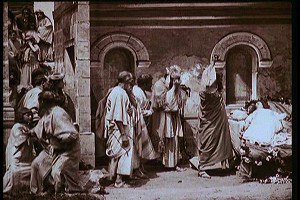
So I was interested to note that in The Life and Passion of Jesus Christ it's not the innkeeper who suggest the stable, but some seemingly unconnected little girl on the street (pictured above). Which makes me wonder, was Life and Passion boldly subverting tradition in favour of fidelity to the original text? Or is it just that the tradition of the innkeeper was not as widely established 100 years ago as it is today? Given the film's pageant-like feel and it's reliance on traditional imagery the latter seems more likely. If so, it's interesting to see how quickly something can become so ingrained on the public consciousness.

Thursday, August 30, 2007

Podcast: Life and Passion of Jesus Christ (1905)

My latest Jesus film podcast on Life and Passion of Jesus Christ. It's the tenth talk that I've done. The other nine (Jesus of Nazareth, Il Vangelo Secondo Matteo, The Greatest Story Ever Told, Jesus of Montreal, Jesus Christ Superstar, The Miracle Maker, Il Messia, King of Kings and Last Temptation of Christ are all available to download.

It's been a while since I wrote about this film so it was good to revisit it again.

Monday, March 6, 2006

The Life and Passion of Jesus Christ (1902-5)

Having discussed what I can only conclude are two forerunners to this film last week, I thought now would be as good a time as any to comment on the film that is the best known version of much of this material - The Life and Passion of Jesus Christ. In 1995 it was one of the 45 films included on the Vatican Film list, and was released on DVD, along with From the Manger to the Cross (1912) in 2003. The text included on that DVD is as follows:
La Vie Et La Passion De Jesus-Christ, N.S. was begun in 1902 by Ferdinand Zecca (1964-1947) for Pathé Frères in Paris, then the most important film company in the world. Zecca made 18 carefully costumed and staged tableaux against painted back-drops which are clearly influenced by the famous Biblical woodcuts of Gustave Dore (1866). In 1903, Pathé Frères developed a sophisticated system for applying up to four colors to each film print by a stencil process; that year and in 1904, ten new tableaux were added to the film. Finally, in 1905, Zecca's collaborator, Lucien Nonguet, added three final scenes, and the resulting color film of 31 tableaux with a running time of 44 minutes became the most impressive of its kind and one of the first long films in the world. Presented by missionaries and itinerant showmen from Indiana to Indochina, it helped establish the popular iconography of the Divine story. This edition is restored from two excellent 35mm original prints and presents The Life and Passion of Jesus Christ as it looked a century ago.
What's most noticeable about this film is how unsophisticated the camera work is as Peter T Chattaway notes in his chapter in "Re-Viewing the Passion" (reproduced at Christianity Today):
Nearly every shot is a simple tableau in which the camera stands still and observes the entire stage, as it were, while the actors move about within the frame. The few exceptions to this format stand out precisely because they are so rare.
The following scenes are shown (citation guide)
Annunciation - (Luke 1:26-38)
Birth - (Luke 2:1-7)
Shepherds - (Luke 2:8-18)
Star & Wise Men - (Matt 2:1, 10-12)
Massacre of the Innocents - (Matt 2:16)
Flight to Egypt - (Matt 2:13-15)
Boy Jesus in the Temple - (Luke 2:40-52)
Baptism - (Mark 1:6-11)
Wedding at Cana - (John 2:1-11)
Mary Anoints Jesus - (Mark 14:3-9)
Samaritan Woman - (John 4:4-29)
Jairus' Daughter - (Mark 5:22-24,35-43)
Walking on Water - (Mark 6:47-48)
Catch of Fish - (Luke 5:1-6)
Lazarus raised - (John 11)
Transfiguration - (Mark 9:2-8)
Triumphal Entry - (Mark 11:1-10)
Clearing the Temple - (Mark 11:15-19)
Last Supper - (Mark 14:16-25
Gethsemane - (Mark 14:32-42)
Trial before Caiaphas - (Luke 22:66-71)
Peter's denial - (Mark 14:66-72)
Trial before Pilate - (Mark 15:1-15a)
Scourging & Mocking - (Mark 15b:15-20a)
Crowds Condemn Jesus - (John 19:5-16)
Road to the cross - (Mark 15:20b-22)
(Veronica) - (Tradition)
Crucifixion - (Mark 15:22-33)
Death of Jesus - (John 19:30,34)
(Actual Resurrection)
Empty Tomb - (Mark 16:1-8)
Acension - (Luke 24:50-53)
A Few Notes:
As far as I can recall, this is the only film about Jesus that chooses to show the Transfiguration. There are two others which also do, The Visual Bible's Matthew, and the Genesis Project's Luke (which was condensed into the Jesus film, both of which had to cover the as they were filming the whole gospel. That said the former film avoids showing it anyway - simply showing the narrator (if I remember correctly). The latter film, however, didn't have to include that episode in the cut down film Jesus, but still does.

Since this has been professionally released the quality of the print is much better than the other films, but even so it appears that it has been restored to something of it's former glory - there is a real crispness to the images we see here.

Another scene that is usually ignored is the Woman of Samaria. Other than this film and it's siblings (I should mention that this film was shot for shot re-made in 1914/1915 with a couple of extra scenes, and extra intertitles and released as Son of Man) the woman of Samaria story is only included in Il Messia (Rosellini - 1975), and the Visual Bible's Gospel of John (2003). Again in the case of the latter film the scene had to be shot. This story is a popular text for preaching, and so it's strange that it is generally ignored in film.

Sadly despite this film having been widely available in the last few years there is relatively little comment available on it. The best review I've come across is by Steven D Greydanus. He says so many things so well that rather than repeat them all again, only less eloquently, it's better if I just link to his review at Decent Films. In addition to his discussion of the film linked to above, Peter T Chattaway also comments on the film at Canadian Christianity. The three of us also talk briefly about the film at Arts and Faith (there was a longer thread on the old forum, but sadly that appears to be lost). Finally, Mike Hernstein of the Flickerings festival discusses it as part of his excellent Survey of Jesus films - probably the best collection of comments on Jesus films on the web to date.

Thursday, March 2, 2006

Death of Christ (c.1900)


Following on from the last two days' posts where I have been looking at a couple of very early Jesus films, I wanted to post today, in more detail on the second of these The Death of Christ. It was hard enough trying to date The Life of Christ, but at least it provided a date to be sceptical about! With this film I would place it at around the same time, maybe even slightly earlier than The Life of Christ, but I wouldn't place it any early than the date claimed at the start of the Life of Christ. Anyway - the full discussion of that was two days ago.

This film is actually more interesting to right about than the earlier one since whereas that film largely contained material that was incorporated into The Life and Passion of Jesus Christ. Whilst this film is shorter (only 10 minutes long), most of the material is original to this film. First things first the scenes guide with scripture citations.
Last Supper (start of) - (Mark 14:16-17)
*Gethsemane - (Mark 14:32-42)
*Arrest of Jesus - (Mark 14:43-46)
*Trial before Pilate - (Mark 15:1-14)
*Scourging & Mocking - (Mark 15:15-20)
*Presented before the People - (Matt 27:24-26)
Road to the cross - (Luke 23:26-28)
*Crucifixion - (Mark 15:22-33)
*Death of Jesus - (John 19:30,34)
*Resurrection - (Mark 16:1-8)
Ascension - (Luke 24:50-53)
A Few Notes
*These scenes are different from those in The Life and Passion of Jesus Christ, although in many cases they have strongly influenced that film, with it being really clear that it re-filmed some scenes almost exactly the same, with only minor "improvements". A good example of this is the trial of Jesus in front of Pilate where in this film it is not very clear that Barabbas is present, whereas in the later The Life and Passion of Jesus Christ Barabbas is far more distinct. The shot is very similar in most other respects.

Only three scenes then are used in The Life and Passion of Jesus Christ. Firstly, the last supper, where the scant footage shown here is actually that which immediately preceds the longer scene in The Life and Passion. Next is the road to the cross scene, and finally, the ascension scene. These last two scenes are actually in all three films. The latter scene is far more complex than any of the other scenes in this film, and has been reasonably well done so it is not surprising that no-one went to the trouble fo re-filming it.

Two further points. Firstly, in comparing the scenes here with the Life of Christ, I noticed that that film seems to jump from the money-changers scene straight to Jesus's trail. Even for viewers who know the story this is a strange move. It does make me wonder if some of the material here was at one stage part of that film.

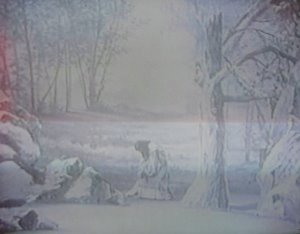
Secondly, of all three of these early films I think this is my favourite. This is partly because it is the least coloured, and the technique is a bit of a distraction, it's partly because it contains one really great scene - that in the Garden of Gethsemane, as well as being the source, I assume, for the innovative ascension scene. I also like the depiction of the scourging in contrast to The Life and Passion of Jesus Christ. Here Jesus offers some resistance, there Jesus almost seems to volunteer for it. I wonder if this was the main reason that this scene was re-filmed as except for a difference in background it is more or less the same. I also much refer the resurrection scene. It's one of the hardest things to film, and film-makers have used a variety of approaches. This is one of the best. Fairly literal, and yet not sensational, kitschy, or cheesy. That said it doesn't really rely on any of the gospels (non of which describe the actual resurrection), and perhaps is most similar to Mel Gibson's version, but it's far more simple, and effective, and not nearly so pleased with itself.

All in all, I'm glad I've uncovered this early classic. Jesus films for the next 110 years have swung between the kitsch and the more profound, and I'm glad that at least one of the very earliest Jesus films falls into the latter category.

Matt

Wednesday, March 1, 2006

Life of Christ (1898)


Yesterday's entry looked at the problems of dating some early films picked up on eBay. Today's post will look at the first of those (as it arrived on the disc), The Life of Christ, purporting to be from 1898. The film is just 14:23 minutes long, and none of the actors' names are given. Here's the scene order (as ever, scripture citations are in the normal format.)
Angels and Joseph's Dream - Matt 2:13-14
Escape to Egypt - Matt 2:15
*The Boy Jesus and the Doctors - Luke 2:40-52
Baptism - Mark 1:6-11
*Woman at Samaria - John 4:4-29
†Feeding 5000 with Fish and Bread - Mark 6:30-44
Christ Walks on Water - Mark 6:47-48
*Entering into Jerusalem - Mark 11:1-10
*Driving out the Money Changers - Mark 11:15-19
Trial before Pilate - Mark 15:1-15
*Ecce Homo - John 19:5
(Veronica) - Tradition
Road to the cross - Luke 23:26-28
Crucifixion - Mark 15:22-33
Death of Jesus - John 19:30,34
Resurrection - Mark 16:1-8
Acension - Luke 24:50-53
A Few Notes:
†This scene (the feeding of the 5000, or the "Fish and Bread" as the intertitles call it is the only one in the film without parallel in The Life and Passion of Jesus Christ. That said...

*Scenes marked with a * are different from those in The Life and Passion of Jesus Christ, even if the later film copies / improves upon them. Sometimes the details are fairly minor (e.g. different actors or backgrounds), at other times the whole composition of the shot is fundamentally different.

Four scenes use camera trickery - essentially double exposure. The two appearances by angels in the first two scenes both use this technique fairly simply, but the resurrection scene, where Jesus floats out of his grave, and "Christ Walks on Water" are both a bit more sophisticated. The later is possibly significant as renown camera trickery pioneer George Méliès released a film in 1899 called Christ Walks on Water. This was thought to be the first part of the bible to be shown on camera outside of Jesus's Passion. Part of me wonders if this scene (later incorporated into The Life and Passion of Jesus Christ) was Méliès's original, and whether this effects the potential dating of this film.

The film starts in a strange place as well, not showing the nativity or any of the events leading up to it, but starting after the departure of the wise men as Joseph is about to have the dream that instructs him to take his family to Egypt. Having thought about the dating of the film more since yesterday, this was one piece of evidence I didn't really consider enough.


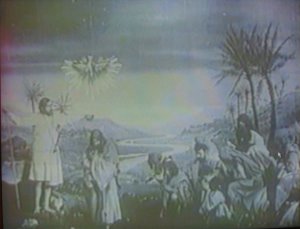
As with The Life and Passion of Jesus Christ this film was shot in black and white, but a number of scenes have been hand coloured. In addition some scenes stencil on extra details, most notably the Holy Spirit stenciled on as a dove in the baptism scene (see left) and the ascension scene.


In terms of episodes that rarely make Jesus films, obviously this film has nearly all of it's material in common with The Life and Passion of Jesus Christ. Even so, both films show the Ascension in an unusual way, and in fact, depictions of this are rare in themself. The scene with the woman of Samaria is also fairly rare in film version of Jesus's life, which is unusual as it gives us a rare three dimensional female role. Directors are usually keen on such roles, note for example one of the most frequently filmed scenes outside of his Passion - the woman taken in adultery.

Finally, one comment that is often made about The Life and Passion of Jesus Christ is worth repeating here. As this was filmed in the very early days of cinema, it's very obvious from this film that even the most basic aspects of moviemaking have yet to be discovered. For example, the camera is always static, and the acting takes place in front of it - this works similarly to watching a play. In a similar vein, nearly all the action takes place in the middle distance. There are a couple of exceptions in this film, and these may have been the first films to pioneer these new techniques. The first is the Ecce Homo moment. The camera get that bit closer to Jesus, just showing his upper half as he stands in front of the words "Ecce Homo" behind him. The second is a shot of Veronica, after she has wiped his face. The camera cuts to a shot of her holding her cloth, close enough for the viewer to see she has a perfect image of Jesus's face upon it.

This film will probably be available from this seller on eBay as part of a compilation DVD Early Religious Films.

Matt

Tuesday, February 28, 2006

The Early Jesus Film Synoptic Problem

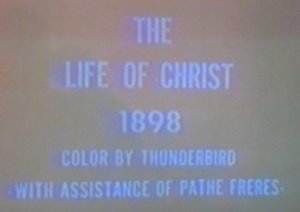
I won a DVD of "Early Religious Films" on eBay, and they arrived yesterday (in less than a week - from Canada). The information on the auction page claimed that it contained 3 films from the 1890s and 1900s, Life of Christ, Death of Christ, and David and Saul. Information about this period in cinema history is fairly unreliable so I was fairly sceptical as to what it might produce.

Having watched both of the Jesus films I'm still not sure what to make of them. I'm going to discuss each film individually as we go through the week. The hardest task before me however is trying to work out the date of these films.

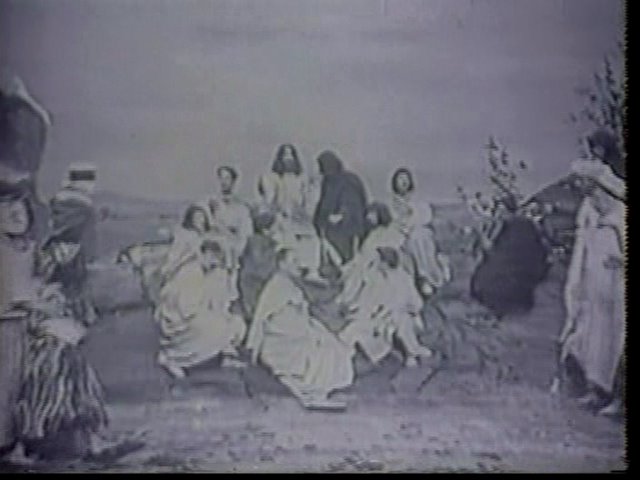
Before the internet, there were two major sources of reference information on Films about Jesus, "Divine Images" by Roy Kinnard and Tim Davis, and "The Bible on Film: A Checklist 1897-1980" by Richard H. Campbell and Michael R. Pitts. However, neither of these films mention a Jesus film, made by Pathé before The Life and Passion of Jesus Christ, listed as 1905. The opening shot of this film is shown below:


It seems unlikely that this might have been faked, particularly as it appears that all three films appear on a video entitled "A History of Color in Silent Films" which covers Pathé films from 1898 onwards, and The Life of Christ is the first.

A third piece of the puzzle is the relationship between this film and The Life and Passion of Jesus Christ. This film was given a wide release on DVD a few years ago, and the packaging claimed parts of it were released in 1902 with extra scenes and colouring being added with subsequent re-releases in he years up to 1905. This contradicts the testimonies of both both "The Bible on Film", and "Divine Images". Both of which list Pathé's first film of this title being released in 1905 and another longer film of the same title being released in 1908, with a colourised version being produced in 1914, when reviewers, who were seemingly unaware of its antiquity, slated it for poor production.

The relevance of this becomes apparent from the first scene of The Life of Christ which is identical to a scene in The Life and Passion, in fact, as the film continues, it appears that most of The Life of Christ was reproduced in The Life and Passion of Jesus Christ. Something of a Jesus film synoptic problem. That said there are some scenes which are different - either the same scene shot very differently, or similarly but in a different location, or with different actors, whereas some are entirely absent in The Life and Passion of Jesus Christ. Other scenes are less extravagantly coloured than the ones from that film. Significantly all of the scenes that look like they have been re-shot are significantly better in The Life and Passion of Jesus Christ.

On the other hand, most of the material from The Death of Christ is original, although even it utilises some of the same material that is later incorporated into The Life and Passion of Jesus Christ. Here though the quality of the film (from an aesthetic point of view) is lower, suggesting that this is the oldest of the three films. In several places where one of the later films improves upon one of the earlier two films, one of its "improvements" is to add special effects. For example the resurrection scene in "The Death of Christ", is less technical, but also far less gaudy than the way Jesus hovers out of the tomb in both of the later films.

So the three films are clearly related, and it would be logical to suggest that The Death of Christ, is the eldest film (particularly given that most of the very first Jesus films were passion plays). However, things are not quite that simple. Firstly, it appears that a number of different actors are used in The Life of Christ. This and the fact that the style of the intertitles changes from those identical to The Life and Passion of Jesus Christ, to others that look older, and less sophisticated, suggests that this film (and possibly The Death of Christ) are composites.

NT scholars will be relieved to hear that my hypothesis isn't that there was a fourth hypothetical Jesus film now lost which the two later films copied parts of and incorporated! My best guess is that the earliest parts of these films do date from 1898, but that the longer Life of Christ film didn't reach this hotch-potched form until 1902. It subsequently was expanded to 2 reels and tidied up a bit in 1905 and released as The Life and Passion of Jesus Christ, and similarly was expanded again to 3 reels in 1908 and re-released under the same title. This means that Campbell, Pitts, Kinnard and Davis come away with some credit, as do the packagers of the The Life and Passion of Jesus Christ, but none of them get things wholly correct. This leaves a number of gaps unfillled, not least the varying intertitles (which would be easier to fix and more noticeable than changing Jesus), and questions as to what point the film got hand coloured (the books say not until 1914, but all the other evidence points the other way).

If anyone knows more about these films, please do post some comments. Alternatively, if you would like to get hold of these films and decide for yourself The Life and Passion of Jesus Christ is widely available and I get the impression that the others will up on eBay again soon (or can be bought on VHS from the link above).

Matt