Monday, February 12, 2007

News on The Inquiry (L'Inchiesta)


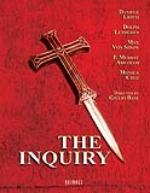
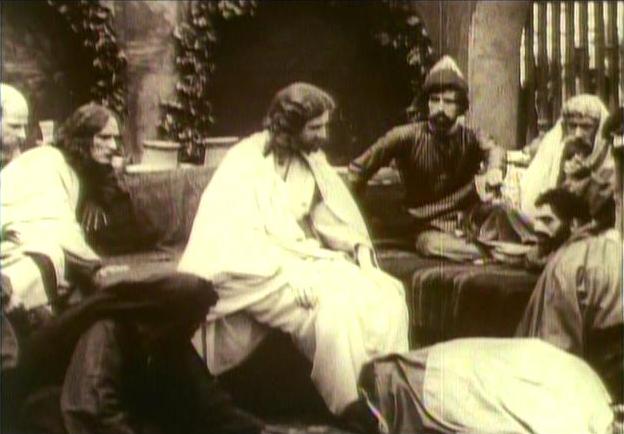
Just before Christmas, I mentioned that Hristo Shopov who played Pontius Pilate in The Passion of the Christ had reprised the role for The Inquiry (L'Inchiesta) which played at the Capri Hollywood Film Festival.

There's no news of a general release for the film yet, but according to the IMDb it will be playing at the Los Angeles Italian Film Festival on the 20 February 2007. The screening will be followed by a Q&A with actors Dolph Lundgren and Daniele Liotti and director Giulio Base. You can make reservations here.

There are also a number of pictures from the film at the Rai Fiction site as well as this plot synopsis
A beautiful, young Israeli woman, Tabitha, awakens to find her mother being stoned by a group of people for cheating on her father with a Roman soldier. In lower Germany, the great Roman warrior Tauro is charged by the Emperor Tiberius to travel to Jerusalem and find the truth behind the legend of a man, Jesus of Nazareth, who supposedly arose from the dead. When Tauro comes to Jerusalem, he encounters Tabitha and her grandmother, saving her from a petty mugger. Love sparks between the two, but she is forbidden to touch, much less speak to a Roman...
I imagine that it is the part of Tauro that the film's main star Dolph Lundgren will be playing. For some reason the combination of Dolph and a great Roman warrior called Tauro makes my expectations for the film slide considerably.

FilmChat also notes how The Inquiry might be being released on DVD by Fox Faith, but under the title The Final Inquiry

Friday, February 9, 2007

Children's Bible Programme Friends and Heroes to Air on BBC

Mark Goodacre posts about a new BBC TV series dealing with Bible stories for children. According to Christian Today Friends and Heroes will start on the 12th March on CBBC (Children's BBC). It will show either once or twice a day starting at either noon (if 2 episodes) or 12:30pm (if only one episode).

The official Friends and Heroes website describes the series as follows:
Friends and Heroes is the epic animated tale of two young people in the First Century - Macky and Portia - whose idealism and friendship leads them across the ancient world, from the fabled Egyptian port of Alexandria, to the besieged city of Jerusalem and finally, to the very heart of the Empire: Rome. As they fight for justice and even survival against the might of the Roman Empire, they become friends and then, in turn, heroes.

Through Macky and Portia, Friends and Heroes brings the inspiring stories of the Old and New Testament to a new, worldwide generation of children in the Twenty-First Century, whatever their faith or background.
The 13 episodes will be broadcast on weekdays between March 12 and 23, sometimes twice a day, starting at 12 noon and 12.30pm, or in single episodes starting at 12.30pm. The series will form part of the BBC's factual output on CBBC which is also used by schools. The website also has an intro video, a making of featurette as well as an episode guide which I've summarised below. These 13 episodes are only the first of three series which combine 2D and 3D animation. Each episode is 26 minutes long.
Episode 1 - Daniel in the Lions’ Den, The Miraculous Catch of Fish
Episode 2 - Samson and Delilah, Peter and Cornelius
Episode 3 - David and Goliath, Peter released from prison
Episode 4 - Rahab and Caleb, Peter raises Tabitha
Episode 5 - Gideon, The Christmas Story
Episode 6 - Moses and the Egyptian, Paul on the Damascus Road
Episode 7 - Ruth and Naomi, The Good Samaritan
Episode 8 - Peter and John healing people, Shadrach and the Furnace
Episode 9 - Esther, Joseph of Cyprus (Barnabas)
Episode 10 - Joseph and his Brothers, Simon Magus
Episode 11 - The Burning Bush and the Exodus, The Last Supper
Episode 12 - Jonah, The Prodigal Son
Episode 13 - Elijah and King Ahab, The First Pentecost
There's quite a bit there, and I'm encouraged that there are a number of lesser known stories included as well as some of the classics. It seems like the characters will be involved in their own adventures in the 1st Century, but the biblical content will be recounted by stories. It's aimed at 6-10 year olds so it will be interesting to see how they deal with the stories. It's noticeable that stories where God/Israelites kill lots of people have been avoided (although that may figure in some - time will tell. This I think is a better approach than that of the Veggie Tales series (where the fate of the enemies are things like perpetual tickling, and thus process of concealing the difficult passages in scripture starts at a young age).

Edit: My review for this series is now available.

Thursday, February 8, 2007

Color of the Cross - Scene Analysis

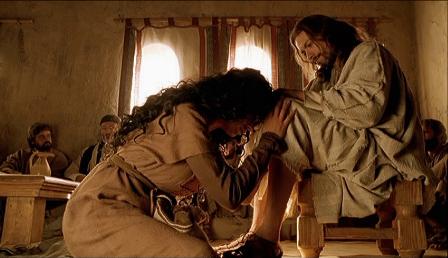
I reviewed Jean Claude LaMarre's Color of the Cross last month, and have been meaning to write the corresponding scene analysis ever since. As usual bible references are cited in accordance with my general citation policy
[Opening Shot of the Cross]
[extra-biblical episodes]
Journey to Jerusalem - (Mark 10:32, Matt 26:52)
Passover preparation - (Mark 14:12-26)
[extra-biblical episodes]
Camping in Gethsemane - (Matt 5:11)
[extra-biblical episode]
Mary's Pregnancy Recounted - (Matt 1:18-25)
[extra-biblical episode]
Birth of Jesus told - (Luke 2:6)
Start of Last Supper - (Mark 14:17)
[extra-biblical episode]
Last Supper - (Mark 14:18-21, 9:33-37)
Foot washing - (John 13:1-15)
[extra-biblical episode]
Bread and Wine - (Mark 14:22-25)
[extra-biblical episode]
Jesus Predicts Peter's Denial - (Mark 14:26-31, Luke 22:31)
[extra-biblical episodes]
Disciples in the garden - (John 12:24)
Testimony against Jesus - (Mark 14:55-59)
Boy Jesus - (Luke 2:41-52)
[extra-biblical episode]
Gethsemane - (Mark 14:32-42)
[extra-biblical episodes]
Great Commission - (Matt 28:19-20)
Arrest - (John 18:1-11)
Crucifixion - (Mark 14:24,34, Luke 23:43, 34)
[Montage of moments from Jesus's life]
Notes
One of the most striking aspects of the scene selection for this film is the omission of the events between Jesus's arrest and his crucifixion. "Yoshua" is arrested in Gethsemane, and then the camera cuts to his dying words on the cross. As I noted in my review it has been suggested that this might be some sort of response to The Passion of the Christ, or it may simply be a way of drawing out the parallels. A third option occurred to me the other day, on reading some of Crossan's work on the crucifxion. Crossan suggests that as the disciples fled after Jesus's arrest none of them could have witnessed these events, and so the details between the arrest and the crucifixion originated in historising prophecy. Whilst I'm not personally convinced by Crossan's arguments (surely the disciples would at some stage try and find out what happened on that fateful night), it does shed an interesting light on this film's portrayal of those events.

There are a number of interesting insertions into the biblical text. Early on the roman leader, who is not Pilate, and Caiaphas meet, and Caiaphas is clearly cast as having to ensure the peace is kept, and being responsible for handing over any would be revolutionaries. The Roman asks how it feels "a Jew handing over a Jew", Caiaphas's response "It doesn't feel good. If I'm wrong let history judge me" both captures the misgivings he may have had about handing Jesus over, as well as recasting the fateful words of Matt 27:25. It's also interesting to see Gamaliel given a role here, although whereas he is the voice of tolerance in Acts 5, here he is the voice of intolerance - unable to accept a black messiah.

This is one of few films to actually show the two disciples going to arrange the Passover meal, and following a man carrying a water jar. As I understand it a man carrying a water jar would have been unusual in 1st Century Judea, whereas here it seems to be fairly mundane. Jesus's prediction that this would be the man to follow appears to be more prophetic than pre-arranged as is sometimes suggested.

The character of Judas is a fairly prominent part of this film. As per John 12:6 Judas is categorised as a thief (which is fairly rare amongst Jesus biopics). However, he is also shown as being either an adulterer or a rapist, when he forces himself on Mary Magdalene (for her part she lies back and thinks of Magdala whilst hoping to delay his betrayal). Bizarrely though despite these two negative characteristics being shown, Judas's betrayal is not motivated because he is (directly) influenced by the devil, but because he is a disappointed zealot, who changes his mind even before he arrives in Gethsemane. Whilst Jesus films often try to undemonise Judas in this way, it is unusual for them to portray his general character in such a fashion whilst doing so. For what it's worth we don't see Judas's suicide.

Jesus's family are shown in greater depth than in most films. Not only is Joseph still alive, but we meet James, Ezra and Leah, all of whom are related to Jesus. The standard Protestant view is that those described in the gospels as being Jesus's adelphos and adelphe are his actual brothers. The standard Catholic view is that these words should be translated cousins in this instance, and the standard orthodox view is that they were Joseph's children by another marriage (although I'm unsure how closely believers in the various camps align with these positions in practise). Most films tend to ignore Jesus's family altogether (except, of course, Mary), presumably in order to avoid offence. This does tend to weaken the all round portrayal of Jewish families in the film. By clearly showing Jesus's kinsfolk as younger than him, the film eliminates the step-brother/step-sister position, and by calling them brothers/sisters suggests it is going the Protestant route. It's worth noting, however, that Mary's costume is highly reminiscent of a nun's habit.

Wednesday, February 7, 2007

The Cross (2001) – Review

Having heard of Lance Tracey's The Cross, a few years ago, I was delighted to find out recently that it is not only available to buy on DVD, but also to download (although this takes several hours). Here's my review, with a scene guide and (hopefully) an interview with the director to follow.

========

During the 90s "What Would Jesus Do?" became a popular slogan to encourage Christian teens (and other ages) to look at the world with his eyes and live accordingly. Lance Tracy's 2001 film The Cross takes things a step further making the camera the eyes of Jesus and placing its viewers in his place to see his crucifixion from his perspective.

Such point of view shots have become increasingly popular in Jesus films, as they have progressively de-mystified the person of Jesus. Interestingly, however, it is precisely the reverence Muslim filmmaker Moustapha Akkad had for Mohammed that led him to use point of view shots in his biopic The Message.

Neither film uses point of view shots exclusively, but given the way the technique in general enables audiences to identify with that particular character, there is clearly special significance in applying this method to a film about someone of religious significance.

That said The Cross is much more than a single concept film. The point-of-view shots are only one of a number of new ideas that the film brings to the table. The film opens with a couple of establishing shots. These are not from Jesus's point of view, but create the context into which the rest of the picture will happen. We quickly find ourselves looking down a crossbeam at the Via Dolorosa. The crowds press in, some sympathetic, some not and it seems like the film is going to be over before it has even started.

However, the camera settles on a particular woman. As we wonder if this is Mary Magdalene, the shot dissolves into a flashback, and we see Jesus heal her from what appears to be a self-inflicted slit wrist. Three years later, The Passion of the Christ would popularise this flashback-as-memory technique in films about Jesus.

But this film does more than simply punctuate its linear narrative with the odd flashback. The normal flow of the story is shattered and re-assembled in non-linear fashion. Even for those familiar with the gospel accounts this is disorientating, and serves to create a level of confusion in the viewer that Jesus must have felt on the first Good Friday. As Jesus is crucified numerous blackouts and blurry point-of-view photography heighten the disorientation.

The array of shots taken from Jesus's point-of-view encourages the viewer to consider other characters whose perspective we might temporarily be adopting. One of the most well-known point-of-view shots is the one taken from on high – popularly known as the "God shot". The Cross' religious subject matter means that it is only natural to interpret any overhead camera work in this manner. Indeed there are several shots that adopt this position, most notably a Dali-esque image at the moment Jesus dies. One of the most powerful moments in the scene is also filmed from this perspective as Mary Magdalene runs to tell the disciples of her encounter with the risen Jesus.

Elsewhere, we witness the moment where Jesus's parent's lose him in the temple from his mother's perspective. Here, also, the camerawork is disorientating and enables the viewer to share Mary's panicked state of mind. Arguably the most striking shot in the film is when Judas leaps to his death. With the camera placed almost directly below him, the shot suggests the point-of-view of Satan as if Judas is jumping straight into the world below.

Not all the aspects of the film are as impressive as the camerawork. As one might expect for a low budget film the acting is a little weak in places. This is exacerbated slightly by the lack of an (on-screen) lead character to give the picture a dramatic core. Addressing that problem, however, would have almost certainly weakened the very concept Tracy sought to explore.

The "making of" documentary on the DVD notes that the film's low meant that it had to be limited to 20 minutes. Unfortunately, adopting Jesus's perspective takes a good while to establish. Sadly, by the time the film has achieved this, there is very little time left to do anything else.

It's a shame that The Cross was produced in 2001 - just after the glut of Jesus films that ushered in the new millennium, and just before The Passion of the Christ made religious films popular again. Even in its original form, The Cross deserved a great deal more attention. Had it been given the resources Lance Tracy's undoubted talents deserved, it may have gained it.

Monday, February 5, 2007

Biblical Studies Carnival XIV

Chris Weimer at Thoughts on Antiquity has posted the fourteenth Biblical Studies Carnival covering the best biblical studies related posts from January. It's well laid out and links to several posts I had missed earlier, as well as some of those I had already admired. Richard Bauckham gets a whole section to himself mainly due to coverage of his latest book "Jesus and the Eyewitnesses".

The carnival for the coming month will be hosted by Charles Halton at Awilum

Thursday, February 1, 2007

Articles at Christianity Today

There are a number of articles at Christianity Today that I'd like to highlight.

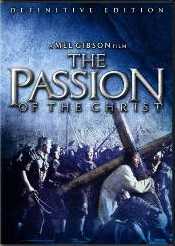
Firstly, there is an article by Peter Chattaway on the Definitive Edition DVD of The Passion of The Christ. Peter notes how the DVD contains both the original cut and Passion re-cut, how it has 4 commentary tracks and numerous featurettes, and also how many of those are dated 2005, as if it was originally due for a much earlier release. Strangely, particularly given Gibson's anti-Semitic remarks last year, the line from Matt 27:25 which he took out of the original film due to its anti-Semitic connotations has been incorporated here as a "deleted scene".

Then there's their list of the Ten Most Redeeming Films of 2006 (HT to Tyler Williams). This is not the "best of" list, but simply the "most redeeming" as voted by the CT writers. The ten are as follows:
1 - The Nativity Story (Catherine Hardwicke)
2 - The New World (Terrence Malick)
3 - Sophie Scholl: The Final Days (Marc Rothemund)
4 - Joyeux Noel (Christian Carion)
5 - The Second Chance (Steve Taylor)
6 - Charlotte’s Web (Gary Winick)
7 - Tsotsi (Gavin Hood)
8 - The Three Burials of Mequiades Estrada (Tommy Lee Jones)
9 - Akeelah and the Bee (Doug Atchison)
10 - Children of Men (Alfonso CuarĂ³n)
I've seen 6 of this list, and I'm keen to watch Joyeux Noel (Christmas was particularly busy this year so no chance), but it's the honourable mentions that give me a few ideas of things I really need to catch. Overall the list grabs a number of good films, but is off, in my opinion at least, in a few places. For example, despite it's merits, The Nativity Story does not, in my book, deserve to be number one. And whilst I haven't seen it, I'm struggling to believe that Charlotte’s Web (#6) deserves to be higher than Tsotsi, The Three Burials of Mequiades Estrada, or Children of Men.


Finally, there's a review of Jeffrey Overstreet's new book, "Through a Screen Darkly". Eric Miller's review heaps praise on the book. Whilst a cynic might point to the fact that Overstreet also writes for CT, that explanation doesn't explain why Publishers Weekly also give it a "starred" review.

Gospel Comparison: Jesus Anointed by a Woman

Yesterday's post got me thinking about the story of the woman who anoints Jesus. I mentioned this incident last year when looking at From the Manger to the Cross. I've always found the varying accounts and the way they vary a bit confusing. There are numerous details in each telling and they all seem to vary significantly from each other. It's also strange because the story is one of the few that is in all four gospels, and because it is Luke's account that is the most different rather than John's as we would normally expect.

Anyway, yesterday I decided to tabulate all the incidents and see how they compare across the four gospels. The results are below, and you can view all four stories in parallel using the Synoptic Parallels page.

DetailMatt 26:6-13Mark 14:3-9Luke 7:36-50John 12:1-8
Before Passover
Y
Y
2 Days Before

Y

6 days Before


Y
At BethanyYY
Y
House of SimonYYY
(The Leper)YY

(The Pharisee)

Y
Lazarus present


Y
Martha serves


Y
A WomanYYYY
=Mary


Y
=Sinful

Y
Alabaster JarYY

A pint


Y
Nard
Y
Y
OintmentYYYY
Broke jar
Y

PouredYY
Y
Tears

Y
HeadYY

Feet

YY
Wipes Feet

YY
With Hair

YY
Kissed Feet

Y
Smells Fills House


Y
Some objections..YYYY
Pharisees object

Y
Disciples objectY


Judas objectsY

Y
Why not soldYY
Y
Year's wages


Y
Judas a thief


Y
Kind of Woman

Y
Leave Her AloneYY
Y
Parable & Rebuke

Y
Beautiful ThingYY

Day of BurialYY
Y
Always Have PoorYY
Y
Wherever Story ToldYY

Total17191423

By doing this on a spreadsheet I was able to do a few comparisons. Firstly, the number of elements of the story that are common to all four gospels are startlingly few. Essentially, Jesus goes for a meal, a woman puts ointment on him and when some present object Jesus rebukes them. There are however a stack of differences. Where and when does this take place? Does the woman anoint his feet, his head or both? Who objects, and what do they object about? And what is Jesus's response.

Some of these details amalgamate quite nicely. Simon could have been a Pharisee who had contracted a skin disease at some point in his life, perhaps when he was much younger. The woman could be Mary of Bethany, who could have had a sinful life. Other details flat out contradict themselves, such as whether this took place two days before the Passover or six days before. Others could possibly co-exist, but would seem unlikely to do so. Perhaps the disciples objected because of the waste, AND Simon objected because of the woman's character.

There are a number of ways to respond to all these details. Firstly, one could decide it was all one incident. The details over timing are minimal and perhaps the woman, who was Mary of Bethany, anointed both his head and his feet with both ointment, and her tears, and wiped his feet wit her hair as well. There were two sets of objections to this behaviour, and Jesus dealt with both. This is the way the majority of harmonised Jesus films try to go, with the woman performing multiple anointings. The major problem with this is that none of the gospels describe the event in this way.

The other possibility is that there were two such events. One recorded in Matthew, Mark and John, and the other recorded in Luke. Certainly, of the 14 details mentioned by the third evangelist, the only one it shares with the other three accounts (other than those elements common to all four as listed above) is that it took place at the house of someone called Simon.
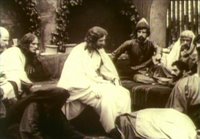
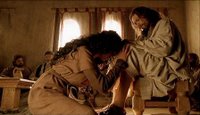
This version of events is how the film From the Manger to the Cross chooses to show things, with two different events. There are, however, additional problems with this. Firstly, it is difficult to know how likely this is. The action seems to have been fairly shocking in it's time. Would two such women have had such a similar response, given how few similar incidents of woman responding in dramatic ways to Jesus are recorded?

Secondly, the details of the other three accounts still don't match up all that well. Of almost 40 individual details, no single account contains more than 23 (John), and Matthew only contains 17. Furthermore, if we compare them we find that although they agree the incident took place at Bethany, and that the conflict and Jesus's reprimand concerned the potential sale of the ointment for the poor, there are only 9 details which they have in common. Comparing them in pairs, Matt/Mark share 15 details, Mark/John share 11, and Matt/John share just 10.

On the other hand there is still a good deal of conflict. Mark and John conflict over when this took place, John implies (at least) that this took place in Lazarus's house, whereas Matthew and Mark say it was Simon the Leper's house. Matthew and Mark only mention Jesus's head being anointed, whereas John only mentions the feet and so on. There is of course the possibility that there were three such events (Mark/Matt's, John's and Luke's), but that would just be getting ridiculous.

Thirdly, it seems reasonably clear that when Luke is writing he is familiar at least with Mark's gospel, and possibly Matthew's as well, yet he erases their story and brings in his own. If he was aware of their incident, and another one which he prefers, why not include both? Mark was happy to do that with the two feedings of multitudes (4000, and 5000 in Mark 6 & 8), as was Matthew, although perhaps the fact that Luke was not has some significance.

Fourthly, there is again the point that none of the gospels record there being two separate incidents. Such a theory is purely conjecture, based on trying to tie up the details of the four different accounts.
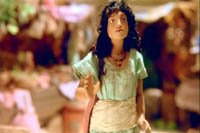

How does all this relate to the films, comments about From the Manger to the Cross not withstanding? Well firstly, what is remarkable is the number of films that add a new detail all of their own, namely that this woman is Mary Magdalene. In fact, as programmes such as The Secrets of Mary Magdalene have pointed out, it is the confusion between this story, and those of the unnamed adulteress of John 8, and Jesus's exorcism of Mary Magdalene (Luke 8:2), that led to Magdalene being labelled a repentant sinner.