Thursday, July 12, 2012

First Photo from the New Noah Film

Click on image to enlarge

These days most of the news about Bible Films in production goes through the Facebook page, partly because so many projects start but never really finish. That said the best place to go for updates for that kind of thing now is Peter Chattaway's new blog.

But one film looks like it really is going to happen, not least because in addition to an impressive cast, a well known director and a production company, it has also started building the ark and sending round the above shot of the work in progress. I'm guessing this means that filming hasn't started yet (although it's possible they move all the machines out of the way every so often and get a few shots of Noah making the thing.

In case you've not picked up on the various bits of information doing the rounds of the movie papers the film is being directed by Darren Aronofsky (Black Swan, The Wrestler) based on a script he wrote with Ari Handel and which was then revised by John Logan (Gladiator). But the cast is pretty impressive. Russell Crowe is to take the lead role, Anthony Hopkins will play Methusaleh (the oldest man in the Bible who died aged 969 the same year as the flood if you go for all that stuff), Emma Watson as Ila Jennifer Connelly (presumably as the wife of one of Noah's three boys) and Jennifer Connelly as Naameh. If, as seems likely, Naameh is Noah's wife, then it seems Connelly is developing a nice line playing the wives of famous historical pioneers after playing Darwin'd wife in Creation. In fact it could be argued that Noah surely qualifies as a technological pioneer as well so if anyone is considering making a film about Isaac Newton, Connelly might be the actress for you.

The publicity is calling this the biggest biblical epic since The Passion of the Christ. I'm interested to know what they meant by that. The budget for The Passion was only $25 million. I suspect that were you to combine what those four actors will be paid for the film it will come in at more than that. So in that sense it will be bigger. Perhaps what they mean is that they are anticipating it taking more than The Nativity Story, but not as much as The Passion of the Christ. With the cast and crew lined up this would seem to be a reasonable hope, Crowe is still a massive star, particularly in the genre in which he became a household name, but his last film in that genre Robin Hood only made back half it's $200m budget in the US, but made an additional $215m everywhere else, making a decent profit. I'd imagine the overseas take would again be quite high, but I'm not sure Noah will make as much as Robin in either market. Still time will tell.

I'm looking forward to this film though. I've written about it several times before as well as about the various other Noah films that someone has announced were being made. In particular I hope he explores what he perceives as Noah's survivor's guilt.

Friday, June 29, 2012

Song of Songs in Radio and Film

BBC Radio 4 has been broadcasting readings from Song of Songs juxtaposed with bits from Lamentations. The idea is to combine the most beautiful and erotic parts of the Biblical imagery with some of the most violent. I heard five minutes of it in the car at the weekend - somehow managing to catch what is probably the rudest part of Song of Songs - but liked the premise and the execution, and I'm hoping to listen to the rest soon via iPlayer.

Coincidentally around the same time that I heard about this production I also heard about a film called Song of Songs (2005) starring Natalie Press (Bleak House, Red Road). It's rated very poorly on IMDb (4.5!) though The Observer's Philip French and The Guardian's Peter Bradshaw both seemed to like it. 2005's Edinburgh Film Festival catalogue described it like this:
Devoutly religious Ruth returns from Israel to care for her dying mother, but when she tries to bring her estranged brother David back into the fold, in accordance with her mother's wishes, the result is a startling journey into the darkest realms of sexual obsession: a forbidden game under the guise of religious law. Dark, ambiguous and distinctly adult, this study of belief and desire, set in the cloistered world of London's Orthodox Jewish community, thoughtfully explores the links between faith and violence, denial and longing.
Whilst words such as "dark" and "intense" seem to pop up in reviews of that film another film that takes a decent look at the book is at the other end of the scale. Keeping Mum, also released in 2005, is a comedy starring Rowan Atkinson and Dame Maggie Smith. It doesn't fare brilliantly at IMDb either (6.8), but I'm told by my friend (@lizzystevey) that it "has some beautiful scenes looking at the Song of Songs." I never saw it when it first came out, though was sorely tempted by the promise of Rowan Atkinson doing one of the things he does best - playing a vicar. I've ordered both films and may report back on them in due course.

Neither of these is a straight take on Song of Songs, but then that's partly because the poetic books don't really lend themselves to a medim such as film that is dominated by narrative. What has happened is that films about Solomon have included little excerpts here and there, usually around the time the Queen of Sheba turns up (as in The Bible Collection's brief quotation). It's been a while since I saw Solomon and Sheba so I can't comment on how much Song of Songs is included in there, but I'm pretty sure it will be cited somewhere amongst the cheesy Hollywood blather. There were at least 2 silent films about Solomon and the Queen of Sheba, but the 1921 Fox film is now lost, and I suspect that my review of Pathé's 1913 La Reine de Saba (Queen of Sheba) would have mentioned it if Song of Songs had been cited in the intertitles.

Thursday, June 7, 2012

Roman Holiday and the Jubilee

I can't think of a more perfect film to watch to mark the Queen's Diamond Jubilee than Roman Holiday. Released in 1953 the year of Queen Elizabeth's coronation it imagines the story of a young princess (Audrey Hepburn) who escapes her duty for a single day, enjoys a day of freedom and falls in love before realising her duty and returning to her life of regal service.

The timing and therefore the parallels are more than coincidental. The thinnest possible veil is pulled between Hepburn's Princess Anne and Elizabeth II: Anne is younger, unmarried, and not from Britain, but how many other royal families have the Queen's English as their first language? Those parallels give extra meaning to the film's deep seated themes. Not only was our new queen stepping into a new life, with it's additional duties, responsibilities and obligations, but also the shock of the abdication of her uncle Edward VIII just 15 years before still hangs in the background creating the plot's central tension: will she return or won't she?

Hepburn is most fondly remember for Breakfast at Tiffany's; Gregory Peck for To Kill a Mockingbird and director William Wyler for Ben Hur, but I think all three do far better work here. The final scene alone is a masterful piece of subtle acting telling a story that no-one else in the room understands. Quiet, dignified and understated it belies the raw and painful emotions that rage under the surface.

It's hard to imagine a film like this would be made today. Not only is Edward's abdication a distant memory, but the idea that the only thing in life that matters is 'being true to yourself' is so deeply embedded now that a character rejecting that for the sake of her duty just wouldn't wash. But it's that same dedication and self-sacrifice that Queen Elizabeth has given for the last 60 years, and why she is so widely admired, something grout back to me watching footage of her carrying on with her obligations throughout the Jubilee celebrations as if it wasn't pouring with rain, or her husband wasn't seriously ill in hospital.

I can't help but imagine what might have become of Hepburn's Princess Anne. When, and if, she became queen; if she married; if she ever had a day that matched one; if, in some imaginary kingdom a lot like Britain, she too is celebrating 60 years, an old grandmother smiling and nodding to give approval to members of the public and 'stars' she will never quite see the appeal of or understand. And whilst we're left with the image of Peck meandering down a grand, spectacular, but empty hall, the perfect image of the life the princess has re-adopted, I wish that more films about 'royalty' conveyed even a fraction of that captured in that long lonely walk.

Thursday, May 31, 2012

Adoption, Babbling Paul and The Silver Chalice

I'm preaching on Romans 8:12-17 on Sunday where Paul talks about us being adopted. Yesterday I read William Barclay's commentary on the passage where he talks in depth about adoption in Rome. One thing he mentions is how the adoption ceremony had to be witnessed by seven separate witnesses.

It brought to mind Paul Newman's role in The Silver Chalice (1954). It's been about 5 years since my only viewing of the film, but I do remember a sub-plot involving Newman's character, Basil, being adopted, but then after his new father's death there being trouble finding witnesses. The witness scene features early on, but there are only five original witnesses rather than seven. I'm unsure of Barclay's source for this information but it seems to be Justinian's "Institutes".

In any case, three of the witnesses have died, and one has turned against Basil. The other, Kester, is no longer in Rome and is eventually found in Jerusalem. (you can check this on the subtitle script here).

The other thing about the passage is the translation of the opening phrase of verse 12. The KJV, NKJV, NRSV and ESV all have "we are debtors, not to the flesh...". Other popular translations (NIV, NASB, GNT) have "we have an obligation (but not)". The problem is that such translations don't really make sense of the following verses.

Paul, as the Epicureans and Stoics pointed out, was a bit of a babbler. His letters and speeches are full of him going off on tangents in an attempt to cover all the bases (I suffer from the same affliction, only without Paul's eloquence). So to unpick Paul's train of thought, you often have to work out which bit is tangent and look at that separately from his main thrust. And if you try and do that neither of these translations above really make sense.

The key for me is verse 15 "For you received not a spirit of slavery...but a spirit of adoption". It's a classic rhetorical contrast between being a slave and being an heir. What I think is significant is that if you look through the earlier verses for a similar pattern you find it.

One such place is in what appears to be part of the tangent in verse 13 "For if you live according to the flesh you will die; but if you live according to the spirit you will live". The other appears to fall either side of that tangent, but the above translations miss out the contrast, tying in the "not" to the bit that follows (which is most natural). My knowledge of Greek is exceedingly poor, but I've translated it below very roughly using numbers 1 and 2 to mark out the parts of the contrast with the tangent marked by square brackets and the contrast within the tangents marked with i and ii.

So then brothers...
1 we are not debtors to living to the flesh
[i For if you live according to the flesh, you die
ii But if {you live} by the Spirit [killing bodily malpractice] you'll live]
2 For those led by the Spirit of God are the sons of God

1 For you did not receive a spirit of slavery [again to fear]
2 but you received a spirit of adoption [hence we cry out,“Abba, Father]


Or taking out the minor tangents and straightening it out a bit:

1 We are not debtors to living to the flesh
2 For those led by the Spirit of God are the sons of God

[i For if you live according to the flesh, you die
ii but if {you live} by the Spirit you'll live]

1 For you did not receive a spirit of slavery
2 but you received a spirit of adoption


That seems to me to the clearest way of understanding a rather confusingly worded passage. Critically though that takes the exactly opposite view of most other translations. There are a couple of exceptions however. Some of those outside the tradition of the KJV such as the NEB, NLT and the Holman Christian Bible do tie the "not" in with the debtors.

This is significant because it says that actually we aren't debtors: indeed such a translation ties in very well with the image of Roman adoptions. That's not to say that we don't owe God a tremendous debt, but the thrust of the passage I would suggest is that we have been freed from the debts of our previous fleshy lives to be free (adopted) heirs. We may not have been born as his free sons (and daughters) but now that is what we have become.

The reason for making this post is not to show how great I am compared to Greek expert scholars, but perhaps to ask those who know more about Greek than I do why they translate it the way they do and not the way that makes sense to me? Is it lined in with not wanting to remove a verse that stresses the debt/obligation we owe to God? Because it seems to me that you can get that from elsewhere without having to force this passage to say it here. I'd be really interested in hearing some feedback on this.

Sunday, April 29, 2012

Scene Comparion - Pentecost

My small group is looking at Acts at the moment and last week there was a bit of a mix up over who was doing what and so seeing as we were at my house I suggested watching the passage fr the day (Acts 2) in some different film versions.

Whilst there are quite a few film versions of a selection of stories from Acts a good number of them are Paul biopics and so are only really interested in Acts from the stoning of Stephen onwards. So films such as Paul the Emissary, Damascus, The Bible Collection's Paul and even, surprisingly, Peter and Paul all exclude this incident.There are however a number of films that do cover these events and here are some comments on a few of them.

Living Bible: Acts of the Apostles (1957)

If ever you want a stiff, very literal rendering of a story played out by men wearing tea towels, then  The Living Bible comes up trumps every time. The budgetary limitations area always obvious so for the start of Acts the Ascension is narrated and the outpouring of the Holy Spirit and the tongues of fire all occur off screen. The rest of the scene is dull in the extreme.

Power of the Resurrection (1958)
Peter is stuck in jail with a young Christian who is scared and so he tells the boy how he met Jesus and gained the courage he now has. So the retelling of Peter's life climaxes with Pentecost. It's strange, then, that there's no tongues of fire scene here either. We do see Annas and Caiaphas in the crowd as Peter preaches. The most interesting feature of this film, for me, is that both the younger and the older Peter are played by Richard Kiley, who would play another disciple turned writer Matthew in the Visual Bible's Matthew. What's most interesting is comparing how the film makers thought Kiley would look like as an old man, and how he actually does look. Had I not seen the latter production, I would have thought it a reasonably credible piece of make-up, but as things stand it looks more than a little naïve.

Atti degli Apostoli (1969 - pictured)
Overall I think Rossellini's film is my favourite of those that deal with Acts, partly because while it is still an obviously low budget piece it makes that into a virtue, rather than a constantly distracting flaw, but then I'm a big fan of Rossellini in general.

Again there are no tongues of fire, but the sky does momentarily go dark red before the disciples burst out into the public square. It's a wonderful moment, partly because it's been preceeded by a long and rather dry exposition of the story's cultural and historical context (from one Roman to another), which both give a better feel for that context but also because the disciples sudden arrival on the scene forms a striking contrast with the more stoic Romans. Furthermore there is something ambiguous about the moment. One the one hand it evokes Joel's prophecy about the sun turning to darkness and the moon to blood, but on the other the disciples' absence from the moment distances them from it, as if to break the causal link. 

My favourite line in this story has always been Peter's "they're not drunk it's only nine o'clock in the morning: I remember laughing about that one as a ten year old at church. The majority of these films deliver it in a very po-faced and forced fashion. Here, Peter dismissively chucks it out over his shoulder as he marches through the crowd. It's reminiscent of Pasolini's Jesus making terse theological or political statements over his shoulder as the disciples struggle to keep up.

And then there's the climax, as Peter, the disciples and a bunch of keen to be new converts all rush in a state of high excitement to a watering hole outside the city. Are they ecstatic or just mad? Rossellini leaves it up to the viewer to interpret it. I imagine both interpretations happened at the time so it's nice to see this captured in the film and both sides thrown up for the viewer to pick over.

Incidentally, did I ever mention that this film is available to view (albeit without subtitles) here?

A.D. (1985)
Just as the series intercuts the story of the early church with tales of the Romans here we get the first Pentecost intercut with the Romans leading an execution. And just as the series often brings both stories together at certain critical points, so it turns out that the man who is due to be executed and is subsequently rescued is a friend of Stephen and other early Christians.

Inside meanwhile Mary seems to be taking a leading role within the early church - you don't have to interpret it that way but it seems to be the implication. On this occasion, Mary tells a story from Jesus' childhood. And then a very quiet wind starts up inside but someone notices it's not blowing outside. The effects look dated and the soppy looks on the disciples faces are rather comical, but Peter delivers his speech with real charisma, and it's probably the best delivery of that sermon of all of these clips.

Visual Bible: Acts (1994)
Whilst the special effect here will hardly have broken the bank it's actually very effective. In contrast to many of the other version - and my own prior visualisation - the moment of the Spirit's coming is initially very serene rather than ecstatic. Very little else works here though. Dean Jones' narration is more obtrusive than Richard Kiley's in Matthew, the word for word aspect feels very forces and
James Brolin is just to handsome, clean cut and all-American to pass for Simon Peter. It's interesting comparing his charismatic proto-TV-politician with the hapless dimwit played by Gerrit Schoonhoven in the Matthew film.

Where the forced literalism really doesn't work is during the crowd's lengthy response to what they are seeing, especially the various members of the crowd taking turns to recite a selection of the nations represented there. It wouldn't have been funnier if they had all done it together Life of Brian style ("Yes we're all individuals... from Phrygia and Pamphylia, Egypt and the parts of Libya near Cyrene.)

St Peter (2005)
The start of this film is so awful I've never been able to get past the first quarter of an hour or so, and the relevant scene here crops up about 35 minutes in. It's certainly one of the more interesting and creative explorations of the scene. The outpouring of the spirit occurs just at the very moment that the disciples are beginning to realise that language might be a barrier to the spread of the gospel.

Inside the moment is strikingly depicted with flames shooting up in the arches behind Peter and the other apostles. Outside however a shock-wave seems to strike everyone in sight. In contrast with the other versions Peter says very little of the sermon from Acts. So effectively this take on the story emphasises experience over explanations.

The scene ends on a rather sour note however. A Roman soldier - the very one who was present at the death of Jesus - wants to be baptised as well, but Peter refuses. I'm interested to see how this pans out: I have a hunch the soldier in question may appear later in the film.

Saturday, April 21, 2012

A Bit More on The Miracle Maker

I've written about The Miracle Maker many times before, most commonly around Easter when I find myself watching it perhaps with my children, or perhaps just with others. This year we sat down to watch it as a family and I had a number of new thoughts about it that I hadn't really considered before. One of the things that demonstrates the film's quality is that despite multiple viewings over the years I still find myself noticing new things about it each time.

Some of the things I found most striking this time around occurred in the opening minutes. In fact the first is the first thing we see as the film starts - the story is dated as "Year 90 of the Roman occupation". The significance of this is that it places the film right away not in our own time frame - viewers of the film unaware that Jesus' ministry was around 30 AD will be none the wiser - but in terms that would have been very resonant in Jesus' day. Straight away it tells us that this is the story about a man, and a people, living under occupation and subjugation. Not just from their own lifetimes but from that of their grandparents and great-grandparents. And the hopes for a messiah are nudged a little into the limelight.

Our first real glimpse of Jesus is as his overseer is about to strike Mary Magdalene. Jesus steps in, parries the man's blow and saves Mary from being struck. This is a deft combination of two leading aspects of Jesus that the film is keen to emphasise: his strength and his compassion.

Having begun his ministry Jesus heads to the Jordan to be baptised. But rather than be baptised by John, Jesus crouches down and baptises himself. The early church is often accused of being rather embarrassed by Jesus' baptism by John. In Mark's Gospel it's a straightforward case of John baptising Jesus. Matthew has John question Jesus' request: surely this is inconceivable. By the time the fourth gospel is written Jesus is no longer baptised by John. Whether or not it's accurate to describe this as the early church being embarrassed by the incident, it's interesting that the film portrays things as somewhere between Matthew's version and John's. Jesus still gets baptised, but it's not John who does it.

Having returned from his post-baptism temptation in the desert Jesus comes out and meets up with his old friend Lazarus. Like much of the early part of this film this is dramatic fiction. What's interesting, though is that Lazarus seems to be attempting to tempt Jesus as well. His words are not suggestions of inappropriate miracles, or self-gotten gains, but simply to turn his back on his ministry and return to normal life. It's intriguing because temptation is often far more like that than the kind Jesus undergoes in the desert. Lazarus is Jesus' friend and doesn't realise what he is doing. The temptation is subtle, but then it so often is. 

The climax of the first half of John's Gospel (and of the first half of many a Jesus film) is the raising of Lazarus from the dead. Whilst this story is included, the climax of the first part of the film is another of the occasions when Jesus raises someone back to life - the daughter of Jairus. The switch fits neatly with the films desire to appeal to children, but it also fits its desire to be more inclusive to women. Not only is Tamar female, but also the woman who is healed in the interlocking episode. It's also the moment when Jairus, his wife and Tamar decide to follow Jesus, which I suppose raises the question for children of whether they will follow Jesus, something backed up in the film's closing scene.

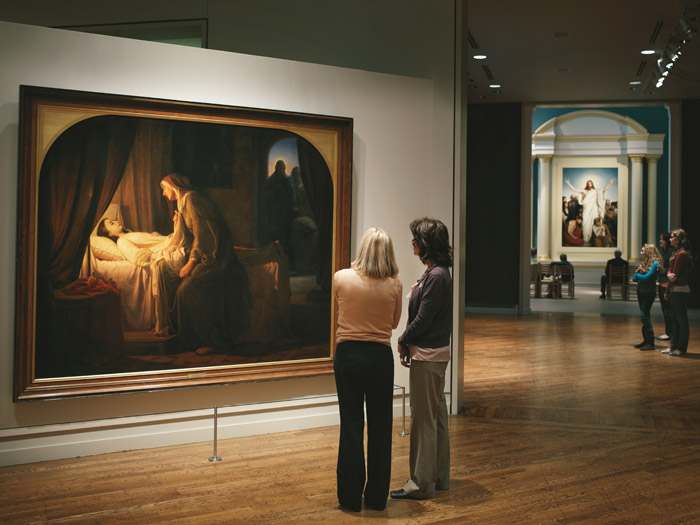
The lighting in this scene (pictured above) is really striking. I don't know a great deal about classic art, but it feels a bit like Caravaggio, though that probably exposes how little I know about that period/movement. That said it might also have been inspired by 19th century painting such as those by Carl Bloch, Gabriel Max and the Russian artist Ilya Repin. Given that the 3D scenes were created by the Russian teams of animators the latter might makes a good deal of sense. In any case it's beautifully lit and captures a certain painterly quality.

The raising of Jairus's daughter is Jesus' greatest triumph, but he comes down with a bump. The scene that immediately follows depicts Jesus hearing about the death of his cousin John the Baptist. Aside from the personal grief Jesus experiences, it's a painful reminder of what is to come for Jesus and in a sense it marks the start of the second half of the film, foreshadowing that which is to come. The first part has been about miracles, strength and compassion all three of which find their expression in raising Tamar to life. The second part will focus on Jesus' death.

Given that this film was made to appeal to children, it obviously had to include Jesus saying "unless you become like a child you will not enter the kingdom of God". Here the film includes the full incident which begins with the disciples arguing about who is the greatest (Mark 9:33-37, though whereas Mark places the story in a house in Capernaum, the film locates it by a camp-fire on the road). Indeed, the argument amongst the disciples flares up whilst Jesus is picking up firewood. This accentuates one of the other key themes of the film, and particularly the second half: Jesus as a servant. It also echoes the incident from John's Gospel where Jesus washes the disciples' feet. In both cases the disciples are arguing over who is the greatest (John 13 c.f. with Luke 22) and in both cases Jesus responds in the opposite spirit by doing the work of a servant.

The servant theme finds its fullest expression in Jesus' death as the suffering servant of Isaiah 40-55. One key hint to this is when Jesus appears before Herod and the film shows the tetrarch pull Jesus' beard. The man of strength and compassion, is now in need of someone to step in and defend him as he defended Mary Magdalene earlier in the film.

Friday, February 17, 2012

The Celluloid Madonna

The Celluloid Madonna: From Scripture to Screen

Catherine O'Brien

Paperback: 224 pages

Publisher: Columbia University Press (13 Dec 2011)

Language English

ISBN: 978-0231161654

It's been a while since there was a new film out on Bible Films so I was really pleased to hear that Catherine O'Brien's "Celluloid Madonna" has finally been published. (I heard about it several years ago, but had lost touch with how things had been progressing.

I'm incredibly chuffed as well by the fact that this blog is mentioned in the Acknowledgements. This doesn't happen often to me so I hope you won't mind too much if I, rather egocentrically, quote what was written. Page viii says:

Matt Page's Bible Films Blog at http://www.biblefilms.blogspot.com/ has been discovered as a superb the source of news and film criticism

I've not had a great deal of time/energy at the moment and so I've made rather poor progress so far. What I can say however is that it talks about a few films that I am yet to see - mainly those that are Mary Hagiopics from primarily Catholic countries as well as a good deal of information about Mary that I was not fully aware of. I'm really hoping to forge some time soon to finish the rest of it off soon and then hopefully I'll be able to review it.

Saturday, February 4, 2012

Biblical Fratricide in Film

I'm going to be writing a short entry for the Encyclopedia of the Bible and its Reception on Fratricide, so I thought I'd sketch down a few thoughts here first of all.

The obvious place to start is with Bible films that cover the story of Cain and Abel. There are a good number of these going all the way back to 1911's Cain et Abel through to a brief cameo is 2009's Year One (pictured). Aside from those two others really stand out. Firstly there's Huston's 1966 The Bible: In The Beginning which has a visceral primitive quality about it. The other is from 2003's The Real Old Testament, which has some great lines in it. "I like Nod. Nod is great" and (on the mark of Cain) "Y'know those kinds of things are just so complicated that..."

Cain and Abel is such a prominent story that it's tempting to just leave it there, but there are a few other stories of (potential) fratricide in the rest of Genesis. Firstly you have Jacob and Esau, which whilst the story itself ends on reconcilliation echoed down the ages and seems to have played a part in the subsequent conflicts between the Hebrews and the Edomites (c.f. the famous verse in Malachi 1:3). Sadly no Bible film that I can recall covers this conflict.

The second is also more about fratricidal intent which manages not to avoid in murder - Joseph at the hands of his jealous brothers. Again Joseph hasn't featured in a huge number of Bible films, although the Emmy award winning entry for "The Bible Collection" series, starring Ben Kingsley, stands out amongst television (and as the emphasis for the EBR is on reception rather than specifically film that should be fine). And of course there's the Lloyd-Webber thing. Incidentally both of these passages are evoked in consecutive chapters of Paul's letter to the Romans (8:28-9 and 9:13), although the first doesn't use a direct quotation.

Finally there is the story of Hamor and Jacob from Genesis. Whilst the Bible doesn't really make it clear how closely Jacob and Hamor are, the story as portrayed in the 1998 Malese film La Genèse emphasises the "brotherly" nature of the relationships between the heads of the different tribes and clans. Furthermore once Hamor's son Shechem marries Jacob's daughter Dinah then the two men become related, through partaking in Hebrew ritual as well as marriage. The subsequent murder of Shechem by Jacob's sons more than touches on fratricide.

But aside from Bible films there are other, more contemporary films which explore the issues. Perhaps the most well known film to draw on the resonances of the Cain and Abel story is East of Eden starring James Dean (1955). The two brothers (Cal and Aron) squabble over their father Adam's favouritism as well as a woman they are both attracted to. Whilst the film does not end with fratricide, many of the same emotions are thrust under the microscope, and the film deliberately nods in the direction of the Biblical narrative.

Another film that has been linked to the Cain and Abel story is Milos Forman's 1984 Amadeus which has been likened to the Cain and Abel story by Gregory Allen Robbins.

Lastly, there is the TV series Kane and Abel (1985). I've never seen it although I remember my parents being taken with it when it aired on TV. Whilst the Kane and Abel here aren't brothers, there's a sense of brotherhood rivalry between the two men which draws additional mythical power from the similarly named biblical story.

The future actually promises a couple of further possibilities. Firstly there's rumours of Will Smith starring and producing a vampire take on the ancient story, likely to be called The Legend of Cain. There's also Warrior a cross between the story of Cain and Abel and that of Rocky. Actually that was released in September last year (2011), but I missed it then and haven't had a chance to catch it yet. I'd be interested to know what anyone who caught it thought. I notice it's currently sat at 145 in the IMDB top 250.

Tuesday, January 24, 2012

Gospel Comparison:Wedding at Cana

Sunday's lectionary gospel reading (in the Church of England at least) was the story of the Wedding at Cana and Jesus turning Water into Wine. In the CofE's lectionary it is one of the few passages from Jesus' ministry to appear every year, and so it's perhaps not surprising that it occurs in a good number of Jesus films.

What's interesting about the various portrayals is that, particularly in the later films, the filmmakers tend to take the opportunity to stress the otherness of Jesus' culture from our own. On occasion, however, this clashes with the film's overall portrayal of Jesus. It's somewhat jarring to see a blond-haired Jesus at a more typically middle-eastern wedding.

The Life and Passion of Jesus Christ (1905)
As is typical of this film, it prevents the action in a very straightforward manner. Jesus and his mother sit prominently at the front of the action, though the film's static camera, which frames the whole scene as if the audience is watching the action in a theatre, means that it's very much Jesus that is centre stage. The stone jars filled with wine are tiny - certainly not capable of holding 20-30 gallons. In contrast to the narrative where only the servants see what he is doing, here Jesus gestures to those at the back to get them to stand and see the action as if he's performing in a magic show.

From the Manger to the Cross (1912)
It's 100 years since Robert Henderson-Bland's Jesus came to our screens. In contrast to several portrayals this is not Jesus' first miracle, and it's one of the film's weaker moments. As with the above the miracle is performed somewhat theatrically and in full view of the guests. The chief steward is still surprised, but not so much because of an apparent breach of protocol. One notable innovation in this scene is that at the moment Jesus performs the miracle a light from above shines on his face.

Intolerance (1916)
The Judean Story, as director D.W. Griffiths called it, is the shortest of the four and is pure propaganda. The film as a whole is essentially campaigning against the temperance movement, showing the damage intolerance and its perpetrators have caused down the centuries. But it's the Jesus story where this intolerance coincides most closely with Griffith's biggest concern. In one intertitle he describes those objecting as "meddlers then as now". In another he adds a footnote explaining that "Wine was deemed a fit offering to God; the drinking of it a part of the Jewish religion". Not dissimilarly to Olcott's portrayal as Jesus conducts the miracle a cross shadow falls across him, only whereas the 1912 film used it to suggest divine approval, here it foreshadows Jesus' demise at the hands of intolerant humans.

The Gospel Road (1973) [pictured]
It would be over fifty years until this episode from the gospels was portrayed in the cinema, and when it came it was at the hands of one well acquainted with the pleasures and problems of alcohol. Johnny Cash's music provided the soundtrack for Robert Elfstrom to direct himself as Jesus. The scene has the surreal dreamy quality typical of much of the film which here reflects Cash's description of this episode as a parable (as some commentators think).

The wedding itself is very sparsely attended, and it's here that there's the greatest clash between the ultra blond Jesus and the effusive middle-eastern dancing. There's also a man smoking a hookah (water pipe) off to the side. Mary seems to be absent in this portrayal, although the camera does linger on a couple of women's faces as it becomes apparent that the wine has run out. Cash pipes up with his song "He turned the water into wine". A handful of particularly nice shots later (of the water being poured out and then changing colour) and Jesus has saved the day.

Last Temptation of Christ (1988)
This is one of the best scenes in the film, particularly because of the emphasis on the story's cultural context. Whilst, as noted above, this is fairly common for this episode, Scorsese nails it far more effectively than most of the other directors, despite Dafoe's blond locks.

The film also showed Jesus dancing, something absent previously but that most of the subsequent films would include, as well as a moment of levity as the miracle is performed. Nathanael, who has invited his new friends to the wedding, is convinced that the stone jars only contain water. Jesus is casual and playfully asks what's in the jars, before gently insisting that it's wine rather than water, and then raising a glass to his stupefied new disciple. Again Mary is absent, though Magdalene attends. When her attendance is challenged early on, Jesus uses the opportunity to talk about his father's feat where everyone is invited.

Jesus (1999)
In many ways Last Temptation is one of the foremost inspirations for Young's Jesus, using some of it's edginess, such as showing Jesus dancing at the wedding, whilst sanding down Scorsese/Kazantzakis's more controversial edges. This scene borrows heavily from Scorsese's, but adds in Mary, portraying her as a somewhat pushy mother catapulting her slacker son into messiahship (the moment Mary the mother of Jesus births the Christ one might say). Jesus is keen to stress that he's not ready, but for Andrew and John, who are having doubts, its the moment that they become convinced he is "the one". Eventually fed up with his reluctance ("My hour has not yet come") she lectures him ("it is time, for Andrew and for John") before forcing his hand telling a nearby servant "Jesus will help you with the wine". She ends by bossing poor Andrew around as well :"Drink Andrew, the cup you desired is here...He is the one Andrew. Have no fear in following him". The use of "he is the one" seems somewhat comical after The Matrix, but it's hardly the film's fault that it happened to be released the same year as one of the most talked about films of the decade.

The Revolutionary (1999)
Also released at the same time as The Matrix was the hilariously bad The Revolutionary. It also has a Jesus who dances, but here in contrast to the exuberance of Sisto and Dafoe, Jesus dances like a creep trying to hit on all the girls. When it becomes clear that the wine has run out Mary (who looks about the same age as Jesus) begs "please they'll be disgraced", whilst the hostess laments "How could this happen? I can't believe it". All of which at least provides a bit of cultural commentary about the severity of such a shortage. The scene is overshadowed however by the ridiculously snobby steward "you can't be serious" and his 'dramatic' change of heart - "This is the best wine I have ever tasted". This exaggeration of the text reflects the common interpretation that this 'sign' is about the wine of Christianity replacing the water of Judaism.

Mary, Mother of Jesus (1999)
Also released in 1999 was Mary, Mother of Jesus. The film makes a few interesting references in this scene. Firstly that the wedding in question is that of Jesus' cousin Joses, reflecting the Catholic interpretation that the brothers of Jesus named were actually his cousins (the precise meaning of the Greek word here is disputed). Secondly Mary Magdalene and Mary, mother of Jesus discuss Peter's view that women shouldn't "be allowed to follow the master". Mary asks Magdala what Jesus said: "that women are fit to guide becuase they raise our sons".

It's difficult to know what to make of this. Directing Peter's comments towards Mary Magdalene evokes the Gospel of Mary, although I'm not sure this is deliberate. But what is particularly interesting is how this relates to the issue of women priests. Peter could be read as a stand-in for the pope and, by extension, the Roman Catholic church. By getting Jesus to disagree the (Catholic) filmmakers might be offering a critique of the church's official church. But on closer inspection, Peter's words go far beyond Catholic teaching, denying the right for women even to be followers. Jesus' reply, in contrast, permits women to guide, but falls far short of condoning priesthood.

Gospel of John (2003)
After all that Saville's Gospel of John is rather unremarkable. Perhaps the most interesting aspect is the use of the Good News Version of the Bible, providing a somewhat softer response from Jesus after Mary's initial comment.

Wednesday, January 11, 2012

Bible Films Blog Review of 2011

It's perhaps fortunate that in a year in which I've struggled to blog regularly there's not been a great deal happening. 2010 was a quiet year; 2011 was quieter still.

From the point of view of this blog, major change was the start of the Facebook page. Apologies if I've been banging one but this, but I'd urge anyone disappointed by the lack of traffic on this blog to keep an eye on things over there, even if you "don't do Facebook". You don't have to start a Facebook account, or give them any information to read it, and all the news about new Bible films, or reviews by others on older ones is there.

I'd also encourage others to keep posting and commenting. I'm particularly grateful to Peter Chattaway who frequently adds new bits and pieces, and for all the others that have contributed. Ultimatey, I guess, I started this blog as a way to resource those looking into Bible Films, and as digital communication has moved on better ways have emerged to do that. Facebook provides a less top-down approach than this blog which means that there can be more interaction between users, and a wider pool of people contributing and so on. And if you just want to read that's fine - the same stuff is over there, but in general you get it much quicker. The blog will stay for more in-depth writing such a recent posts.

Despite the rumours which continue to fly about Bible films in the works (including the exciting news this year about Scott Derrickson filming Goliath) almost no new dramatic portrayals of the biblical narratives were released this year. The closest we came was the première of the midrashic Young Avraham at the Vancouver Jewish Film Festival. There was also the short film The Gathering and DVD releases of a new filmed version of Schöenberg's "Moses und Aron" and Where is my Father>, a new film about Job.

Thankfully, there were at least a few documentaries to keep up the interest. The BBC gave us a three-parter The Bible's Buried Secrets presented by Exeter University's Francesca Stavrakopoulou. The first part looked at the evidence (or lack thereof) regarding David and Solomon, part 2 raised the question as to whether God had a wife, before the final part looked at the origins of the Garden of Eden myth and proposed that the original story used Eden to talk about Jerusalem. The series was interesting, although not always convincing, and managed to avoid some of the modern TV documentary clichés, but was beset by overly dramatic rhetoric about "rocking" and "shaking" the very core of monotheism.

For those who felt the series was a little too one-sided in favour of atheists and liberals, the BBC, as always, redressed the balance at Easter offering a two-part documentary The Story of Jesus. Aside from such prominence being given to such a orthodox / traditional / conservative retelling of the Easter story, the programme was also notable for breaking from the standard format of having one expert narrating and interviewing others by using nine different scholars do the work on screen, occasionally meeting to hand on to the next. It also featured some good footage from Big Book Media.

The only other significant occurrence was about as tangential as things can get. BBC4 broadcast a rather surreal fictionalisation of the events leading up to the release of Monty Python's Life of Brian in general and the infamous TV debate in particular. Holy Flying Circus starred Charles Edwards as Michael Palin and Darren Boyd as John Cleese as they went head to head with Malcolm Muggeridge (played by Michael Cochrane) and Mervyn Stockwood, the then Bishop of Southwark (Roy Marsden). It contained a few good laughs, but was overall rather hit and miss and its greatest contribution was perhaps giving the BBC a legitimate opportunity to air the full version of the original programme Friday Night, Saturday Morning.

And that was more or less it! For the blog and me it was a year of great contrasts. The start of the year was busy with several different presentations and projects all happening within 10 days of one another at the start of the year and struggling to be able to even put metaphorical pen to non-literal paper. Whilst 2012 already has the publication of a new Bible films book to it's name (Catherine O'Brien's "Celluloid Madonna"), the popular Easter release window is looking rather unpopulated at the moment and there's precious little else on the horizon at the moment. Time will tell.

Sunday, January 8, 2012

Nativity Scenes Revisited - Part 4: The Nativity (2010)

In the absence of a significant Jesus film this year, the BBC version's of The Nativity remains the most recent portrayal of the events surrounding Jesus' birth. The first three half hour episodes I watched with the kids, but knowing the content was a little harsher in the final episode I watched that one alone.

It's hard to really explain to a 5 year old and a three year old why "funny Joseph" as they had been calling him suddenly got scarily angry, but it speaks volumes of Andrew Buchan's performance that as an adult I could appreciate that his reaction wasn't as extreme as might be expected in the circumstances.

The downsides were perhaps a little more obvious this time around. Whilst I still think this is one of the, if not the, best versions of the Nativity Story on film some of the things that make it good also rein it back from becoming great. Paramount in my thoughts here is the soap-operainess of the whole thing. On the plus side the characters are well rounded, and simply by making it a kind of soap opera a lot of the religious veneer is stripped away. It's unclear how special Mary and Joseph know they are. Weird things are happening to them, yet they are not being transported to another plain of reality - they remain the same people. But then at times it does just feel a little too like Eastenders. In a way that's no bad thing - Eastenders is a far better soap than most in the world as well as in this country - but there's nevertheless a tension between the side of me that likes to see religious fluff blown away, and the side that wants there to be some sense of gravity. Perhaps in the end it's just one or two moments that just take me out of things and make me feel I'm watching a soap opera, and, at the end of the day, I don't watch soap operas.

It also feels a little over long. I'd be interested to see the film cut down to one ninety minute feature. I think it would benefit from being a little leaner. Part of the problem here is that gradually drawing the three threads alive requires each to be kept alive, but that the side stories never land as well as that of Mary and Joseph. That said some of the birthing footage would be amongst the first to go were I trying to chop half an hour out of the programme.

What I do like about the final episode is the way Joseph is shown as returning to his ancestral home rather than, as is usually the case, just a random town. He still has family there, and it's there rejection of Mary, and Joseph's dislike at the way they treat her that sees the two of them stuck in a stable. Lastly the final few shots of this catch something of the otherness of this moment. Some films do it with soaring scores attempting to direct your emotions, other with lighting or dialogue. Here however, it's with quietness and humility. Suddenly it makes no sense that these Magi and these shepherds even, are on their knees worshipping a little baby. It's odd and yet there they remain rooted to the spot and aware of their own smallness in the presence of one smaller even than themselves.

Saturday, January 7, 2012

Nativity Scenes Revisited - Part 3: King of Kings (1961)

I know Christmas ended yesterday in the west, but as there is at least one regular reader of this blog that celebrated Christmas yesterday, I thought I might make at least one more entry in this series before moving on. In fact, there might be at least one more give the last news from Mark Goodacre). Besides I got a new Blu-Ray / up-scaling DVD player yesterday and this is is usually the first Bible film I head for in these circumstances.

For a three hour film, the Nativity sequence is surprisingly short at just three and a half minutes, although, as with other entries in my series, that's excluding the slaughter of the innocents. In this film that's quite a significant point. The Nativity sequence is just a part of a much bigger prologue, which last for around 18 minutes in total. The thrust of this prologue is political and historical rather than theological. The film is big on the political context of the Romans invading and oppressing the Jews; the violent attempts to overthrow them by some; and Jesus' coming as the Prince of Peace.

The Nativity scenes themselves are a bit mixed. There are a couple of astounding long shots, but the closer scenes look too obviously fake. This is made worse by the voices not being in-sync with the actor's mouths.

Orson Welles narrates over a series of shots of the holy couple starting as specks in the distance and then in a wide shot and then in a mid shot. The next scene is Bethlehem which the voice notes has been "much corrupted by Rome" (again inserting the political) and Joseph struggling to find somewhere for Mary to give birth. Eventually they find the cleanest stable, not only in Bethlehem, but one suspects, the whole world.

One thing that is striking is that the birth happens entirely "off camera". There's not even an establishing shot accompanied by relevant sounds or a fraught looking Joseph. The first we see of it is a remarkably perky looking Mary laying down the new born king.

There's a beautiful shot of the magi following the star, one of those that relies on its movement for it's composition - I couldn't find a screen grab that captured its essence - shots like this are truly cinematic. Then it's back to the studio as the magi dismount and continue on foot to the rather twee "ah-ah-ahs" of the background chorus. Unlike the magi, the shepherds are not mentioned, but have already arrived and there's a couple of classic Nativity scenes before the scene ends in a classic pose. Interestingly this nicely composed shot bears very little relation to the reverse shot that is shown directly before it.Like other artistic interpretations of Matthew's gospel there is a certain level of parallelism between Jesus the new born king and Herod the Great. Here however things are ramped up. The scene after the stable scene is of Herod and his son who will also go on to be a king (or at least a tetrarch) in discussion with Lucius about the "King of Judea". Interestingly Herod senior almost seems to defer to his son as to the best course of action. Herod junior plays it with a straight bat, preferring to bide his time one the one hand whilst simultaneously giving tacit approval to his father's horrendous solution. Lucius objects but obeys, yet it's here that his long path to salvation begins - it seems as if this is the first time Rome's orders have ever clashed with his own morals.

Sunday, December 18, 2011

Nativity Scenes Revisited - Part 2:Life and Passion of Jesus Christ

Having started with Pasolini's nativity scene a few days ago, I thought we'd go back to the beginning and look at The Life and Passion of Jesus Christ. My kids have watched silent films before, mainly Buster Keaton, so it wasn't so much of an education. That said the real advantage for them of watching this film was that it kind of predates intertitles, or rather it still has title cards, but not the cards which tell you what the characters are saying. In many ways this is very good for young kids who know the story, but wouldn't necessarily grasp the dialogue, and it helps me talk get used to the idea of interpreting film, and thinking about what they watch.

The other thing it gave me the chance to talk to them about was the fact that moving images are in fact a series of still images. I didn't go too far with this one, but as Nina asked some very interesting questions about the black and white to colour process here, it was a good chance to talk about hand colouring and how laborious that was because it was frame by frame and so on.

To my mind it"s still rather unclear about which parts of this film emerged when. In the early days the content of this film wasn't fixed in the way that is universal today. There was a catalogue of the available tableaux (scenes) that distributors/theatre owners could choose from, so the content of this film was fluid from the start, which explains why there are so many versions of this film available today, in very different cuts, some scenes hand coloured by nuns, some not, and so on. And this film appears to have been doing the rounds for a long time. Parts of the material appear to date from the nineteenth century, one widely available version of the film with a few sound effects dates from 1933 (I seem to recall. Don't quote me on that).

One of the reasons I mention that is because whilst the date of this film is usually cited as around 1905 (give or take a few years) some of the techniques are quite advanced. Take for example the faded in appearance of the angel to Mary. My knowledge of early techniques is limited to things like double exposures, shielding and so on, but I don't know how exactly they get the angel to fade in so smoothly. Feel free to fill me in below!

Likewise when the wise men (who have previously been filmed using a blue filter) arrive in the stable (hand coloured), there is a certain amount of camera panning here (very rare in its day, perhaps one of the earliest example?) and for a while it's unclear how the two colour styles are going to resolved. In the end the right hand side of the screen is filtered blue whilst the coloured characters against the black and white background are on the left. It's an ugly shot, but it's fascinating seeing the filmmakers wrestle with these questions, develop processes, and develop solutions, even if they are not entirely satisfactory a hundred years later. It breaks our visual code, but was, in a way, part of creating such a visual code to begin with.

I was also reminded in watching these scenes about something I've been meaning to say since seeing this film in a proper cinema a couple of years ago: Pathé have placed their logo on a number of the film's sets. I'm not sure whether this was merely crass advertising, or some form of early copyright (meaning that either the film, or the sets could be easily identified in case someone tried to use them without permission), but it seems Incredibly crass here. Less noticeable on the small screen, but certainly obtrusive when seen in a cinema,

I mentioned a few years back how this film misses out the innkeeper, and this scene retains a good deal of interest. For one thing when a couple with a donkey arrive on the scene right at the start many will expect that they are Mary and Joseph, but in fact they are just two of the extras who disappear off screen moments later. The arrival of the real Mary and Joseph is heralded by the clearing of the set, but their arrival on foot strikes a real contrast with the bedonkeyed couple that have preceded them. It also adds a sense of unease. Is that Mary and Joseph or just someone else?

There's also a nice piece of paralleling between the shepherd scene and the Ascension. Both feature a horizontally split screen to reveal heaven above and earth below, and whereas in this scene the good news is coming from heaven, later the subject of that good news will be making the return trip.

Monday, December 12, 2011

Nativity Scenes Revisited - Part 1:Il Vangelo Secondo Matteo

I thought a good way to resurrect this blog would be to revisit some of the film portrayals of the Nativity story in the run up to Christmas. It's a good way to attempt to ensure that the kids don't get so focussed on the fat guy in the red suit that they forget about why we celebrate Christmas in the first place.

In many ways Il Vangelo Secondo Matteo (The Gospel According to St. Matthew) is not an obvious place to start with a 3 year old and a 5 year old, but the more I thought about it, the more it seemed like an interesting idea. Firstly I occasionally hear some of my friends complain that all their kids ever watch is cartoons. That's always seemed a shame to me, so we've always tried to give them a mix of cartoons/CGI with films with people. The Adventures of Robin Hood (1938) and Singin' in the Rain (1952) have long been favourites and there are plenty of others.

Secondly, I also want to broaden their horizons so they are not just limited to Anglo-American fare. Studio Ghibli is a great place to start, and the more I thought about it the more I could see Pasolini's film as being another easy access point. After all they are already familiar with the Nativity story, and this part of the film has relatively little dialogue. As it happens Nina has all kinds of snippets of language under her belt that are unknown to me: just the other day she was saying hello in Romanian or Albanian (she wasn't quite sure which) that she had picked up from a Romanian/ Albanian friend at school.

There's a third reason as well that Il Vangelo is good place to start. Most images of the nativity picture it rather laviously. Mary wears royal blue and salmon pink robes, the wise men are dressed as kings, even the shepherds are relatively handsome. Pasolini cuts his images from a more basic fabric. His wise men - clearly rich due to their substantial entourages - are ordinary looking. They have time weathered faces and their dress is - compared to their rivals from other films - relatively threadbare. When they bring their gifts they are not conveniently smelted lumps of gold nicely packaged in a decorative case, they are a selection of jugs and goblets held in a blanket (I have Nina to thank for drawing my attention to that).

Whilst there are many anachronisms in Pasolini's images, clothes and backgrounds, his locating of the story primarily in a peasant culture, in a poorer, less luxurious age is quite striking, and a nice antidote to the typical religious Christmas card image.

Aside from the educational advantages that Pasolini's film provides, it's also just a great piece of filmmaking. One of my favourite moments in all cinema is the silent arrival of the magi accompanied by the haunting sounds of Odetta's "Sometimes I Feel Like a Motherless Child". It's remarkably moving and poignant and captures the holiness and spirituality of the moment, whilst simultaneously highlighting the relative loneliness of Jesus' birth and calling compared to most these days.

The other major segment of this part of the film is, of course, the annunciation. This is also simply wonderful. The opening dialogue-free scenes convey far more in their close-ups and images than most films with dialogue. Mary has, presumably, just told Joseph of her pregnancy and is at a loss for any further explanation. Joseph is similarly speechless. When the angel appears in a dream there are no flashing lights, just a girl in a white dress against a toned down background sound. The reconciliation is similarly wordless. In a sense little has changed - neither can find the words to express what is going on. Yet clearly, in another sense everything has changed. Margherita Caruso (Mary) allows the corners of her mouth to flicker the smallest bit at Joseph's return, and then Pasolini makes us wait for what feels like an age before allowing her a proper smile. The delay triggers a far greater emotional response than such a flicker of happiness would normally provide.

Around these two scenes we get Herod and his cronies, again ordinary looking, but with a nicely underplayed hint of the sinister, and the girl angel appearing again to Joseph and the magi to warn them of the impending attack from Herod. The later is again wordless. The angel stands in their path, looks in one direction and then leas them in another.

The gamble worked. The kids enjoyed it, even the three year old Digory managed sat relatively engrossed, and Nina declared at the end "I like watching Italian film". As a lover of Pasolini and Rossellini's neo-realist cinema I can't wait until she can read well enough to be able to introduce her to some more.

Monday, October 24, 2011

Friday Night, Saturday Morning: Monty Python vs The Church

Having been waiting to see this for years now, it was very pleasing to discover that the show had been re-broadcast by BBC4 to coincide with the broadcast of Holy Flying Circus last Wednesday. It's available on iPlayer for two more days.

For those unfamiliar with the details, in the run up to the release of Life of Brian the BBC's late night talk show in hosted the now infamous debate between John Cleese, Michael Palin, Malcolm Muggeridge and Mervyn Stockwood, the then Bishop of Southwark. It must have made a big impact then as well: shortly afterwards the TV comedy sketch show "Not the Nine O'Clock News" produced a well-executed spoof.

Having seen numerous clips of this debate over the years, almost whenever the film is discussed in fact, I have long wanted to see the whole thing, and have wondered why the full version hadn't appeared on any of the many special edition DVDs of Life of Brian.

The most likely reason for this it now appears is length. Given that most comparable programmes today usually restrict such items to 15 minutes; that I always seem to see the same few excerpts; and from what I'd gleaned from various discussions of the programme, I'd always assumed it was about 10-15 minutes. In fact the programme spends over 52 minutes on the subject, briefly squeezing in a song from Paul Jones and a chat with Norris McWhirter before it ended 15 minutes later.

Something else also became fairly clear: the reason that these same few excerpts are repeated again and again (despite the quantity of material) is that the debate was incredibly poor. Leaving aside the fact that Stockwood and Muggeridge, and to a much lesser extent Cleese and Palin, fail to listen to what their opponents are saying, chairman Tim Rice, just lets the church representatives drone on and on about irrelevant side issues. No wonder modern day programmes tend to keep things shorter.

Part of this is perhaps because they missed the crucial opening scenes of the film which established that Brian was not Jesus, but it was mainly due to the pair being allowed to bring notes, and Rice's deferential attitude to them. The 1970s were a very different time, with the authority of the church having a far greater hold - for instance the first ever "Question Time" featured a bishop, but I can only remember that happening once when I've watched it and I'm an avid fan. Stockwood in particular seemed to think the he was entitled to go on and on rather tangentially, and Rice seems too intimidated to step in.

I suppose this was also due in part to the fact that Palin and Cleese were interviewed on their own first, and so, to a certain extent, had already had their say. Yet the subjects being discussed were far less controversial in this section. They talked about the process of raising the finance, and how they develop the script and so on. There were even a couple of interesting points around Bible films. Incredibly for a man who only a few years before had contributed to a hit film about Jesus, Rice had never heard of Rossellini, or Il Messia, which was released just two years after Jesus Christ, Superstar. Secondly Cleese makes the point that three more biblical comedy films were in production, which makes me wonder which one. Wholly Moses (1980) would seem obvious, but it tries so hard to cash in on Life of Brian that it's hard to imagine that it was close to completion much before Brian's welease. Mel Brooks' History of the World: Part 1 (1981) would be the other likely choice, but as to a third, all I can think of is the French film Deux heures moins le quart avant Jésus-Christ, released in 1982.

That said, it was this section of the show that contained what was, for me, one of the most interesting parts of the show.
Rice
"Is there anything that could offend you on screen"

Cleese (shrugs, then pauses)
"I have one tiny quibble and I think that Terry Jones and Graham Chapman would no doubt disagree with me, but I think the crucifixion thing at the end is not about pain, it's about death and they are very separate."

Rice
"So what's your beef?" [i.e. what's your problem?]

Cleese
My beef is that there are one or two close-ups of one or two people registering pain and I think that that confuses what the last thing's about. 'Cos I mean one's not really making fun of the fact that someone has been flayed to this flesh hung down and then nailed up. The point of that last thing is that it's about death, y'know it's about attitudes to death, and it's quite possible, to be relatively cheery about death, quite possible. I'm not saying it's easy.
Cleese elaborates on this later on including talking about how if Christianity is true then death does have a bright side. I must admit that I've never really thought about that final scene in that way. I'm not sure the latter point holds up that well, but I'm certainly intrigued by the part of his answer quoted above.

The above exchange is typical, actually, of Cleese's attitude throughout the debate. It's often been said that he and Palin were trying to have a serious debate and the two non-comedians were playing for, and getting, the laughs. Indeed one point that really stood out to me is when Cleese is trying to make a serious point but because his answer sounds like something out of a Python sketch the audience laugh, and Cleese looks almost aggrieved that his serious point has been lost because it was mistaken for a joke. Cleese steals the show actually. Stockwood and Muggeridge are two smug and too entrenched to really get their point across, indeed it could be argued that this debate was the defining moment of the established church's weakening grip on authority. Palin for his part is clearly furious and insulted and whilst his restraint is impressive, it hampers his contribution to the discussion.

One final thing that I found interesting was how little these debates have changed in some ways. Whenever some perceived "outrage" is perpetuated against Christianity, someone will always object that "they" would dare to do this kind of thing about Islam. This argument is put to Cleese and he demolishes fairly well, by explaining about the dominance, authority, history and impact on the culture that Christianity has had and how this is why they set their sights on it. So it's surprising that 30+ years later the argument is still trotted out overlooking the fact that people do satirise Islam, and that Jesus is also considered a prophet in Islam.

Secondly Stockwood/Muggeridge also lament the declining standards in biblical understanding. Perhaps this is even worse now than it was, but it was interesting to note that this was a point of debate even then. Other things are different though. The opening credits are far racier than any you see today - a couple seemingly naked and in bed stop to turn on the show. It wasn't clear if this was during, after or instead of having sex, but whichever way there would probably be a fair amount of complaint about increasing sexualisation of our culture were this to happen today.

Overall then, the debate was a bit of a disappointment. The best bits have obviously been shown many times before and what is usually left out was fairly dreary. If only Rice had been David Dimbleby. At least Dimble might have heard of Rossellini.

Thursday, October 20, 2011

Holy Flying Circus

There have been many controversial films, books and television programmes over the years, but there's something completely different about Monty Python's Life of Brian: people actually like it. Many defend the right of Martin Scorsese to have made Last Temptation of Christ, or Salman Rushdie to have written "The Satanic Verses", but few people have the strength of feeling for them as they do for the anarchic tale of a man who was mistaken for the Messiah.

It's no doubt because of this strength of feeling that BBC4 commissioned Holy Flying Circus about the events leading up to the release of the film. The programme is the latest in a long series of fictional recreations of the off screen lives of 60s and 70s entertainers and focuses on the, now infamous, TV debate between Michael Palin and John Cleese on the one hand, and the Bishop of Southwark and Malcolm Muggeridge on the other. The story is told from three sides, that of the Pythons, that of the programme's production team, and a group of Christians (distinct from Muggeridge and the bishop) who object to the film.

All of which makes it sound rather dull, except for the fact that the story is told in a surreal and Pythonesque way. In addition to the general atmosphere of silliness we also have over-the-top characters, men playing women, animated sequences, John Cleese played as Basil Fawlty, obscure interludes and even a scene inside an alien spaceship. In short Holy Flying Circus tries to make the medium the message.

One further similarity is the way which both films have Jesus speaking at the start of the film and then not really again. Life of Brian famously shows Jesus giving the Sermon on the Mount before the camera pans out to those at the back who can't quite hear what's being said. But Holy Flying Circus has Jesus explain in Aramaic - a clear nod to The Passion of the Christ, another controversial religious film - that the story is largely fictional, and just to make the point it has the supposed Jesus-figure fart.

I suspect that many people, were they to see the film, would find that pretty offensive and will also be unhappy with the language and the nudity. I suspect the programme-makers would defend it on the grounds that doing so re-ignites the same battle now that the Pythons were fighting then. Sadly I don't think that's true. Is using the C word, doing Tourette's jokes and showing a penis for the sake of it really edgy, or just a bit like the kind of jokes Cambridge students might do "on a damp Tuesday afternoon"?

That's not to say it isn't funny. Parts of it are very funny, particularly Mark Heap's turn as the head of the Christian protesters. But overall it's rather hit and miss; the odd laugh out loud moment interspersed with mediocre jokes and self-indulgent rubbish.

But in the final quarter of an hour, the film changes gear and actually gives a reasonable and extensive portrayal of the talk show debate. This was particularly interesting to me as there are still parts of the debate that I have ever seen (indeed I was reflecting earlier that if Holy Flying Circus ever gets released as a DVD this would be an excellent special feature.

This last part of the film, interspersed with the occasional deviation into Michael Palin's mind, is clearly the strongest part as the gags are refined a little and the drama takes over a little. Much of this is also due to a stronger focus on the better portrayed characters. Charles Edwards's take on Palin is outstanding. Complex and nuanced Edwards manages to play the domestic scenes touchingly despite the fact he is playing opposite Rufus Jones in drag. Darren Boyd also does a great job playing Basil Fawlty even if the concept he was given is a bit odd, but the others are rather weak. Punt is hopeless as Eric Idle and he and the three of the other Pythons are all rather two-dimensional. Lastly Stephen Fry's turn as God demonstrated precisely why his status as national treasure is beginning to drift.

So whilst the concept of telling a story about Python in the style of Python is good, and whilst some of the performances are very impressive indeed, the overall effect is rather like the sketch shows described by Palin's taxi driver home - "very hit and miss".

Tuesday, October 18, 2011

Dim Recollections - Moses und Aron

Over on the Bible Films Facebook page - which is where you should go for latest news, and other people's reviews about Bible Films (you don't have to "do" Facebook to read it!) - Peter Chattaway has posted news that Jean-Marie Straub and Danièle Huillet's 1973 adaptation of Moses und Aron was recently screened in New York. It's been a long time since I saw the film, but it's one of those films that has stuck with me if for no other reason than it's the only feature length film I've seen that is anything like it.

The film is an adaptation of Arnold Schönberg's unfinished opera, Moses und Aron. Two other versions of Schönberg's piece have been released in the last few years, neither of which I've managed to see, but both of which I am keen to see. If nothing else I feel they might help me get a better understanding of Schönberg's work to enable me to grapple with what Straub and Huillet are doing with the material.

In other words, then, Moses und Aron is not for the faint-hearted; I would class it as the least accessible film I have ever seen. Schönberg's opera is a complex exploration of how hearing God speak is an ineffable experience. It works on the interplay between Moses and Aaron. Moses is able to hear God's voice, but is unable to express what God has said correctly. Aaron on the other hand has the task of disseminating what Moses tells him for the sake of the masses. In the process much is lost, and essentially it's that which the libretto is trying to explore. What gets lost in translation?

Schönberg never finished the third act and so only his lyrics remain, which shows that even the great man never quite got a hold on his subject matter, which makes me feel a little better for never managing to write down my thoughts on watching the film. He also pioneered in the field of atonal music - which uses notes independently of the standard scales with a single central tone. This means that even the music to the opera is not easy to appreciate and enjoy.

Filming such material was never going to result in box office gold, but Straub and Huillet also have their own set of complex ideas that they wish to explore by adapting Schönberg's material. The majority of their work was, in fact, adapting established works. Indeed, the only other piece of theirs I have seen is Toute révolution est un coup de dés (Every Revolution Is a Throw of the Dice - 1977) was an adaptation of Stéphane Mallarmé's poem. I'm sure that in this day and age there are several others available to watch online, and so I should really watch more. Not to mention my need to read the two booksI have about their work.

Their style is so cinematically austere, that it makes your standard Dogme film look like Scott Pilgrim vs. the World. They use long, long shots, with very little movement. The image that is most prominent in my mind of this film is such a shot of the back of Moses head. There's also a lack of dramatic action. The focus of the film is the relationship between Moses and his brother, but there are occasional scenes with the rest of the Israelites (the chorus). But they remain stationary in the kind of rigid formation you expect from watching a choir perform live, rather than how you would expect a crowd to act - even in an opera.

The austerity has a point however: it's pushing questions about cinema's form to an extreme. As David Thomson puts it in his essay on Straub 1.
What we think of as story is invariably the effect of a chosen way of filming. The medium is intensely decision based, and thus there has always been an abiding formal element to it.

...There is a further, inevitable kind of order in the sequence of shots within a film. And although Straub's work has alarmed audiences and been enjoyed by relatively few, it is built upon the assertion that in cinema we respond to those sequences; that composition; light, movement, and sound play upon our thoughts and feelings."
I'm not sure I fully understand that, but it's the most succinctly clear summary I have to hand!

The final act is just read out - no music exists and so in some ways the final act is less accessible for more conservative opera fans, although conversely it does mean that the film becomes a little less accessible for the average film-goer.

In Straub and Huillet's hands the opera also explores the question of word vs image, which is very in-keeping with the second commandment's ban on graven images, often understood as a ban on using images to gain a greater intellectual or spiritual understanding of God.

So that's about it really, like I said, dim recollections. There are more perceptive comments from Richard Brody at the New Yorker.

1 - David Thomson, "The New Biographical Dictionary of Film", LONDON (Little Brown), 2002, Fourth Edition, p.843.

Thursday, September 29, 2011

Doubt in the Gospels

I've been reflecting a little bit on the subject of doubt in the Gospels, and I thought I'd share some of what has been going through my mind.

In my experience at least, doubt is not often something that is welcomed in church contexts. It's sometimes accepted, but often a cause for concern. Occasionally someone makes the point that we need to have doubt in order to have faith.

There are at least four passages in the canonical gospels where they record someone/some people doubting in the face of the miraculous. I suppose there are far more if you count the enemies and opponents of Jesus, but in most of these cases the doubt is a result of their predetermined decision not to believe in Jesus.

The most famous one is, of course, the disciple Thomas in John 20. I don't want to dwell on him too much. Firstly because being the obvious one I am sure that everything that can be said about him has been somewhere by someone. But secondly, some scholars suggest that this is actually the author(s) of John trying to smear the growing sect springing up around the (emerging) Gospel of Thomas. From a Bible films point of view however, it's noticeable that he nearly always gets a raw deal. If this scene is to be included then you can bet your bottom dollar that Thomas will express some doubts earlier in the film as well.

It's possible that this incident is also referred to in passing by Matthew. The second passage I want to cover comes from Matthew 28:16-17
Now the eleven disciples went to Galilee, to the mountain to which Jesus had directed them and when they saw him they worshiped him; but some doubted
Matthew's "some" suggests that Thomas was not alone. Perhaps John focussed in on him to increase the drama of his narrative (though I suppose Thomas's doubts were before he had seen the risen Christ). What I find interesting though is the way the comment is casually thrown in and remains without comment. These people are seeing the risen Jesus, and yet still they doubt. But there's no shock horror, no rebuke. They were there, they saw everything everybody else did, they just still had their doubts.

What's also interesting is that the suggestion is that these people worshipped in spite of their doubts. Furthermore the next verse is even more telling because Jesus includes them in his commissioning. They have their doubts but Jesus still values them and their contribution. It's significant that these other doubters never appear in a Jesus film.

The third passage I want to look seems to be evading me for the minute. I think it is also in Matthew, and as it's the one that I noticed most recently.

Lastly there is John 12:27-30. Jesus asks God to glorify his name, and God replies "I have glorified it and I will glorify it again". We're told the crowd heard it but whilst some attributed it to an angel some said it was just thunder. Again this is intriguing because it seems like the kind of occasion when it should have been easy to draw a consensus. And yet some heard the voice of God or an angel; others just heard thunder. This passage appears in 2003's "Gospel of John" but nowhere else as I recall.

What's I find intriguing is firstly the way that Jesus seems to be fine with the doubts, at least on these occasions. But more striking is that the case is often made by atheists today that people in Jesus' day were likely to misattribute unusual natural occurrences to the hand of God. But the Bible provides evidence several times that people were both willing and able to suggest alternative explanations for supernatural events. Scepticism isn't new, but significantly, in the latter two/three cases it also doesn't seem to be a barrier for following Jesus and being included by him.