My small group is looking at Acts at the moment and last week there was a bit of a mix up over who was doing what and so seeing as we were at my house I suggested watching the passage fr the day (Acts 2) in some different film versions.
Whilst there are quite a few film versions of a selection of stories from Acts a good number of them are Paul biopics and so are only really interested in Acts from the stoning of Stephen onwards. So films such as Paul the Emissary, Damascus, The Bible Collection's Paul and even, surprisingly, Peter and Paul all exclude this incident.There are however a number of films that do cover these events and here are some comments on a few of them.
Living Bible: Acts of the Apostles (1957)
If ever you want a stiff, very literal rendering of a story played out by men wearing tea towels, then The Living Bible comes up trumps every time. The budgetary limitations area always obvious so for the start of Acts the Ascension is narrated and the outpouring of the Holy Spirit and the tongues of fire all occur off screen. The rest of the scene is dull in the extreme.
Power of the Resurrection (1958)
Peter is stuck in jail with a young Christian who is scared and so he tells the boy how he met Jesus and gained the courage he now has. So the retelling of Peter's life climaxes with Pentecost. It's strange, then, that there's no tongues of fire scene here either. We do see Annas and Caiaphas in the crowd as Peter preaches. The most interesting feature of this film, for me, is that both the younger and the older Peter are played by Richard Kiley, who would play another disciple turned writer Matthew in the Visual Bible's Matthew. What's most interesting is comparing how the film makers thought Kiley would look like as an old man, and how he actually does look. Had I not seen the latter production, I would have thought it a reasonably credible piece of make-up, but as things stand it looks more than a little naïve.
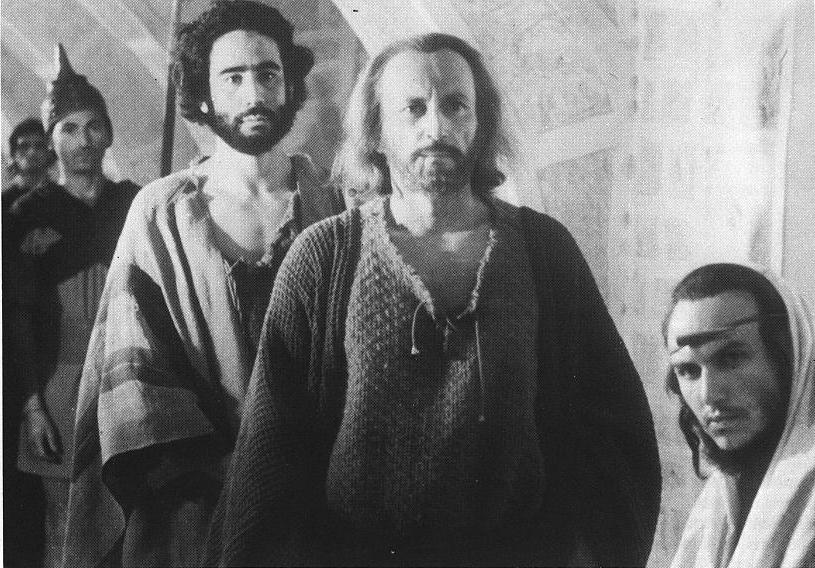
Atti degli Apostoli (1969 - pictured)
Overall I think Rossellini's film is my favourite of those that deal with Acts, partly because while it is still an obviously low budget piece it makes that into a virtue, rather than a constantly distracting flaw, but then I'm a big fan of Rossellini in general.
Again there are no tongues of fire, but the sky does momentarily go dark red before the disciples burst out into the public square. It's a wonderful moment, partly because it's been preceeded by a long and rather dry exposition of the story's cultural and historical context (from one Roman to another), which both give a better feel for that context but also because the disciples sudden arrival on the scene forms a striking contrast with the more stoic Romans. Furthermore there is something ambiguous about the moment. One the one hand it evokes Joel's prophecy about the sun turning to darkness and the moon to blood, but on the other the disciples' absence from the moment distances them from it, as if to break the causal link.
My favourite line in this story has always been Peter's "they're not drunk it's only nine o'clock in the morning: I remember laughing about that one as a ten year old at church. The majority of these films deliver it in a very po-faced and forced fashion. Here, Peter dismissively chucks it out over his shoulder as he marches through the crowd. It's reminiscent of Pasolini's Jesus making terse theological or political statements over his shoulder as the disciples struggle to keep up.
And then there's the climax, as Peter, the disciples and a bunch of keen to be new converts all rush in a state of high excitement to a watering hole outside the city. Are they ecstatic or just mad? Rossellini leaves it up to the viewer to interpret it. I imagine both interpretations happened at the time so it's nice to see this captured in the film and both sides thrown up for the viewer to pick over.
Incidentally, did I ever mention that this film is available to view (albeit without subtitles) here?
A.D. (1985)
Just as the series intercuts the story of the early church with tales of the Romans here we get the first Pentecost intercut with the Romans leading an execution. And just as the series often brings both stories together at certain critical points, so it turns out that the man who is due to be executed and is subsequently rescued is a friend of Stephen and other early Christians.
Inside meanwhile Mary seems to be taking a leading role within the early church - you don't have to interpret it that way but it seems to be the implication. On this occasion, Mary tells a story from Jesus' childhood. And then a very quiet wind starts up inside but someone notices it's not blowing outside. The effects look dated and the soppy looks on the disciples faces are rather comical, but Peter delivers his speech with real charisma, and it's probably the best delivery of that sermon of all of these clips.
Visual Bible: Acts (1994)
Whilst the special effect here will hardly have broken the bank it's actually very effective. In contrast to many of the other version - and my own prior visualisation - the moment of the Spirit's coming is initially very serene rather than ecstatic. Very little else works here though. Dean Jones' narration is more obtrusive than Richard Kiley's in Matthew, the word for word aspect feels very forces and
James Brolin is just to handsome, clean cut and all-American to pass for Simon Peter. It's interesting comparing his charismatic proto-TV-politician with the hapless dimwit played by Gerrit Schoonhoven in the Matthew film.
Where the forced literalism really doesn't work is during the crowd's lengthy response to what they are seeing, especially the various members of the crowd taking turns to recite a selection of the nations represented there. It wouldn't have been funnier if they had all done it together Life of Brian style ("Yes we're all individuals... from Phrygia and Pamphylia, Egypt and the parts of Libya near Cyrene.)
St Peter (2005)
The start of this film is so awful I've never been able to get past the first quarter of an hour or so, and the relevant scene here crops up about 35 minutes in. It's certainly one of the more interesting and creative explorations of the scene. The outpouring of the spirit occurs just at the very moment that the disciples are beginning to realise that language might be a barrier to the spread of the gospel.
Inside the moment is strikingly depicted with flames shooting up in the arches behind Peter and the other apostles. Outside however a shock-wave seems to strike everyone in sight. In contrast with the other versions Peter says very little of the sermon from Acts. So effectively this take on the story emphasises experience over explanations.
The scene ends on a rather sour note however. A Roman soldier - the very one who was present at the death of Jesus - wants to be baptised as well, but Peter refuses. I'm interested to see how this pans out: I have a hunch the soldier in question may appear later in the film.
Showing posts with label Peter. Show all posts
Sunday, April 29, 2012
Wednesday, May 4, 2011
Some Obscure Paul Films
Recently I've come across a number of lesser-known films about St. Paul so I thought I'd post a few bits and pieces about them here.The first is Damascus (pictured above). It's a docudrama made in 2008 as part of a collaboration between Agape 4 Media (the team who distribute the Jesus film), Youth Arise and one or two others as part of the Pope's Year of St. Paul. It's shot in and around Damacus itself and uses actors from the region and at some point I should hopefully get around to reviewing it.
The next is Life of St. Paul (1949). According to the IMDb it starred DeForest Kelley, best known for his role as Dr "Bones" McCoy in Star Trek. Paul was played by Nelson Leigh who would reprise the role 8 years later in The Living Bible Series: Acts of the Apostles. Life of St. Paul was made the same year as The Pilgrimmage Play which also starred Leigh (as Jesus). Both films were made by the same director, John T. Coyle.
Then there is I Paul from 1980. IMDb contains a good synopsis of this one. It was essentially a soliloquy given by Fred J. Scollay as Paul delivers his final message from prison to Timothy using the words of the King James Bible. It's available on DVD in the States, but seemingly not in the UK, which is a shame given that this is the 400th anniversary of the KJV.
Dayamayudu appears to be a sequel to the Jesus film Dayasagar. It's about Peter and Paul and can be seen on YouTube in its entirety. (I assume given the advert that plays at the start and that its there in full that it's legitimate to watch it on YouTube). Sadly there are no subtitles.
Also online is Paul the Emissary which I've discussed in passing before and a long time ago at Arts and Faith. It's available through the producer's website TBN (you have to scroll down a bit as there are a number of other films you can view online including The Revolutionary.
Lastly, I posted a link on the Bible Films Facebook page to a piece on 1960's Paul of Tarsus. There's an article all about the 10 part series at Roobarb's Forum. According to Ian K McLachlan it still exists in its entirety in the BBC archives (as does 1956's Jesus of Nazareth. Another poster adds that there is a clip from the series in the Roger Delgado documentary on the Doctor Who Dalek War set. I'm not a great fan of Dr. Who these days, but I know a couple of readers of this site who are. Has anyone seen this documentary?
Whilst I'm mentioning the Facebook page, just a quick plug to encourage you to "like" it (which means all the news bits will appear in your News Feed) and to post your own links / opinions there. I really want the page to become much more communal and as so many of you know things that I don't it would be great to have your contributions direct.
Saturday, January 22, 2011
A.D. (Anno Domini) - Episode 3
Saul may have been converted at the end of the last episode, but word has been a little slow getting around the Christian community, and even those who have heard are understandably sceptical. Leading the charge for the doubters is, of course, Thomas, who continues to be rather short in the joy department. In the meantime fear of Saul has driven the church further afield. The opening scene in episode three finds Peter (pictured) in Samaria, exorcising a man and scolding Simon the magician. The idea then comes to Peter that going around in threes isn't as effective as it might be, and so whilst Peter returns to Jerusalem, Philip is sent off to Gaza encountering the Ethiopian offical en route. Things are slightly different from Acts - the Ethiopian's chariot (a carriage really) overtakes Philip on the way. The scene is quite effective though and it's quite an interesting depiction of members of the early church coining fulfilment interpretation off the cuff. The baptism scene - shot from below - is one of the best so far, and it's the first time the emotional theme in the soundtrack fits rather than cheapening the moment. Meanwhile Paul sees his companion on the road to Damascus killed by zealots and heads to Jerusalem to try and convince Peter and the others that he has been converted and to gain some instructions.
There's plenty going on in the Roman side of things. Caligula is continuing to be as mad a March, April and May hare, and the Jewish brother (Caleb) and sister (Sarah) are starting to fall in love with Romans. Caleb is falling for a Roman gladiator which doesn't really ring true, but it does bring some much needed sexual tension. Sarah is smitten by a prominent centurion who conveniently finds himself with access to Caligula, Claudius, Priscilla, Aquila and later on Paul. His experience watching Caligula order his army to collect shells on a French beach rather than invading Britain drives him to plot his emperor's assassination and it's not long until he and others carry out their plan and crown Claudius.
Peter then appears in Jaffa, and is called on to bring Tabitha back from the dead. There's a great scene of him and Thomas trying to remember what Jesus did in this kind of situation, and it's nice to see Thomas being the faith filled one rather than Peter. It all brings a nice angle to these events capturing the humanity of Peter which often seems absent in Acts. We also see him struggling with the fame that comes with his ministry.
The film's low budget (big name actors aside) is occasionally apparent, and it's here that it's most notable. We first meet Cornellius at the start of the episode in a sea side villa that looks suspiciously like the one in Capri Tiberius had retired to. Similarly Peter's vision is not shown, only his experience of it. Cornellius is converted and is baptised in a dirty looking rock pool by the lusciously blue sea.
Sarah's love (Julius Vallerius) is trying to buy her out of slavery and in so doing goes to Priscilla and Aquila for help (they have already helped him locate her). Aquila and Priscilla are two of the best characters in this production. Since not a lot is known about them from the New Testament, the scriptwriters have pretty much free reign in terms of how to use them and how to develop their characters, but there;s just enough in the pages of scripture to make their characters interesting. Not only is it through them that we see things such as the purge of the Jews from Rome, we also get to see them grow from a couple not really sure if they are Christians to people leading others to faith.
Peter's experiences in Joppa lead to another meeting of the church in Jerusalem where they try to come to a consensus on admission into the church and the relationship between them and mainstream Judaism. In the background here is Caligula's attempt to install a statue of himself of the Jewish temple. But the very next scene shows Caligula's assassination and the episode ends with the statue, which was still outside the temple, being toppled and destroyed in celebration of the news. Watching it today I couldn't help but think of a similar statue meeting a similar fate not to far away in Iraq. The fact that it's purely coincidental (unless this series was big in Iraq) is a useful reminder not to read too much into similar looking images.
Thursday, January 13, 2011
A.D. (Anno Domini) - Episode 1
I've been trying to get a copy of the full version of 1985's AD for four or five years now and having finally got hold of it I'm going to share a few notes as I go. I'll post some details about the DVD a bit later, but for now I want to focus on episode 1 and in particular the parts concerning the trials and triumph of the early church.The series actually begins before the start of The Acts of the Apostles" with a story from Luke's first volume, the Road to Emmaus (Luke 24). Cleopas and his companion are quickly joined by Jesus as they hide behind a tree from some Romans. Jesus is rather annoying. He's quite smug and speaks in an Eddie Izzard-esque "Hello, we are the Romans" voice. The incident is shown at some length across several scenes and leading in to Doubting Thomas confession. Thomas's portrayal is even more extreme than it is in most such films. Not only is he a sceptic, but he's also very grumpy.
Interestingly though there's no ascension scene. Thomas's confession is followed by Jesus' promise of Matt 28:20, and a final dose of bread and wine. The camera pans round the disciples who are sat in a circle but when it returns to Jesus' spot, he has disappeared. At first it appears that he has simply disappeared in a similar manner to his arrival. However he's never seen again, and the next scene involving the disciples is the day of Pentecost.
Before then however we get a very nicely done introduction to Gamaliel and New Testament ers Judaism. Gamaliel is holding some kind of discussion with a number of men representing a good swathe of Jewish sects from the period. Present is Paul who is somewhat likeable if detached from the others, and Stephen who is yet to be converted but is still well on the way. A zealot contingent is also present. It's obvious from this episode alone that this production is at pains to provide a sold context for its story. Scenes like this and little details here and there do well at educating without being teachy.
The portrayal of Pentecost isn't very satisfactory. There's a build up with a mysterious blowing wind (despite all being calm outside) and then some kind of orange lighting effect whilst the disciples dance around. The accompanying music is terrible too so it's all rather disappointing.
This is followed by some kind of spontaneous procession into the temple (replete with people waving palm branches) and Peter delivers his sermon. He gets another chance to preach to a crowd in the final incident from the Bible in this first part. Peter and John appear in the temple and heal the man there. Peter gets to speak, as watched by some of the high priests and Paul who does definitely not approve.
The final glance we see of characters from the Bible is Stephen (pictured) converting and being baptised in the river. In many ways this episode is as much about Stephen as it is about Peter or Paul. The majority of the programme follows a paranoid Tiberius at Capri and a bunch of zealots trying to free one of their number from Roman arrest. Stephen is not a zealot but is determined to free the man (Caleb) as the two were wrestling prior to Caleb's arrest. But having introduced us to Saul/Paul the porgramme has been set-up nicely to learn more about Paul and his conversion in part 2.
Monday, January 10, 2011
Old Thoughts on Peter and Paul
Over the next few weeks there will be a number of posts on films based on Acts, mainly the two 80s TV programmes, A.D. (1985) and Peter and Paul (1981). I've now seen the first episode of the former, but writing up my thoughts on that will have to wait until I have a bit more time. So for now I thought I'd edit and post a few thoughts I wrote back in December 2004. Please be warned this is not he best, or most well informed, writing I have ever produced!=============
Watching Peter and Paul is rather like reading the book of Acts. Obviously that's the intention - although the film is much more than a simple reproduction of Luke's second great work - but it also reflects the way Acts starts off well, but peters out towards the end (pun most definitely intended).
Hopkins is, as you'd expect, great value and he produces a really good mix of Paul the hothead that comes through so clearly from his writings. At the same time he avoids playing Paul as the kind of vitriolic bigot that he's so often caricatured as today. This view always seems a bit out of context, and casts him as someone who would be unlikely to achieve what he did. Hopkins does this better than any of the other actors I've seen play Paul, although surprisingly he delivers Paul's most vitriolic line ("why don't they just go and castrate themselves?") coolly and calmly, as if he's talking about removing a slightly annoying toenail clipping.
What I liked most about the programme was the way the script made constant biblical references like little extracts from the prophets, Psalms or now-familiar Pauline Hebrew Bible was pretty staggering when we consider that for him it wasn't all in one convenient little volume, he didn't have a concordance, and he didn't have the luxury of being able to leave a gap and cut and paste the quote in later. He seems pretty steeped in the Old Testament - I imagine he would have had to have memorised large parts of it to be able to pull out all the passing references and connotations he does - and the film portrays this rather well.
Paul is also shown referring to Jesus' teaching and here I was less convinced, particularly as he doesn't really do this much in his letters. We know he was familiar with bits of it, but he doesn't seem to use it that often and I'm not sure he would have known bits verbatim in their canonical form as the film suggests, particularly as some of those bits probably hadn't found this form when Paul was writing. But it is interesting how that as Paul goes on he uses Jesus' words less and less and starts to use his own words more. Perhaps this is suggesting that Paul's teaching started to drift from the message of Jesus, but it could simply mean that as Paul went on he had more and more confidence in his own material.
There are however a few moments in the second half, which particularly focus on Paul, which let things down. Dramatically the shipwreck in Acts 27 is potentially an exciting scene, but all we get is reference to a storm that is coming followed by a cut to a scene of the shipmates arriving on the beach clinging on to bits of driftwood. Likewise, the legal drama is left to the scene with Festus and Agrippa. I do find this a bit tedious in Acts, but I couldn't help wondering how much better these scenes might have been is they had been made by someone with good experienced of making legal dramas.
That said, the real let down is the depiction of Peter. Early on he seems to have decided he couldn't lead people despite a great Pentecost preach and called James in to do it for him. Peter then feels unhappy about the situation but tends to moan about it rather than getting on with the business in hand. He and Paul get on well and he seems to inspire Paul at the start but then doesn't speak to him for 8 years, and then there is the Council of Jerusalem and the clash of Galatians 2, and they never speak again. After this Peter wanders around going to Babylon (rather bizarrely) and eventually re-tracing Paul's steps, and only returning to real, on-the-edge, preaching once Paul dies. By this time it's only a matter of weeks before he'll die too, and it just seems like a dithering old man desperately trying one last attempt to make something of himself.
This is wrong for a number of reasons. Firstly Peter is played into a weak role. It's not Robert Foxworth's fault he can't match Hopkins, but the script for Peter is poor too. Key Petrine moments are erased completely - notably Peter's last main solo narrative with his vision and Cornellius. But later on we delve into fiction (or perhaps its less well known legend with the closing scenes) whilst ignoring more popular "legends" such as the Quo Vadis moment. Fatally ending on the weak Peter, means that the film ends really badly. Once Paul goes, so does any resemblance of interest.
Thursday, July 5, 2007
St Peter (2005) DVD release (Starring Omar Sharif)
Omar Sharif starred in two of last year's Bible Films - the cinematically released One Night With the King and the TV series Ten Commandments (2006) and I've just caught wind of a third Sharif Bible film released in March of this year (although produced in 2005). St. Peter is another Bible film from the seemingly inexhaustible Lux Vide (who brought us The Bible Collection) and stars Sharif in the lead role. Here's the blurb from the press release:As a dedicated follower of Christ, Peter spreads the message of the Christians across the land, often staying only a few steps ahead of those determined to persecute him. As tensions between the Christians and Romans grow, the apostles lose St. Paul to crucifixion. On the road to Damascus, Peter comes face to face with a stranger, who shows him that he must put himself on the cross, for only martyrdom can bring peace to Rome.Back in 2005, there was a report in The Guardian about this film. Sharif's comments had apparently led an al-Qaida linked website to advise its readers to kill him. Sharif converted to Islam in the 50s, but said playing Peter was "so important for me that even now I can only speak about it with difficulty. It will be difficult for me to play other roles from now on". He also claimed "to hear voices" during filming.
Peter Chattaway has just reviewed the film for BC Christian News. It appears it's a mix of Acts of the Apostles and Quo Vadis? and whilst he finds Sharif as the 30 year old Peter unconvincing he does praise "the sensitivity of his performance".
It'll be interesting to compare this film with St. Paul (known as Paul the Apostle in the US) which I made a few brief comments about in my post on Galatians vs Acts in Film.
Wednesday, July 4, 2007
Atti Degli Apostoli (Acts of the Apostles)
When reading Acts of the Apostles in the Bible, it's easy to forget that the events it describes took 30 years to unfold. Aside from the prologue Luke's gospel spends 24 chapter on the events of just 3 years, and the immediacy of his writing style changes little between parts 1 and 2 of his story about Jesus and his followers.Films about Acts have tended to reinforce the speed with which we perceive the events occurred. With 28 chapters to cram into just a few hours it's difficult to carve out the space to show time ebbing along.
Rossellini's Atti Degli Apostoli (1968), however, bucks the trend. Whilst including a great deal of the biblical material (only chapter 19 and 24 are completely omitted), it still manages to convey the slowness of the process which led to Paul's arrival in Rome.
Rossellini does this by utilising a number of different techniques, many of which pull against the epic film genre. Large crowd scenes are kept to a minimum, as are on-screen depictions of miracles (although there are examples of both, particularly at the start of the film). Acts' many sermons are delivered in a low key style rather than converted into the kind of rousing speech that is so typical of the epic. Further more, most of the apostles' evangelism consists of one on one conversations, or talks in front of small groups, perhaps in a remote synagogue. The production opposes the epic in other ways, for example, it usually underplays the hero's persecution and refuses to import romantic sub-plots.
There are a number of other ways in which the film creates this more leisurely pace. Firstly, Rossellini punctuates his action with moments where nothing is really happening. There is space in this film, often at the start or the end of a shot. In some ways these moments of space are unnecessary; but in other ways they are the very essence of the film.There's a masterful shot at the start of the seventh episode1 which starts with a close up of a deserted dust track. The shot ever so gradually widens as the camera pulls back, eventually incorporating Paul and Barnabas as they trek up the road to Pisidian. It's one of many examples of Rossellini's Pancinor zoom technique – the long shots which zoom in and out drawing attention to various parts of the scene but keeping them connected to the larger whole. Here it starts with the emptiness of a remote path and then locates Paul and Barnabas on it. The shot as a whole tells the story of a long quiet walk along a deserted road.
Prior to this point in the film the action has centred around a busy Jerusalem, with only brief forays into the outside world. But from here on in, Paul becomes the main protagonist, and he and his companions pursue a lonely course of action through the towns of Asia Minor. Even the council of Jerusalem occurs outside the actual city itself.
The second way in which this film implies a more protracted timescale is by stressing how isolated Paul and the other disciples are from each other, and how unaware they are of the impact they are having. When Paul meets a besotted Prisicilla and Aquilla he is stunned to discover that he, and his Lord, are already well known in Rome. As he nears the great city in the closing scenes, he is again taken aback to find he is known and admired by a sizeable Christian community.
The great strength of these scenes is how emotionally powerful they are given their apparent restraint and understated acting. Somehow the numerous subtleties of the performances and the way they are filmed add up to something quite moving. Another example of this is disciples' reunion at the council of Jerusalem. Before launching into the debate about gentile adherence to the law, Rossellini pauses to show Peter waiting for the other delegates. But rather than being absorbed with the business the council needs to attend to, it seems he's mainly looking forward to seeing his friends and brothers again.
The film's ultra-long takes are, in themselves, another way in which the film suggests the passage of time. Perhaps the majority of scenes in Atti are filmed in a single, extended, shot. There are of course exceptions, notably the food riot in Jerusalem where the montage is perhaps a formal way of underlining that this particular episode is fictional, but these only serve to remind us of the longer takes elsewhere.Filming a scene in a single shot gives the cuts between these scenes extra significance. Within a shot the action occurs in real time. Once that continuity is broken the time that has passed whilst the camera has been turned off is unknown and potentially, therefore, represents an extended period.
Commentators have suggested a number of reasons why Rossellini relied so heavily on the long shot, (accompanied by the Pancinor zoom and the plan séquence). For some writers it was simply economy – long shots reduced the post production editing process to simply joining the scenes in the correct order, whilst also reducing the time and money spent altering lighting and make up for each scene. Other commentators, however, whilst perhaps accepting those particular advantages also see it as a way of giving the film more realistic aesthetic, and allowing the films to be more neutral.
By this stage in his life Rossellini was firmly into his historical period, producing films that he thought would "aim human beings in becoming more rational".2 To this end he had reverted to making films for television where "the [critical] spirit of the individual is more accentuated".3 Rossellini's desire for historicity is apparent throughout the series. Almost the entire first episode consists of an enslaved scribe giving a Roman noble a tour of Jerusalem along with a social and historical commentary. Elsewhere the rise and fall of the various Caesars is introduced into the relevant part of the script.
There is also a great deal of the everyday in Atti. The apostles spend a great deal of time engaged in manual labour. Peter is shown dyeing, Paul weaving, Stephen serving food and so on. Often the disciples spread they gospel as they work, a theme that would reappear in Il Messia.That said Rossellini's concern is not so much with a detailed recreation of the period as of the particular work in which he is adapting. This also apparent with his other historical works which are also adaptations of historical artefacts. So whilst the costumes and locations are fairly realistic, these areas are not attended to as rigorously as they are in many historical films today. The aim is to recreate (the feel of) the work rather than the events the work discusses.
This is one of the reasons why so many of the miraculous stories are not shown directly. This is simply a feature of Luke's work which Rossellini is seeking to recreate. Yet Rossellini relies on characters recounting supernatural occurrences more than Luke. Whilst this might appear to be an inconsistency, it only reflects the manner in which the story has been heard ever since.
There are two further reasons why Rossellini portrays the miracles in this manner. Firstly, describing the miracles is far more ambiguous than showing them. This allows the viewer to approach them from their own perspective, without forcing a particular opinion. Secondly, it recontextualises them. Set in a fresh context they once again become startling, like they were for their original audiences, liberated from the confines of familiarity.
This recontextualisation is also seen in some of the speeches made by the apostles. "In these films, characters boldly foreground their words, paradoxically, by delivering them in a flattened, often completely uninflected way... [focussing attention] on the ideas and historical forces at work".4Another way in which the film may be seen to be at variance with the book is in its great respect for the Judaism of the period. The lengthy prologue places the narrative firmly in a broader context explaining, for example, that Christianity was only one of a number of Jewish sects. It is also keen to stress the Judaism of the early apostles. Prior to his conversion Saul is shown sitting in the Sanhedrin, and even after his trip to Damascus he retains his side curls.
There are also points where the film questions Paul's modus operandi of using the network of synagogues to promulgate his message. Is he taking advantage of the hospitality which he is shown? Do the Hebrews (as the film generally calls them) in that town have good reason not to abandon their faith for his?
Such questioning should not be seen as an outright criticism of Paul. Indeed his dedication and his genuineness come across very clearly. Perhaps the biggest slur against him is the irritating American drawl used to dub the film into English.
Fortunately, the visuals are so brilliantly memorable that they persist in the memory long after the poor dubbing has faded into obscurity. As with the book, the precise words used by the apostles may no longer be recoverable, but the impact of what they achieved endures.
1 - The version of the film I saw was the ten episode "catechical" version. There is also a 5 episode version of this film (where each section is just short of an hour) where this shot should occur at the beginning of episode 4.
2 – Brunette, Peter. "Roberto Rossellini", University of California Press (1996) p. 253
3 – Interview, Filmcritica, no 190 (Aug 1968), 351 – cited in Brunette
4 – Brunette, Peter. "Roberto Rossellini", University of California Press (1996) p. 262
Subscribe to:
Posts (Atom)