It’s great to see Mark Goodacre is back up to full speed with his blog at
New Testament Gateway. Mark’s currently exploring the relationship between the contrasting accounts of Paul’s visits to Jerusalem in Acts and Galatians. It’s a subject I’ve looked at in some length before and it’s one of those subjects I find fascinating. Mark’s posts are making me re-consider my position, which is always good, and I’d suggest taking a peak yourself.
So I thought it would be good to look at the various ways these incidents have been portrayed on film, and see how they try and combine the source material into a coherent account.
The Living Bible: Acts (1957) (Episodes 3 to 6 of 10 – total run time ~ 180 minutes)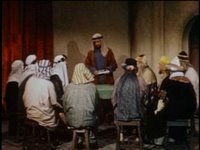
The Living Bible series takes a fairly literal approach to the bible and
Acts is no exception. The story is largely narrated, intentionally based on Acts and rarely adds extra-biblical material. However, the 160 or so minutes run time is divided into 10 self contained episodes, and as a result there are incidents present in Acts but which falls between episodes.
Episode 3
Light From Heaven deals with the conversion of Saul, but leaves him in Damascus, before flashing forward to a far older Paul reciting 1 Tim 1:15-17. The next episode is
No Respecter of Persons which deals with Peter and Cornelius and so Paul’s possible visit to Jerusalem at this point is omitted.
The fifth episode is
God’s Care of his Own which deals with the church’s collection for those in Jerusalem, and Peter’s escape from prison. Whilst we see Paul and Barnabas making the collection, and setting off to take it to Jerusalem, we never actually see them arrive. Hence, the point at which the two of them arrive is left open to interpretation, and could be read as suggesting that they arrived much later and that there are parallel chronologies here.
Episode 6 is simply a conglomerate of mission related clips from the first 13 chapters of Acts, but in episode 7,
Salvation and Christian Fellowship we arrive at the council at Jerusalem. The council is initially a very public affair, but cleverly incorporates the word “privately” in Gal 2:2 by having a smaller group go to a different room to make their decision which reflects Acts rather than Galatians. Unusually here there is heavy interpretation applied. The film’s narrator describes the decision as reflecting the majority, and calls council’s letter a “happy solution”, and “wonderfully friendly and frank”. So the film appears to support aligning Gal 2:11-16 with events leading up to the council (Acst 15:1-2) rather than following it as the Galatian letter suggests, although it has such a high view of Peter that his involvement is absent here.
Peter and Paul (1981) (Between 30-90 mins for a 180 minute long film)
Here only two people lower Saul from the walls of Damascus, and the implication is that these are not his disciples. Paul is also beaten in Damascus (no reference in the text) We are then told it is 38AD and Paul is in Jerusalem to see Peter. The film here deftly combines the accounts from Acts 9:26-31 and Galatians 1:18-24. Paul comes to Jerusalem to talk to Peter, but the apostles are afraid of him. Barnabas arranges a meeting between the two and Peter and Paul spend a lot of time together, which it is easy to conceive is the 15 days of Gal. 1:18 (Peter even takes Paul to Galilee). Finally Paul meets James, and leaves for Tarsus (Acts 9:30).
It is then 8 years before we meet Saul again (46 AD). Barnbas mentions that Jerusalem is starving (rather than Agabus prophesying it) and tells Paul about the forthcoming meeting in Antioch. We never see this meeting instead the action moved onto Peter’s escape from Prison in Acts 12. When he arrives at the house of Mary and John Mark, Barnabas has just also arrived
without Paul, but with a supply of food. Clearly this is a slight, but significant alteration. The film moves fairly meticulously through the available material at this point, eventually ending up with the council in Jerusalem (precipitated by Barnabas being told on his trip to Jerusalem that Greeks have to conform to Jewish law). The Jerusalem Council starts as a large and angry affair, but manoeuvres skilfully around the word “privately” in Gal 2:2 by having the major players go off into a side room to decide what to do. James’s decision, though, is to place “no restrictions” on the Gentile believers appearing to prefer Galatians to Acts. Peter then accompanies Paul to Antioch, and it is then that the events of Gal 2:11-14 occur. It is here that we see this film’s cleverest pieces of writing. The men that arrive from James bring the letter of Acts 15:23-30. The split from Barnabas is both due to his seeing Peter’s point of view and his support for John Mark (the reason given in Acts and in Galatians). Thus Paul continues his misson without ever having been party to the restrictions on the Gentiles.
Visual Bible: Acts (1994) (Between 55-110 mins for a 180 minute long film)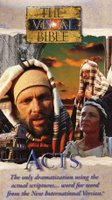
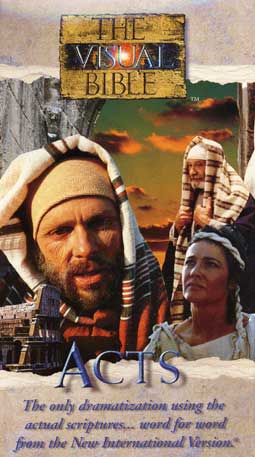
This is a 3 hour word for word visualisation of Acts and so it has to present all of the Acts material and obviously largely ignores Galatians. Because it uses the NIV Paul’s escape from Damascus is assisted by his “followers” rather than the more committed-sounding “disciples” in some translations. Interestingly once this action has been shown we cut to a boat where an older Luke narrates the events of Acts 9:27-31.
The text then continues with stories about Peter, and some of these are shown whilst others are again narrated from the boat. Significantly Acts 11:25-30 is again just narrated. The action returns for the story about Peter’s imprisonment, and Herod’s death. We do see Paul in relation to Act 12:24, but he is not in Jerusalem, but walking in the countryside.
When it comes to the Jerusalem council, we are shown the action, although again the dispute in Antioch is not depicted (Luke simply smiles as he narrates this argument – hardly the way Paul feels about this dispute). The council of Jerusalem seems like a very well mannered affair. We also do not see the letter of Acts 15:23-29.
So whilst the nature of this project means that the film has to narrate these passages, the visuals do all they can to downplay the early appearance(s) in Jerusalem, and the controversy that led to the events of Acts 1. Whether this is just to avoid alienating some of their potential audience, or just to avoid commenting on such issues is hard to discern.
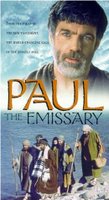 Paul the Emissary (1997) (Between 9-15 mins for a 54 minute long film)
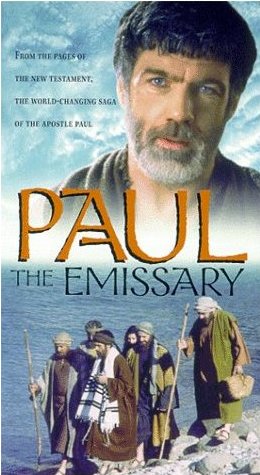
This is a very short film about Paul, and actually focuses a high proportion of its run time on the later part of Acts. Strangely it leaves out any trips by Paul to Jerusalem prior to the events of Acts 21. It’s main focus is on Paul’s preaching and so it ignores the theological issues that Council of Jerusalem throws up, in order to spend more time listening to Paul’s speeches such as that at Athens.
St. Paul [known as Paul the Apostle in the US](2000) (Between 90-150 mins for a 180 minute long film)
Paul goes from Damascus to Jerusalem and meets Peter (and James) in a private meeting. He stays around Jerusalem and has another private meeting with Peter and James later on. They agree that Peter should go to Lydda, Barnabas to Antioch, Paul to Tarsus (9:30) whilst James stays in Jerusalem. So this is clearly Acts 9 territory. Initially Peter wants to delay message to Gentiles, and both he and James see it as meaning new rules for any potential gentile converts. Next time we see Peter he recounts his vision, but submits to James over Jewish/Gentile practice. Later Barnabas collect Paul from Tarsus (Acts 11:25-26) and they head to Cyprus (Acts 13:2-4), Herod dies (Acts 12:20-25), Paul and Barnabas go to Lystra, before arriving in Antioch.
Once in Antioch, Peter, and some people from James are there, and Paul accuses him and Barnabas of hypocrisy. So the film ties together the Acts 15 and Gal 2 accounts. The chronology fits with Acts (and goes against the order in Galatians 2), but Barnabas’s hypocrisy is in line with Galatians 2. This is followed by the Jerusalem council which is of such a size so it can be interpreted as either private or public. Peter is persuaded by Paul’s arguments, and so James decides that there is no burden except to keep the (ten) commandments, and there is no mention of the collection or of the letter. Paul and Barnabas then split over whether to go to Rome or not, ignoring both the excuse about Mark from Acts and the explanation in Galatians regarding Barnabas. Next thing, Paul is in Athens (Acts 17) and the film moves on.
One final observation, it is interesting to see how the film’s early baptisms are sprinklings whereas a later baptism is carried out by full immersion.
======
There are two other relevant films that I’ve been unable to cover. The most well known is
AD / Anno Domini the TV series from 1985, which I saw when I was a boy, but have not seen since. If any of you who have seen it more recently (or even own it) want to contribute how this films deals with these issues, please do so via the comments.
The other is Roberto Rosellini’s
Atti Degli Apostoli which at 5 hours and 42 minutes is almost twice as long as any of the other films. Given that runtime, and since it also downplays the supernatural events recorded in Acts one would expect it to give a good amount of time to these events, and indeed it does. Almost all of the "fourth chapter" is given over to the Council of Jerusalem.
It is interesting that none of these films support the minority conservative chronology (that equates Gal. 1 with Acts 9, and Gal 2 with Acts 11), and that they tend to equate the first visit with Acts 9 and the second with Acts 15, generally downplaying Acts 11 and 12. However, the dispute with Peter (Gal 2:11-14) occurs in various places, both before and after the Council of Jerusalem, in watered down form, or not at all.
 Over the next few weeks there will be a number of posts on films based on Acts, mainly the two 80s TV programmes, A.D. (1985) and Peter and Paul (1981). I've now seen the first episode of the former, but writing up my thoughts on that will have to wait until I have a bit more time. So for now I thought I'd edit and post a few thoughts I wrote back in December 2004. Please be warned this is not he best, or most well informed, writing I have ever produced!