Showing posts with label DeMille. Show all posts

Monday, January 4, 2010

Cecil B. DeMille: American Epic

Arguably the pick of the Christmas telly over here in the UK was a screening of TCM's 2004 documentary Cecil B. DeMille: American Epic. At around two and a half hours Kevin Brownlow's tale of DeMille's life could have been as overblown and drudging as some of DeMille's films, but actually the time flew by. That's always a good indicator of the quality of a documentary, but anyone still unconvinced only has to look at some of the interviewees to be reassured. The talking heads for the programme were a mix of new and archive footage. The new footage featured Steven Spielberg and Martin Scorsese (both fans to a certain extent), DeMille's grandaughter Cecilia, and a much used contribution from Robert Birchard. I imagine it takes a great deal of effort to get to interview Hollywood's two most iconic and well known directors, but Brownlow gets the most out of them: there's not too much gushing, a good number of perceptive remarks, and the clips never damage the film's pacing.

The archive footage is drawn from over 60 years (the dates of the earliest snippets are hard to ascertain), but includes bits of interviews from several members of his family, not to mention the man himself. There were also clips from various members of his casts and crews, including Angela Lansbury, Charlton Heston and Gloria Swanson.

There are also numerous clips from the films themselves. Many of these seemed to have been colour tinted at some stage, which was a little strange when those parts of the film are only in black and white in the DVDs in my possession. Most notably the parting of the Red Sea scene from DeMille's first Ten Commandments. The sea itself was tinted blue, whereas the Israelite's reaction scenes where sepia. I'm not sure whether this is simply a different print, or something TCM did themselves, but I did kind of like it. As there are already two versions of the 1923 film (with and without a coloured exodus scene), I wouldn't been surprised if this was original, but then the colour did seem rather bold, and I don't recall reading of DeMille colour tinting before in spite of him pioneering with technicolour.

Anyway I found a few interesting new revelations and watching this overview of DeMille's life in one swoop gives a more immediate perspective than reading a more detailed version (like Birchard's) over a longer time period.

Incidentally you can see a trailer for this documentary from the site previewing it's appearance at 2007's San Francisco International Film Festival.

Wednesday, May 13, 2009

Weiss to Play Lamarr Playing Delilah?

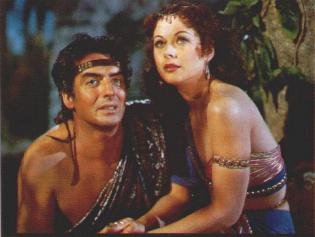
Peter Chattaway is wondering whether Rachel Weiss will indirectly play Delilah given The Hollywood Reporter's story that Weiss has taken the leading part in a Hedy Lamarr biopic. Lamarr's most famous role was, of course, as the titular honey-trapping Philistine in DeMille's 1949 Samson and Delilah. Peter asks "Will the new film depict the making of DeMille's film in any way, shape or form?". I would have to guess "yes", but would be surprised if it showed any actual footage.

The film, with the working title Face Value will be directed by Amy Redford, daughter of Hollywood legend Robert.

Monday, December 8, 2008

Herod in DeMille's Cleopatra

Peter Chattaway recently watched Cecil B. DeMille's Cleopatra for the first time and has made some interesting comments about it, notably concerning the appearance of Herod the Great. It's one of DeMille's films that I've not seen yet. Perhaps I should add that DeMille boxset to my Christmas list.

Sunday, November 9, 2008

Samson and Delilah and Sunset Boulevard

I've been meaning to post this for weeks and weeks, but for some reason I've failed to, delaying other plans elsewhere. Anyway, perhaps as long as two months ago now, I had my first viewing of Sunset Boulevard. It was one of those films I'd been meaning to see for ages, and as I was reading Robert S. Birchard's "Cecil B. DeMille's Hollywood" it seemed a particularly good time.

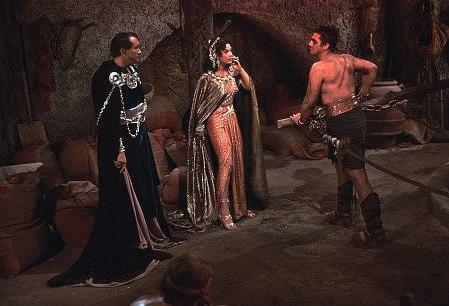
Unsurprisingly, the scene which most caught my attention was the one where Norma Desmond (played with relish by Gloria Swanson) goes to the Paramount Studio to meet her former director Cecil B. DeMille. For those not in the know, DeMille plays himself and it's interesting to see how closely his brief cameo coincides with the portrait of him in Birchard's book. Birchard repeatedly cites examples of DeMille's faithfulness to, and his care for, his former stars. Here he has a difficult case to deal with; one of his former, silent, leading ladies is deluding herself that she can make a comeback and has sent DeMille her own script. Meanwhile, one of DeMille's team has contacted Norma to try and borrow her vintage car for another film. Misinterpreting a call from DeMille's office as a sign of his interest in her script she rushes to Paramount to meet with him. There she is treated like the star she once was (see picture below), not least by another DeMille old timer who lets her experience life in the spotlight for one final brief moment. DeMille's sensitivity and care is apparent throughout, and whilst we should not forget that hie words are both scripted and directed, it also seems to come very easily to someone who only stepped in front of the cameras to act on a handful of occasions.The other thing that grabbed my attention was the fact that this scene appears to take place on the set of Samson and Delilah. I don't know much about this kind of stuff, but I would guess that this is the real set of Samson and Delilah. Firstly, Henry Wilcoxon (above) is filmed, but is not given any dialogue. Wilcoxon played a leading role in Samson and Delilah, but was also DeMille's associate producer . His presence would be easily explained if the Sunset Boulevard crew came onto the Samson and Delilah set, but it's unlikely that they would pay a star such as Wilcoxon just to be an extra.

Secondly, the scene in question is being filmed on a studio sound stage as most of Samson and Delilah was. Would the makers of Sunset Boulevard really build a set that was identical to one that already existed? I suppose there is the possibility that the existing set didn't give the the right angles for the pulled back shots they required, but it still seems like the most probable answer?

One final point, it took me a little while to figure out the chronology. After all Sunset Boulevard is set in, what was then, the modern day, so audiences assume that it's 1950. But Samson and Delilah was actually released the year before in 1949 suggesting that Boulevard actually takes place 1948-1949. I can't remember if there is any other evidence in the film that suggests a more specific date.

Wednesday, October 8, 2008

Giving of the Ten Commandments

My church is looking at the Ten Commandments at the moment, so I got asked to dig out some clips of Moses receiving the commandments. I looked at the following five which are probably the best crafted of those available:
The Ten Commandments (1923)
The Ten Commandments (1956)
Moses the Lawgiver (1975)
Moses (1996)
Ten Commmandments (2006)
As well as being the best clips they are probably the most widely known. The other popular Moses film that is not on the list is obviously The Prince of Egypt, but this only really shows a brief shot of Moses holding the commandments right before the credits roll. Likewise there is no equivalent scene in 1974's Moses und Aron For the record I could also have included clips from the following:
Green Pastures (1936)
The Living Bible - Moses, Leader of God's People (1958)
Greatest Heroes of the Bible - The Ten Commandments (1979)
History of the World Part 1 (1981)
The Ten Commandments: The Musical (2006)
Ten Commandments (2007)
...not to mention a whole host of cartoons.

Anyway, for anyone interested in repeating the exercise elsewhere, here are the start and end places/times of the clips I used - the clip length, and the version that I used. In most cases these are region 2, but I imagine the difference will be very slight, particularly as the DVD releases for the first two are identical regardless of the regional code. Links are to previous posts on each film. I've also added the leading actor's name and a few comments.
The Ten Commandments (1923)
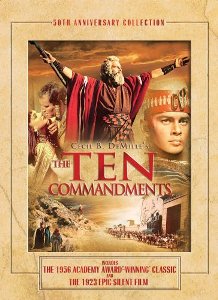
Ten Commandments (1956) 50th Anniversary Collection – region 2
Disc 3 - Chapter 6; 35:05 – 42:48 [7:43 minutes]
Moses played by Theodore Roberts

This is the oldest of those available, and, for those unused to silent films, the style takes a bit of getting used to. Note the age of Moses here, and also that DeMille's citations are from Exodus 31 and 32 rather than the first account of the giving of the commandments in Exodus 19 and 20.

The Ten Commandments (1956)
Ten Commandments (1956) 50th Anniversary Collection – region 2
Disc 2 – Chapter 15; 73:12 – 78:45 [4:30 minutes]
Moses played by Charlton Heston

This is, obviously the most famous version, but it's utterly reliant on DeMille's earlier version. The streak of fire writing the commandments is fresh, but otherwise it's just a remake. Note how in both examples Moses receives the commandments at the top of the mountain, and whilst commandments 1 and 2 are being broken (not that the people would have known given this film's chronology!)

Moses the Lawgiver (1975)
Network/Granada Ventures – Region 2
Disc 2 – Chapter 3; 10:48 – 15:00 [4:12 minutes]
Moses played by Burt Lancaster

This is perhaps the most controversial version of these events, but it's relatively accurate to the accounts in Exodus. The clip ends with Moses on his way up the mountain with the tablets already under his arm, with the people having already agreed. An earlier scene shows Moses hearing God's call (in Lancaster's own voice) from the top of the mountain, but it's entirely ambiguous as to whether these commandments are from God or from Moses. It's also good how they are given more as prose than as "commandments".

Ten Commmandments (2006)
Disc 2 – Chapter 7; 68:10 – 72:04 [3:52 minutes]
Moses played by Dougray Scott

This is the most recent of the five, and it's main concern seems to be showing off it's technology. There's a heavy dependence on DeMille too - the idea of Moses going up the mountain to get the tablets, and of them being literally written by God (although not literally the "finger of God" as the text states), not to mention the desire to make this a showy scene.

Moses (1996)
Time Life Box Set – region 2
Part 2; 29:30 – 36:20 [6:50 minutes]
Moses played by Sir Ben Kingsley

This is perhaps my favourite of these five clips, largely because I had to see it to make me realise how the story actually appears in Exodus. It's sticks very closely to the text (Exodus 19:10-20:21), but given how stagey other version have been, this is a good thing, which is also why I recommend showing it last. I also like the idea of the commandments being something that welled up from the people as they encountered God, and the idea of the people corporately being the mouthpiece of God.

Monday, October 6, 2008

Book Review: Cecil B. DeMille's Hollywood


Cecil B. DeMille's Hollywood

Robert S. Birchard

University Press of Kentucky
(July 1, 2008)
Hardcover, 496 pages
English
ISBN: (978)0813123240
22.6 x 15 x 3.8 cm

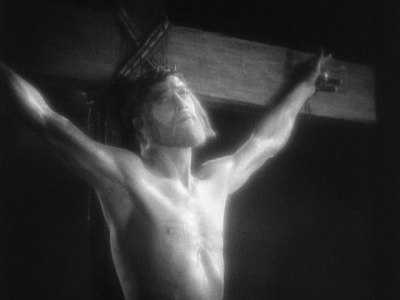
There's a great story about Cecil B. DeMille from the time when he was shooting The King of Kings. In order for his picture to capture the correct degree of reverence DeMille instructed the cast and crew that whilst his leading characters were still in make-up they were to be treated "as if they were the original characters of the Bible". Everything was going wonderfully until one day the actor playing Jesus, H.B. Warner, kept fluffing his lines. Finally, DeMille blew his top and poured forth a stream of abuse only for Warner to shoot back. "Mr. De Mille, do you realize to whom you are speaking?"1

It's the kind of classic anecdote so typical of the great director's reputation; the pious tyrant so capable of flying into a rage when things went badly. But such stories have become so ingrained in our consciousness that it's sometimes difficult to get beyond them to the real Cecil B. DeMille.

Robert S. Birchard, however, opts for a different approach entirely. Having worked as a "volunteer film archivist" his connections with the DeMille estate not only enabled him to view all of the DeMille films still in existence, but also gave him sufficient access to a wealth of DeMille's correspondence. As a result, "Cecil B. DeMille's Hollywood" contains very few anecdotes such as the one above. Instead Birchard concentrates on the facts as conveyed through the mountain of correspondence DeMille left behind him.

The result is an impressively thorough examination of the story of DeMille's films. This should not be mistaken for a DeMille biography. There's nothing of his birth or childhood except in retrospect, and only if it becomes relevant to a particular film. Instead, the book opens in 1913 with the events that culminated in the production of DeMille's first film The Squaw Man. Birchard proceeds to take a separate chapter for each DeMille film. Whilst the chapters that cover the films now lost to us are obviously shorter than the others, they still provide a good deal of information about them. Some, I suppose, would see such history as a little pointless, but, in fact, these chapters are vital; they ensure that the book is about DeMille's body of work as a whole - a narrative comprised of shorter narratives if you will - rather than being a merely a collection of essays about some of his films.Much of the book is comprised of extended quotes from this correspondence, and Birchard uses it to highlight several facets of DeMille that tend to go unnoticed. In particular, DeMille's loyalty to fading stars who had worked for him in their younger years is demonstrated time and again. It casts a very different light on DeMille's appearance in Sunset Boulevard. And indeed whilst Birchard does provide the occasional example of DeMille's famous temper, overall he is presented as far more measured than the anecdotes would have you believe. The kind of person, in fact, who might possess sufficient collaborational skills to be able to produce seventy movies. Particular? Yes. A little short tempered? Certainly. Cruel and out of control? No.

ButBirchard's account is also honest enough not to portray DeMille as someone he wasn't. Birchard accepts that his artistry was not that of certain other well known directors, but insists that, nevertheless, there was more to his movies than he has often been credited with.

Indeed it's this considered, measured approach to DeMille's work that is the book's biggest strength. DeMille's own autobiography is entertaining , but leaves one wondering how things really happened. Higham's biography is criticised as being sycophantic.3 By contrast, Birchard sticks largely to the facts interspersing his own commentary on events with excerpts from letters and telegrams, and sections of movie dialogue. There are also three substantial collections of photos (the majority of which are from the author's own collection). There are also three appendices listing A - DeMille Pictures' Costs and Grosses, B - Other DeMille film credits, and C - Unrealised Projects.

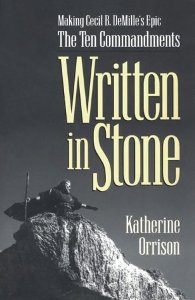
However, at times, Birchard's love for his sources gets in the way somewhat, as the details occasionally elbow out some of the more interesting information. Take, for example, chapter 68 about Samson and Delilah. Birchard discusses, at some length, the departure a largely unknown member of DeMille's costume department - Ralph Jester - even quoting, in full, one of DeMille's letters to him. But moments later, Henry Wilcoxon's promotion to associate producer is given a mere half sentence, despite the fact that Katherine Orrison has written both his biography and a book on DeMille's 1956 Ten Commandments largely based on his memories.4 It also means that, sadly, the book isn't quite as engaging as it perhaps could have been. DeMille was an extraordinary character, but somehow the book drags a little on occasion.

Overall though, it's a fascinating insight into the inner workings of DeMille's seventy films with the such a wealth of evidence and the kind of precision that gives the reader real confidence in the trustworthiness of what they are being told. And whilst no-one will ever be able to capture everything about Cecil Blount DeMille within the pages of a mere book, "Cecil B. DeMille's Hollywood" is certainly an admirable attempt.

1 - Amusing though it is, I should clarify that this is precisely the kind of anecdote that the book avoids. It is, in fact, adapted from this story at anecdotage.com.
2 - Birchard, Robert S., "Cecil B. DeMille's Hollywood", The University Press of Kentucky (Lexington, Kentucky, 2004), p.xiv
3 - See for example Jonathan Rosenbaum.
4 - Peter T. Chattaway - Interview with Katherine Orrison - FilmChat - March 21st 2006 - http://filmchatblog.blogspot.com/2006/03/katherine-orrison-interviews-up.html

Monday, September 22, 2008

Bible Films that Never Were

Cecil B. DeMille's name will forever be associated with the biblical epic even though he only ever made three and a half films based on the Bible - his two versions of The Ten Commandments (19231 and 1956), his Jesus film The King of Kings and 1949's Samson and Delilah. Indeed, given that Samson and the second Ten Commandments were two of the last three movies he ever made , it's a reputation he might never have earned at all. True, there were a number of other ancient epics in his seventy-film canon, but it was those last two films in particular, that cemented his place in the popular imagination as the man that made biblical epics.

However, I've been reading Robert S. Birchard's "Cecil B. DeMille's Hollywood" recently, and one of the appendices lists the veteran director's unrealised projects. Given the vast number of movies he made, it's surprising that there are only twelve sucfilms, but it's interesting that four of them are Bible films.

The first of these is The Deluge which I discussed last year. DeMille was considering making the film in the late 20s, but when it became apparent that Michael Curtiz was already making Noah's Ark he switched his attention to The King of Kings instead. Aspiring filmmakers considering adapting the story of Noah take note.

The second film on Birchard's list was Esther (or The Story of Esther) and he notes that MacKinlay Cantour was working on this in the summer of 19342. Birchard doesn't say anymore, but given that this was the same year that DeMille directed Cleopatra, my guess is that he ultimately decided he could only handle one heroine-driven ancient epic at a time.

There's a good deal more information on Queen of Queens, DeMille's planned story of Jesus's mother, (though it's hard to believe that such a title would ever have been taken seriously).
Jeannie Macpherson worked on the script from November 20, 1939 to July 27, 1940. William C. DeMille also worked on the script from March 4, 1940 to June 7, 1941, and William Cowan wrote on the project from September 3 to October 9, 1940. Queen of Queens met some resistance from the Catholic Church , and the film was never scheduled for production.3
Lastly, Birchard tell us that Macpherson also started work on a script for the story of King David, Thou Art the Man.4 This was six years before David and Bathsheba reached the screen with its take on David's adultery, so it seems unlikely that once again DeMille had been put off by a similar project at another studio. Perhaps, given his long-standing desire to bring Samson's story to the screen he decided to focus on that instead.

Aside from the list of DeMille's films-that-never-were, I was also interested to read that Steve Reeves and Cary Grant had both been considered for the leading role in Samson and Delilah. Reeves is not in the least surprising, given that he went on to play Hercules and Goliath, but it's incredible to think that any kind of consideration was ever given to Grant. Of course, the whole point of the Samson and Delilah story is that the source of Samson's strength isn't obvious. So it wouldn't have been inconceivable for Grant to play him, but when you look at the final film, and it's emphasis on, and love for, Mature's oiled torso, it's hard to imagine Grant in that same role.

====

On a not unrelated note, Eric David of Christianity Today has written a short piece on French director Robert Bresson which claims that he was initially approached to direct Dino de Laurentiis' The Bible: In The Beginning.
In the mid 1960s, Dino de Laurentiis planned a series of films based on the Bible, featuring top directors of the day, including Huston, Visconti, Welles and Fellini. When Bresson, slated to direct Genesis, told de Laurentiis that he planned to film it in Hebrew and Aramaic, and wouldn't show any animals on Noah's Ark, only their footprints in the sand, he was fired. Huston took over and The Bible: In The Beginning, was released, but did not perform well enough to justify the other directors helming their respective films. Bresson yearned to film Genesis the rest of his life, but it never came to pass.
That would certainly have made for a very different film, but given that Bresson instead went on to direct his masterful Christ-figure film Au hasard Balthazar that same year, and that Huston's version has so much to commend it, it may well have all been for the best.

Thursday, February 14, 2008

Dan Castellaneta to Play DeMilleSands of Oblivion

Peter Chattaway has details of Anchor Bay's Sands of Oblivion which is being released on DVD next month. The story revolves around the set for DeMille's 1923 version of The Ten Commandments which was buried in the Californian desert upon the film's completion. DeMille joked at the time that "If, a thousand years from now, archaeologists happen to dig beneath the sands of Guadalupe, I hope they will not rush into print with the amazing news that Egyptian civilization, far from being confined to the banks of the Nile, extended all the way to the Pacific coast of North America."

It seems that DeMille's words became something of a self-(un)fulfilling prophecy. In 1983 filmmaker Peter Brosnan and archaeologist John Parker, began a quest to find the ruins in the sand dunes of Guadalupe, California. This new film has nothing to do with them, as far as I know. It's a horror film / conspiracy drama which is partially set in 1923 but also follows the fortunes of a "soon-to-be divorced archaeologist couple Jesse and Alice Carter". According to this movie, the reason that DeMille buried the set was nothing to do with foiling his competitors but because "the set holds the spirit of a vengeful Egyptian god, trapped in a smuggled artifact".It's certainly an unusual premise and I guess it'll be a combination of The Mummy, Stargate and Shadow of the Vampire. There are various interesting characters in the cast, including George Kennedy (from perhaps my favourite film Cool Hand Luke), but the most interesting casting choice, to me at least is that of Dan Castellaneta as Cecil B. DeMille. Castellaneta has made his name in The Simpsons but his face and his normal speaking voice are largely unknown. SO in some ways despite his fame he's a fresh face.

And the interesting thing is that he actually looks a wee bit like DeMille as well. The baldness clearly helps, and the photo of DeMille below doesn't make the similarity as obvious as some pictures of him from around 1923, but nevertheless it will be interesting to see how he plays the role. There's obviously a good deal of footage of DeMille around - not least from the opening to his 1956 remake of the film in question.

Monday, July 2, 2007

DeMille's Collaborations Redux

I've mentioned the great Cecil B. DeMille in two posts recently, and I've done a bit of searching on them so I thought I'd refer back.

The first was regarding Michael Curtiz. Peter Chattaway noted some similarities between Curtiz's Noah's Ark (1928) and DeMille's The Ten Commandments (1923). When I was preparing to write my review of Noah's Ark I came across some more information which suggested that the influence could have worked in both directions.

Yesterday I was flicking through the the substantial liner notes for the Criterion Collection's release of DeMille's 1927 The King of Kings when I noticed some information regarding Noah's Ark. It seems DeMille was due to work on a similar project about Noah in 1926 called The Deluge, but the plug was pulled when DeMille got wind of Curtiz's project. This shows the two were at least partially aware of each other's work, and that execs then preferred to stop making a film if it was too similar to another (rather than go head to head as often happens today).

Interestingly neither DeMille's autobiography, nor Charles Higham's biography mention Curtiz at all (at least, not in their indicies).

Which leads me nicely onto the second post about DeMille to which I want to return. Last week I commented on a piece in the The Villages Daily Sun newspaper which claimed that DeMille made films with Edgar J. Banks (dubbed the original Indiana Jones). As with Curtiz there's no mention of Banks in the autobiography and Higham's book.

I also (finally!) got hold of Henry S. Noerdlinger's book "Moses and Egypt: The Documentation to the Motion Picture the Ten Commandments" about the 1956 DeMille film. Again, despite the depth of information produced in this book, there's no mention of Banks. Admittedly, DeMille's later version of this film was not released until 10 years after Bank's death, but if DeMille and Banks really were working on films together it's strange that nothing Banks achieved merited a mention in Noerdlinger's book.

That's not, at all, to say the story is a hoax, simply that if it is true it was one very well kept secret.

I'll end on a trivia piece. DeMille made bible films with Banks, who was the inspiration for the Indiana Jones films made by Steven Spielberg, who also directed Close Encounters of the Third Kind, which included a clip from the 1956 Ten Commandments - a bible film directed by DeMille. I hope those people who love making these kind of links appreciate that one. I wonder if DeMille ever pondered making a film about Banks?

Thursday, June 28, 2007

Did Edgar J. Banks make films with Cecil B. DeMille?

Peter T. Chattaway has a piece on claims that Indiana Jones-style archaeologist Edgar J. Banks (right) made films with Cecil B. DeMille. (How that for a string of initialised middle names?).

The story surfaced at The Villages Daily Sun paper in Florida. Here's the interesting bit:
[Banks] made motion pictures with famed director Cecil B. DeMille

"They were involved in a company known as Sacred Films," Wasilewska [Banks' biographer] said. "The films were not only 'Sacred,' they were secret. The company wasn’t registered anywhere. But it really did exist."

That incredible claim is supported by about 200 old movie stills from sets of Biblical epics Banks’ late daughter, Daphne McLachlan, left to her children.

"In 1920, at the beginning of moviemaking, a lot of people were making movies about Biblical events. But they were all poor-quality, low-budget productions," Wasilewska said. "This was very different. This was high-class, very professional. It was a secret company, but many important people were involved, including famous actors and actresses."

What became of the films is one of many puzzles related to Banks. Banks’ next endeavor is also shrouded in mystery.

"With the experience he got in California, he saw he could start a company in Florida to produce his own films," Wasilewska said. "He used local actors, and so it would not be very expensive."

Banks’ company, Seminole Films, made movies depicting life in ancient Rome and Greece, but the world never saw the films. In a weird twist of irony, the archaeologist who brought so many treasures out of the ground, deposited his cinematic efforts into the earth.

"He actually did make some movies, but none were released," Wasilewska said. "He opened this company and he couldn’t sell the movies he made, so one day he packed all of the movies in tin cans and buried them on his property."

The movies were never recovered.
I'll try and remember to check my DeMille biography and auto-biography to see if there is any mention of Banks. I may also check the credits for DeMille's 1923 version of The Ten Commandments to see if Banks is mentioned there at all.

Friday, September 15, 2006

Samson and Delilah (1949) Scene Guide

Having covered the Bible Collection of Samson and Delilah yesterday, I thought it would be good to look at the scenes for DeMille's famous 1949 version of the story. This was a highly influential film. After the Hays Production Code had killed off the biblical epic in the early 1930s, this film kick-started the epic film revival that was so prevalent in the 50s and early 60s.
[Introduction]
[Story of Moses recounted]
[Extra-biblical Episode]
Girl from Timnah (Judges 14:1-5)
Samson kills a lion (Judges 14:5-7)
A Wedding Riddle (Judges 14:10-18)
Samson Pays his Guests (Judges 14:19)
Death of Wife and Family (Judges 14:20; 15:6-7)
Burning of Fields (Judges 15:1-5)
[Extra-biblical Episode]
Samson's People Betray Him (Judges 15:9-11)
Jawbone of an Ass (Judges 15:14-17)
[Extra-biblical Episode]
Delilah agrees to trap Samson - (Judges 16:5) (Judges 16:5)
Samson falls for Delilah - (Judges 16:4) (Judges 16:4)
Samson tricks Delilah - (Judges 16:6-12) (Judges 16:6-12)
Delilah betrays Samson - (Judges 16:15-22) (Judges 16:15-22)
[Extra-biblical Episodes]
Death of Samson - (Judges 16:23-30) (Judges 16:23-30)
[Extra-biblical Episode] (Judges 16:31)
A Few Notes
As noted yesterday, DeMille omits chapter 13 of Judges - the angelic visitations announcing Samson's birth. There are a number of interesting points here. Firstly, in DeMille's next and final biblical epic, The Ten Commandments he is at pains to draw as many parallels as possible between his protagonist and Jesus, adding all sorts of flourished, and changing minor details (such as the manner of death of the Israelite infants in Exodus 1:22). Yet here he spurns the most obvious connection between Samson and Jesus. Secondly, DeMille replaces this opening with a more universal introduction, voiced over the image of the earth seen from afar. This demonstrates his intention to give the picture universal resonances. A similar technique is also applied that the start of The Ten Commandments

The other incident missing from this portrayal is that of the prostitute of Gaza, and Samson carrying the gates to Hebron. This puts Samson in a more positive light, he is naive and a little weak, rather than someone who is driven by lust.

Both the 1996 version and this one have Delilah choose to betray Samson before he has fallen in love with her, whereas the text shows that she is only approached after her and Samson has fallen in love. This has two implications. Firstly, it makes Delilah appear as a calculating, manipulative, sexual predator (women in bible epics tend to fall into one of two categories pious or whore). DeMille's casting of Lammarr enhances this. Lamarr carried a certain notoriety after she appeared nude in Extase (1932). Whilst the film was banned in the US, it gave her a particularly type of fame, and using an actress with such connotations brought something to the role that other actresses, such as Angela Lansbury, could not have. Whilst the text does portray Delilah as manipulative, there is nothing to indicate her initial love wasn't genuine. Secondly re-ordering these scenes in this fashion takes away the parallels between Delilah and the girl from Timnah. In both cases Samson unwisely falls for a Philistine girl, who shows her loyalties are with her people rather than her lover. However, this then leads to Samson being able to rout the Philistines. Interestingly Demille demolishes this point of comparison, but establishes another - than Semador and Delilah are sisters. Over the years, art has perhaps been a little unfair to Delilah.

One of the interesting additions to the text is the role of the boy Saul, who we find out at the end of the film will be Israel's first King. It's probably the most positive portrayal of Saul on film (in contrast to say that of Orson Welles), but it also creates a link between Samson's weaknesses and that of the man who followed him. Additionally it portrays Samson as a prophet as well as leader. Given that Saul was a Benjaminite, and Samson a Danite there is cause to question whether Samson would even have led Saul's people. At the same time it is not inconceivable that he would have, and is a nice touch.

One other contrast with the biblical text is that here Samson burns the Philistine fields because his wife has been killed, whereas in Judges, she, and her father, are killed because Samson burnt the fields after his wife was given to someone else.

There are a few comments on this film, and portrayals of Samson through the ages at the Samson and Delilah Home Page

Tuesday, July 18, 2006

The DeMille Collection

I've been meaning to post this for a while. Five of legendary Bible Films director Cecil B. DeMille's films have been released on DVD as "The DeMille Collection". The collection includes Cleopatra, The Crusades, Four Frightened People, Sign of the Cross and Union Pacific, which, as far as I'm aware, aren't available on DVD in any other format yet.

I've not actually seen any of these films, and so I'm fairly tempted to get the collection. Of most relevance here is obviously Sign of the Cross, the now infamous "early Christian" film which provided the necessary impetus to get the Hayes production code off the ground. There's obviously some common ground as well with Cleopatra and The Crusades, two stories which have been fairly poorly represented on the screen. The most famous version of Cleopatra is the 1963 Liz Taylor and Richard Burton version, whilst the lost, Theda Bara version from 1920 seems to be the one otherwise best remembered. Similarly there have been relatively few movies on the Crusades. Last year's Kingdom of Heaven being something of an exception. Peter Chattaway has previously discussed some of the other films that have looked at those events.

As for Four Frightened People and Union Pacific I know very little other than what it says on the Amazon & IMDB.

Friday, July 14, 2006

The King of Kings (1927) - Scene Guide

This scene guide will be slightly different to normal as DeMille and his writer, Jeannie MacPherson, take a different approach to most Jesus films - different even to other silent films about the life of Christ. Whilst they build their plot as normal - primarily using stories out of the gospels - and also take the majority of their dialogue from the gospels, the words "spoken" are not infrequently from a different gospel story to that which is being shown. Hence, two sets of verses will be cited. Firstly, those in round brackets (like this) will refer to the episode being shown, and will follow my usual practice. Secondly, those verses in curly brackets {like this} will be the verses that form the dialogue, based on the intertitle cards which cite the relevant passage.

[extra-biblical episode - Home of Mary Magdalene]
[extra-biblical episode - Healing of Mark] - {Mark 2:1-2, John 9:16, 1 Pe 3:13}
The 12 disciples - (Mark 3:16-19)
[extra-bibical episode - Healing a blind girl] - {Mark 3:2, John 12:46, Luke 8:39}
Exorcism of Mary Magdalene - (Luke 8:2) - {Matt 7:7, 8:3, 5:8}
The Plot against Jesus - (John 11:45-53) - {John 12:19, 5:18, Matt v21:46, John 7:47}
Woman Caught in Adultery - (John 8:2-11) - {John 8:4-5, 7, Luke 18:11, John 8:10,11,11}
Jesus and the Children - (Mark 10:13-16) - {Luke 8:1, Mark 10:14}
Raising of Lazarus - (John 11:17-44) - {John 11:21-22, 23, 17, 25, 43, 44}
Cleansing the Temple - (Mark 11:15-16) - {John 2:14, 16, Mark 11:15, Matt 21:23, 13, John 2:19}
Triumphal Entry - (Mark 11:1-11) - {Luke 19:37, Mark 11:10, John 14:6, Luke 19:38}
Attempt to crown Jesus King - (John 6:14-15) - {John 6:15}
Temptation of Jesus - (Matt 4:1-11) - {Matt 4:8, 9, Luke 4:8, John 18:36, Matt 6:9-10}
Judas agrees to Betray Jesus - (Mark 14:1-2, 10-11) - {Matt 26:14-15, Mark 14:2}
Last Supper - (Mark 14: 12-31) - {Luke 22:19, Matt 26:27-28, John 13:33-34, Luke 22:21, John 13:27, Matt 26:22, John 16:33, Matt 20:28}
Gethsemane - (Mark 14:32-50) - {Matt 26:36, 38-36(sic.), Luke 22:42, 44, Matt 26:40-41, 42, John 17:1-4, Matt 26:48, 49, Luke 22:48, Matt 26:51, 55, John 18:8}
Trial before Pilate - (John 18:28-38) - (Mark 15:1, Luke 23:2, 3, John 19:10, 18:37, 38, Luke 23:14-22, Matt 27:20, Ps 15:5)
Mocking and Scourging - (John 19:1-3)
2nd Trial before Pilate - (John 19:4-16) - {Matt 27:18, John 18:39, Luke 23:18, Matt 27:22, Mark 15:14, John 19:15, Matt 27:24, Matt 27:4}
Road to the Cross - (Luke 23:26-32) - {Luke 23:32, Mark 15:21}
Crucifixion - (Mark 15:21-32) - {Luke 23:33, Mark 15:23, Matt 27:42, Luke 23:34, 39, 40-41, 42, 43, Matt 27:45, 43
Judas Hangs Himself - (Matt 27:5)
Death of Jesus - (Mark 15:33-41) - {Luke 23:46, Matt 27:51, Mark 15:39, Matt 27:51}
[extra-biblical episode - Resurrection]
Appearance to Mary - (John 20:11-17) - {John 20:11, 15, 13, 16, 16, 17, Matt 28:6}
Appearance to Disciples - (John 20:19-29) - {John 20:19, 19, Luke 24:39. John 20:28, 29, 21:17, Mark 16:15)
[extra-biblical episode - "modern" day ending] - {Matt 28:20}
Notes
Firstly, the above guide is based on the shorter version of the film (112 minutes) which has been available on NTSC VHS for a number of years, and until recently was the only version on general release. I believe this is the version that has now been released on DVD in the UK (although different retailers claim different things). However, in America there is now a 2 disc version of this film available which contains both this shorter cut (which I believe was not released until 1928), and the longer original release which ran to 155 minutes. Peter Chattaway reviewed the Criterion 2-disc release for Christianity Today back in 2004 and listed the following scenes that were cut from the version I am familiar with:
For those familiar only with the shorter version of the film, the original, longer version is a revelation. Most significantly, it enhances the role of Judas, and his efforts to exploit the ministry of Christ for political purposes. The original film also suggests it was Judas who tried to cast a demon out of a possessed boy but failed, presumably because he wasn't a "real" disciple, before Jesus came along and did the job properly (Mark 9:14-29).

Other roles are enhanced, too. The Virgin Mary comforts the mother of one of the thieves at Calvary, and can now be seen directing Jesus's attention to Mary Magdalene outside the empty tomb; Pilate's wife (Majel Coleman) makes an appearance; and the scene in which Peter (Ernest Torrence) denies Christ has been fully restored. In keeping with DeMille's creative rearranging of biblical stories, the longer film also includes a sequence that brilliantly combines the conversion of the tax collector Matthew (Mark 2:14), the exchange in which Jesus advocates paying taxes to Caesar (Mark 12:13-17), and the episode in which Jesus pays the Temple tax with a coin that Peter finds inside the mouth of a fish (Matthew 17:24-27)
. He also notes how not only is the colour technique used for the resurrection scene at the end of the film, but it is also used for the scene in Mary Magdalene's house at the start of the film.

Secondly, another guide to this film is included in Stern, Jefford and Debona's "Savior on the Silver Screen". However, I was surprised to find such a large number of differences between their account and mine. I think there must have been a typesetting error at their end as they jump from Jesus blessing the little children to Gethsemane and the trial before Pilate, and then back to the raising of Lazarus and the cleansing of the temple. I did wonder whether they were reviewing the longer cut, but they don't mention the changes Peter highlights, nor does the flow of their narrative (no matter whether you read it columns then pages, or the other way around). However, it is also interesting to notice that we come up with different sets of verses. I think this is possibly because they are more interested in allusions from the gospels, whereas I'm more interested in the portrayal of incidents from the gospels.

Finally, it's interesting to see how this film compares with the gospels it harmonises. DeMille both blends the gospels fairly closely, and conversely does away with chunks of them in favour of his own interpretation and re-contextualisation. But which gospel portrait does it most closely resemble? One obvious pointer is that the film excludes Jesus's childhood (like the gospels of Mark and John). Like DeMille's The Ten Commandments (1923) before it the film is not concerned with its central figure's character development, emotions, or inner thoughts. This is a fully developed Jesus remote from human experience from the start. This would be a more Johannine portrait than a synoptic one. If we take a closer look at the scenes we find that of the four key biblical episodes shown prior to the Last Supper (Woman Caught in Adultery, Raising of Lazarus, Cleansing of the Temple and the Triumphal entry) two are solely from John, and the other two are in both John and the synoptics. Furthermore, the trial scenes most closely resemble John with the scourging seeming to be Pilate's attempt to placate the crowd yet save Jesus's life. Finally, the only scenes following Jesus' resurrection are John's accounts of Mary finding the risen Jesus, and his appearance to the disciples with Thomas's confession.

Wednesday, March 22, 2006

Ten Commandments expert Katherine Orrison Interviewed at Christianity Today

A few years ago, I did a lot of research on Cecil B. DeMille's Moses films The Ten Commandments (1923 and 1956. Somewhat annoyingly, shortly after I had written everything up, I discovered that Katherine Orrison had written a book solely devoted to the later Charlton Heston film. Fast forward a few years to 2004 and we find that Orrison is now doing a commentary on the special edition DVD of The Ten Commandments (1956). As I mentioned a week or two ago, a new The Ten Commandments boxed set has just been released with both versions of the film included. Orrison has also done a commentary for the silent (1923) version of the film as well for this set and accordingly Peter T Chattaway has interviewed her for Christianity Today.

From the interview it's nice to see that Orrison has such a deep love for the film. I hope that comes across in her writing as well as in this interview. One of the things that interested me was that it seems that there was some doubt whether to include on the DVD the opening scene where DeMille comes out from behind the curtain to address the audience. This scene is certainly remarkable for it's uniqueness, and it seems strange that the DVD producers could even have considered removing it. It's such an integral part of the film. I wonder if it was Orrison's reaction that persuaded them to change their minds.

Peter says at his FilmChat Blog that he's going to post the full interview there shortly. I'm looking forward to it, perhaps it will finally convince me to get around to buying the book.

Friday, March 10, 2006

More Bible Films coming to DVD

Over at FilmChat, Peter Chattaway reports on how the Easter season is bringing with it a host of old religious epics coming to DVD!. Peter's most excited about the 50th Anniversary edition of The Ten Commandments (1956), which also includes the earlier silent film by DeMille as well (a little bit like how he recent release of Ben Hur did this - see my earlier blog posts). As I already have both these films, albeit on VHS, I'm less excited by that than he is.

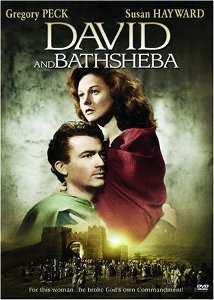
What I am excited by is the release of David and Bathsheba (1951) which I've never actually seen. It's one of the Films that Babington and Evans discuss at length in "Biblical Epics", plus it stars Gregory Peck who is one of my favourite actors. (Just the other night my wife and I were watching him in Big Country (1958) which is the film, linking these two DVDs as it also stars Charlton Heston). From a timing point of view having recently watched one of the earliest David films, I'm keen to see what one of the most famous is actually like.

Matt

By the way, the review of Jesus will either appear later today, or more likely on Monday.