 I've just been watching the latest Weetabix ad (starring Michael Gambon I think) on YouTube. As ever with YouTube there are relevant recommendations down the side, and as you'd expect there were several others, including an Errol Flynn-esque Robin Hood one. Then I noticed there was also a Samson and Delilah one featuring a cover of Tom Jones' song for good measure. As you can probably tell from the above screen shot, the quality is not great, but it's enough to get the idea.
Showing posts with label Samson. Show all posts
Showing posts with label Samson. Show all posts
Friday, November 6, 2009
Samson, Delilah and Weetabix
I've just been watching the latest Weetabix ad (starring Michael Gambon I think) on YouTube. As ever with YouTube there are relevant recommendations down the side, and as you'd expect there were several others, including an Errol Flynn-esque Robin Hood one. Then I noticed there was also a Samson and Delilah one featuring a cover of Tom Jones' song for good measure. As you can probably tell from the above screen shot, the quality is not great, but it's enough to get the idea.

Friday, July 24, 2009
Samson et Dalila
.jpg) Ferdinand Zecca, Pathé, France, 1902, 3 mins.
Ferdinand Zecca, Pathé, France, 1902, 3 mins.The earliest film of those shown at the Ancient World in Cinema event was Samson et Dalila (Samson and Delilah) from 1902. Strangely it was also one of the few shown on the day for which I've been able to find any sort of production image.
Given its age, it's no surprise that this is also one of the shortest of the films shown. Indeed the film starts when the story of Samson is almost over. Delilah has already extracted Samson's secret from him; all that now remains is for her to out it to the test. Putting aside from the other incidents in Samson's life, and looking solely at the Samson and Delilah story, it seems to me that the dramatic interest in the tale is about the conflict between the two, which climaxes when Samson finally reveals his secret. So it's strange that this film begins its version of events immediately after this point.
Samson isn't really shaved here, in fact when he awakes he still has rather more hair and beard than is typical today, but I guess something more convincing may have been more difficult to pull off at such an early stage in proceedings (though an "O Brother Where Art Thou-type beard-on-a-string would probably have bee acceptable in 1902.
There follows Samson's arrest and imprisonment tied to a millstone, but it's the temple scene that's really interesting. Firstly because Samson's appearance is preceeded by a troupe of dancing girls giving a fairly lengthy performance. Given the very short total running time of the film, this sequence takes a very large proportion of it. One wonders how this came to be. Of course, what's interesting is that such deviations would become a staple part of the biblical epic genre. You don't have to think for too long before numerous descendants of this sequence - scantily clad girls dancing for the benefit of the viewer, if not the plot - spring easily to mind. And introducing non-biblical episodes into the story, sometimes at the expense of great chunks of a film's runtime, has gone on to become the norm, rather than an exception as it was in the time of these films.
The downside of this portracted sequence, at least from the point of view the story is meant to be understood from, is that it gives us a degree of sympathy for the girls whose performance is rewarded by being crushed by not-particularly heavy looking cinema stand-in stones. That contrasts with Samson who we've had little time to get acquainted with. The moments we do have do this quite well - his despair at finding his hair cut, the forlorn figure operating the mill and his thoughts (And prayers) moments before brining the roof down on the Philistine temple.
The biggest surprise, however, is Samson's ascent to Heaven, portrayed in a style very familiar to those conversant with Zecca's The Life and Passion of Jesus Christ. Given that that film was compiled over a number of years, it's hard to know which scene came first. There are plenty of other Pathé trademarks as well, such as the hand coloured film and the distinctive cotuming.
The film is the first to be mentioned in "The Bible on Film" (as the Old Testament section comes before the New). Campbell and Pitts have this to say:
SAMSON AND DELILAHThere's a slight discrepancy in the film's stated length which is somewhere between Campbell and Pitts's 15 minues and the BFI's 3. The BFI archive has little more to say although they may be behind this synopsis on the UCL website:
1903, France, Pathé, 15 minutes B/W
Director: Ferdinand Zecca
Perhaps the first film version of the story of mighty Samson, from the Book of Judges, whose physical strength could not keep him from falling under the spell of the beautiful, but evil, Delilah.
Delilah cuts off Samson's locks. Bereft of his strength, he turns a millstone in prison. Brought back, the shackled Samson tears away the pillars of the temple where he has been publicly humiliated, causing it to crash down in pieces. Samson's triumphant spirit, accompanied by angels, rises out of the ruins.And there's also an entry (in French) from the Pathé database.
Wednesday, May 13, 2009
Weiss to Play Lamarr Playing Delilah?
 Peter Chattaway is wondering whether Rachel Weiss will indirectly play Delilah given The Hollywood Reporter's story that Weiss has taken the leading part in a Hedy Lamarr biopic. Lamarr's most famous role was, of course, as the titular honey-trapping Philistine in DeMille's 1949 Samson and Delilah. Peter asks "Will the new film depict the making of DeMille's film in any way, shape or form?". I would have to guess "yes", but would be surprised if it showed any actual footage.
The film, with the working title Face Value will be directed by Amy Redford, daughter of Hollywood legend Robert.
Wednesday, January 28, 2009
First Kings now Samson
 With the release of NBC's Kings just weeks away, the show's director Francis Lawrence (I am Legend) has signed up for another futuristic Bible adaptation. Variety is claiming that Lawrence has signed up with Warner Bros. to make Samson "a futuristic retelling of the Samson and Delilah story." Scott Silver (8 mile) will be writing the script with Erwin Stoff producing. Thanks to Peter Chattaway for this one.
Oh and Kings will now première on Sunday, March 15, at 8 pm, not Thursday March 19th as previously stated.
Sunday, November 9, 2008
Samson and Delilah and Sunset Boulevard
 I've been meaning to post this for weeks and weeks, but for some reason I've failed to, delaying other plans elsewhere. Anyway, perhaps as long as two months ago now, I had my first viewing of Sunset Boulevard. It was one of those films I'd been meaning to see for ages, and as I was reading Robert S. Birchard's "Cecil B. DeMille's Hollywood" it seemed a particularly good time.
Unsurprisingly, the scene which most caught my attention was the one where Norma Desmond (played with relish by Gloria Swanson) goes to the Paramount Studio to meet her former director Cecil B. DeMille. For those not in the know, DeMille plays himself and it's interesting to see how closely his brief cameo coincides with the portrait of him in Birchard's book. Birchard repeatedly cites examples of DeMille's faithfulness to, and his care for, his former stars. Here he has a difficult case to deal with; one of his former, silent, leading ladies is deluding herself that she can make a comeback and has sent DeMille her own script. Meanwhile, one of DeMille's team has contacted Norma to try and borrow her vintage car for another film. Misinterpreting a call from DeMille's office as a sign of his interest in her script she rushes to Paramount to meet with him. There she is treated like the star she once was (see picture below), not least by another DeMille old timer who lets her experience life in the spotlight for one final brief moment. DeMille's sensitivity and care is apparent throughout, and whilst we should not forget that hie words are both scripted and directed, it also seems to come very easily to someone who only stepped in front of the cameras to act on a handful of occasions.
 The other thing that grabbed my attention was the fact that this scene appears to take place on the set of Samson and Delilah. I don't know much about this kind of stuff, but I would guess that this is the real set of Samson and Delilah. Firstly, Henry Wilcoxon (above) is filmed, but is not given any dialogue. Wilcoxon played a leading role in Samson and Delilah, but was also DeMille's associate producer . His presence would be easily explained if the Sunset Boulevard crew came onto the Samson and Delilah set, but it's unlikely that they would pay a star such as Wilcoxon just to be an extra.
Secondly, the scene in question is being filmed on a studio sound stage as most of Samson and Delilah was. Would the makers of Sunset Boulevard really build a set that was identical to one that already existed? I suppose there is the possibility that the existing set didn't give the the right angles for the pulled back shots they required, but it still seems like the most probable answer?
One final point, it took me a little while to figure out the chronology. After all Sunset Boulevard is set in, what was then, the modern day, so audiences assume that it's 1950. But Samson and Delilah was actually released the year before in 1949 suggesting that Boulevard actually takes place 1948-1949. I can't remember if there is any other evidence in the film that suggests a more specific date.
Monday, September 22, 2008
Bible Films that Never Were
 Cecil B. DeMille's name will forever be associated with the biblical epic even though he only ever made three and a half films based on the Bible - his two versions of The Ten Commandments (19231 and 1956), his Jesus film The King of Kings and 1949's Samson and Delilah. Indeed, given that Samson and the second Ten Commandments were two of the last three movies he ever made , it's a reputation he might never have earned at all. True, there were a number of other ancient epics in his seventy-film canon, but it was those last two films in particular, that cemented his place in the popular imagination as the man that made biblical epics.
However, I've been reading Robert S. Birchard's "Cecil B. DeMille's Hollywood" recently, and one of the appendices lists the veteran director's unrealised projects. Given the vast number of movies he made, it's surprising that there are only twelve sucfilms, but it's interesting that four of them are Bible films.
The first of these is The Deluge which I discussed last year. DeMille was considering making the film in the late 20s, but when it became apparent that Michael Curtiz was already making Noah's Ark he switched his attention to The King of Kings instead. Aspiring filmmakers considering adapting the story of Noah take note.
The second film on Birchard's list was Esther (or The Story of Esther) and he notes that MacKinlay Cantour was working on this in the summer of 19342. Birchard doesn't say anymore, but given that this was the same year that DeMille directed Cleopatra, my guess is that he ultimately decided he could only handle one heroine-driven ancient epic at a time.
There's a good deal more information on Queen of Queens, DeMille's planned story of Jesus's mother, (though it's hard to believe that such a title would ever have been taken seriously).
Jeannie Macpherson worked on the script from November 20, 1939 to July 27, 1940. William C. DeMille also worked on the script from March 4, 1940 to June 7, 1941, and William Cowan wrote on the project from September 3 to October 9, 1940. Queen of Queens met some resistance from the Catholic Church , and the film was never scheduled for production.3Lastly, Birchard tell us that Macpherson also started work on a script for the story of King David, Thou Art the Man.4 This was six years before David and Bathsheba reached the screen with its take on David's adultery, so it seems unlikely that once again DeMille had been put off by a similar project at another studio. Perhaps, given his long-standing desire to bring Samson's story to the screen he decided to focus on that instead.
Aside from the list of DeMille's films-that-never-were, I was also interested to read that Steve Reeves and Cary Grant had both been considered for the leading role in Samson and Delilah. Reeves is not in the least surprising, given that he went on to play Hercules and Goliath, but it's incredible to think that any kind of consideration was ever given to Grant. Of course, the whole point of the Samson and Delilah story is that the source of Samson's strength isn't obvious. So it wouldn't have been inconceivable for Grant to play him, but when you look at the final film, and it's emphasis on, and love for, Mature's oiled torso, it's hard to imagine Grant in that same role.
====
On a not unrelated note, Eric David of Christianity Today has written a short piece on French director Robert Bresson which claims that he was initially approached to direct Dino de Laurentiis' The Bible: In The Beginning.
In the mid 1960s, Dino de Laurentiis planned a series of films based on the Bible, featuring top directors of the day, including Huston, Visconti, Welles and Fellini. When Bresson, slated to direct Genesis, told de Laurentiis that he planned to film it in Hebrew and Aramaic, and wouldn't show any animals on Noah's Ark, only their footprints in the sand, he was fired. Huston took over and The Bible: In The Beginning, was released, but did not perform well enough to justify the other directors helming their respective films. Bresson yearned to film Genesis the rest of his life, but it never came to pass.That would certainly have made for a very different film, but given that Bresson instead went on to direct his masterful Christ-figure film Au hasard Balthazar that same year, and that Huston's version has so much to commend it, it may well have all been for the best.
Sunday, October 28, 2007
Online Trailer and Reviews for van Eijk's Samson and Delilah
 There's a trailer online for Corina van Eijk's Samson and Delilah which has now been and gone at the VIFF. It looks fantastic, if odd. I've also found a handful of short reviews.
 Ron Reed has replaced his original post about the film with his review, which includes the following paragraph:
This radical reinterpretation of the celebrated Saint-Saëns' opera is a splendid example of cinema offering many things that the stage cannot. Ingenious ideas abound, from the political sparks of the contemporary setting to the sensational use of the simplest of décor to the very entertaining use the singers make of the freedom cinema allows for facial expression.
 Sandra Peredo has also reviewed it for Intermedias.
Opera Spanga director Corina Van Eijk’s take on Camille Saint-Saens’ 19th century opera Samson and Delilah is replete with bizarre meanderings. Love her style or resent it, Saint-Saens’ music is still gorgeous.Lastly, there's a capsule review on the film from Matthew Englander which I'll quote in full. He hated it, giving it only 1 out of 10.
The French-language opera adapted for film with some kind of modern middle-east setting. Boring and cartoonish, I almost walked out several times and I wish I had. Shot in digital video, the movie looked terrible; perhaps just the way it was projected but all the reds and blues were garishly ugly. The music was loud and unpleasant and never let up. The singing voice of Klara Uleman, playing Delilah, was particularly grating.I had also quoted a bit of blurb on the film from the VIFF organisers and it turns out that that was part of a longer write up which is now available on the VIFF website.
Thursday, September 20, 2007
The Book of Judges and Pulp Fiction
 First off, let me start by saying that I realise this is a bit tenuous, but sometimes idle speculation can be a lot of fun and not entirely worthless so I though I'd post this anyway.
 I'm currently running a course called Through the Bible in Five and a Half Years, and this month we're looking at the book of Judges. It's about eleven years since I did some detailed study on the book, but one of the things I remembered thinking all that time ago was how Judges was the Pulp Fiction of the Bible.
It's no doubt partly down to the fact that I first watched Pulp Fiction at around the same time, and partly down to the fact that there I was encountering various literary features of the book which I'd not really come across before. Anyway, as part of my preparation for Monday's session I thought I'd re-watch it, particular as I've not seen it since that initial viewing.
The comparison with Judges is certainly interesting. There's not been a film made about the book as a whole, at least not as far as I'm aware. Furthermore, despite a number of interesting, colourful, narratives only two characters have been represented in film at all. The first is Gideon who has only featured in two obscure films - Great Leaders of the Bible: Gideon (1965/6), and Gideon: The Liberator (1958). The other is, of course Samson. About a year ago I listed at least 49 films about the legendary strongman, and the recent appearance of Corina van Eijk's Samson and Delilah nudges that tally up to 50 (making his the second most filmed biblical story after Jesus).
 The two things that first led me to connect Judges and Pulp Fiction were the violence in each story and the non-linear chronology. At first citing "violence" appears somewhat superficial - after all much of the Old Testament is horrifically violent. Yet Judges particularly seems to revel in the violence, and at times use it for humour, and the same could be said of Pulp Fiction. The most pertinent example from Judges is when Ehud's sword is swallowed up by Eglon's fat belly. The narrator seems to wallow in this detail and delight in spelling it out. It's worth pointing out that Ehud is effectively a hit man. The same could point could be made about Samson (although from the perspective of the Philistines his final act is perhaps a suicidal act of terrorism). Pulp Fiction was Quentin Tarantino's second film, and the violence was much commented on at the time. Indeed Tarantino's first film Reservoir Dogs was initially banned from video release due to it's violent imagery.
The second point is the non-linear narrative style that both writers adopt. At the time of the film's release this was one of the film's two major talking points (the other being the snappy dialogue). The film ends with the same scene it started with, albeit from a different perspective. Furthermore rather than the film consisting of one main story split into many different scenes, this is more of a collection of stories woven into a broader narrative. In between the opening and closing stories various other stories are told which, chronologically speaking, are from both before and after it. Whilst there is no one-reason why Tarantino adopted this approach, Roger Ebert noted how "if you told the story in chronological order that would get monotonous, this way the audience stays on its toes".1 Certainly the tension that emerges in that final scene would have been greatly dissipated. Re-arranging the chronology of the individual parts of the story allows the film to draw different themes to the fore.
 In the same way, Judges consists of a collection of individual stories sewn together to form a broader narrative. Indeed it's noticeable that whereas these various stories generally only concern a tribe or two at a time, the redactor uses them to comment on what was happening in the whole of Israel at that moment in time. Now whilst a minority of scholars would still claim that the historical data presented in Judges is accurate, the vast majority, including many conservative scholars, consider the chronology to have been highly stylised in order to give the overall story greater impact. Judges contains a prologue and epilogue that are often held to be later additions to the text, and these are generally set aside when looking at the core of the book's literary structure.
Both works have a kind of symmetry with their opening and closing stories both reflecting one another, but also being notably different. In Pulp Fiction we see the same scene, but from a different perspective. In Judges the differences are more significant that the similarities, but we effectively see Ehud paired off with Samson. As noted above, both are lone hit men whose actions are so strategic that they turn the course of the conflict decisively in Israel's favour. Whilst the similarities in Judges are weaker, this chiastic pairing is continued as we move towards the core of the book. Deborah and Jephthah are both social outcasts who Israel calls in during a desperate period to lead them to great victory. Both victories require the one of the heroes to break a part of their respective social codes. Whilst Jael's disregard for hospitality seems, to us, trivial compared with Jephthah breaking the laws against child sacrifice, the two taboos would have been far closer in the minds of those at the time. The final pairing is Gideon and Abimelech who are almost opposite in terms of their character and their faithfulness to God - and it's this contrast between faithfulness and unfaithfulness, and the impact of each, that is the book's major concern.
By contrast, Pulp Fiction uses it's non-linear chronology to shield the film's major theme from the viewer until the end. When the sequence of events is unjumbled it becomes apparent that both Jules and Vincent both witnessed the same "miracle", but responded to it in very different ways. Jules realises that he has to leave his life as a hit man behind him. Vincent carries on as before and is shot by Butch shortly afterwards. In fact "every one of the major sequences in Pulp Fiction ends with a character being saved".2 Mia is saved from her drug overdose, Butch is saved from a life on the run. Pumpkin and Honeybunny are saved from the new style life of crime they were about to embark on, and Jules is saved from his life as a hitman.
 This leads to a further similarity then: both works are deeply moral calling their protagonists to leave behind them horrifically sinful lives and be righteous. Samuel L Jackson, who plays Jules in the movie claims that "the story is totally about redemption. Everyone in the script who's life is spared is given another chance to do something with their lives".3 In this way it actually differs from Judges. Pulp Fiction's moral cycle works it's way up. It's greatest act of salvation occurs at the end of the movie. By contrast, Judges portrays a downward spiral where the morality of the characters descends with each new segment.
It's easy to be so disturbed by the degradation that is on display in Pulp Fiction that this theme is missed, and not dissimilarly its surprisingly how many of those reading Judges fail feel to feel the heaviness with which the author regards his countrymen's apostasy. Actually both find characters pulling their way to bloody salvation - both spiritually and in terms of their physical security, and the end to the threats under which they had previously been held.
I'm sure I had a few more observations, but they all escape me for the time being. I'll post up any that come back to me.
1 - Roger Ebert on "Siskel and Ebert - At the Movies: Pulp Faction"
2 - Roger Ebert on "Siskel and Ebert - At the Movies: Pulp Faction"
3 - Roger Ebert on "Siskel and Ebert - At the Movies: Pulp Faction"
Thursday, September 6, 2007
Van Eijk's Samson and Delilah to play at VIFF
 According to Ron Reed the Vancouver International Film Festival will feature Corina van Eijk's Samson and Delilah - a film based on Camille Saint-Saëns's opera. There's nothing about the film on the VIFF site yet, and most of the sites from my Google search are Dutch (as van Eijk is). Babel Fish helps, but there's still not really much to go on.
 However, Ron did manage to find the following blurb on the film:
Director Corina van Eijk's reworking of the celebrated Saint-Saens' opera is a splendid example of cinema offering the many things that the stage cannot. Ingenious ideas about at every turn, from the sparks of the contemporary setting to the acting of Klara Uleman as the temptress who tricks the strong man into a haircut.There's also this from Symphony Space which relates to van Eijk's stage version:
Hailed by Opera News as "witty, elegant and bold," Nine Circles explores the interplay of words and music blending chamber music and theatre. This unique production, in association with De Muselaer Netherlands, introduces the brash and brilliant Dutch director Corina van Eijk to American audiences in a one-hour reconception of Saint-Saens’ opera for Dutch soprano Klara Uleman singing Delilah and Nine Circles Co-Artistic Director Gil Morgenstern on violin, "singing" Samson.
 Finally, a couple of bits from Babel fished reviews. Firstly, Parool, suggests that the story is set in the Middle East featuring "a white desert, shutted down cars, pivot wire, army uniforms, guns and a stylised version". Secondly the IMDb links to a review by Rob Veerman:
The opera Samson and Delilah of...Camille Saint Saëns has been based on theOld Testament tale of the fight of the Israelites against the Philistines. The Philistines are the oppressors, but the people of Israel fight back and have an important trump card in the person of Samson. He has God given strength which makes him invincible, until he falls for the charms of verleidelijke (seductive?) but false Delilah. "in war he is relentless, but he is a slave in my poor," she sings triumphantly. If she succeeds in diddling him of his strength, it seems Samson will be irrevocably lost.
Thursday, September 28, 2006
Samson and Delilah (1984) (TV)
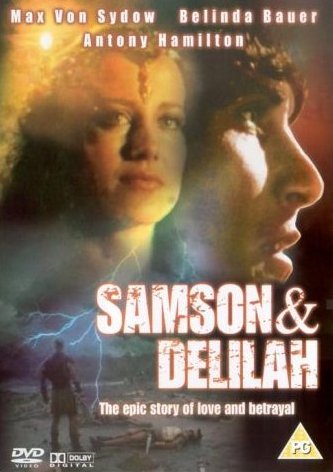 After one of my more studious posts yesterday, I thought it was probably time to lighten things up. Having written about the two most well known Samson films in the last few weeks (the 1996 version, and the 1949 version), and listed all the Samson films I'm aware of, I thought I would briefly post a few comments on what is probably the next most watched version (at least by today's audiences).
One strange fact about this film is that it forms a link between those two films other than the shared title and subject matter. Victor Mature, who played Samson in DeMille's 1949 version makes a cameo in the film, and it also stars Max von Sydow who would go on to narrate the 1996 version (albeit uncredited).
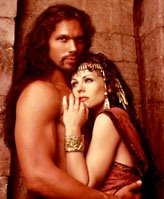
As the DVD cover above might suggest, this is a particularly lame version of the story. It's primary purpose could even be to show as much of Samson and Delilah's flesh as possible. Whilst there are decent supporting performances from von Sydow and Jose Ferrer the rest of it is pretty terrible. How Antony Hamilton (who played Samson) ever got close to getting the role of James Bond is a total mystery (thankfully, he was pipped by Timothy Dalton). Hamilton isn't helped by Samson's legendary "long hair" being reduced to a wonderful 80's mullet. Actually the mullet (which perhaps should have also received a billing) does raise a few theological points regarding the film. Firstly, most people probably don't realise that the nazarite vow was actually to keep it short on the top and the sides and just leave the back uncut. That must have been something they discovered amongst the Dead Sea Scrolls or something ;-) Secondly, when Delilah finally, and thankfully, applies the scissors, she simply does what any
self-respecting woman would do given half the chance, and gives him a short back and sides. For what it's worth, none of these three films show Samson with a shaved head, which seems fairly strange.
 Another strange choice, present in all three films but that seems to run against the bible is the design of Dagon's temple. In all three films these are open roofed, meaning no matter how much Samson pushes, it is hard to see how he could really claim quite so many lives. That said presumably this choice owes either something to Archaeological finds which suggests that roofs on this scale had not yet been developed, or it is an example of the DeMille film's pervassiveness that the other two films copy these details, possible without even realising.
Another unusual choice which, in this case, is particular to this film is that Samson is never shown lying to Delilah about the secret of his strength, so she just catches him first time. In some ways this seems a more plausible scenario. How stupid would you have to be to actually tell your secret to someone who has already tried, three time, to zap you of your strength and hand you over to your enemies? That said, Samson does come across as the least wise character in the bible (which is up against some pretty significant competition) so it's perhaps not too surprising.
So, all in all, this is not one to rush out to get hold of. There are numerous other Samson films which I have not seen but which are available from Amazon. Feel free to post any comments you have on any of them on the "Films About Samson" post.
Friday, September 22, 2006
Films about Samson
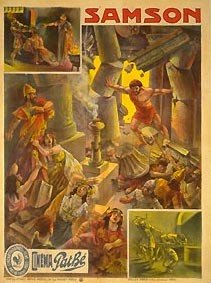 Having discussed DeMille's Samson and Delilah (1949), and the version by the Bible Collection recently, I thought I would round up a list of all the films about Samson I could find info for. There were A LOT more than I had bargained for! My main three sources for this was the Internet Movie Database, Campbell and Pitts's "The Bible on Film", and Tyler Williams's online The Old Testament on Film list. Campbell and Pitts's book was published in 1980 and thus pre-dates the internet. It lists only 9 films, the first seven of which are from the silent era. The IMDB lists a good deal more, but many of these have nothing to do with the biblical Samson. Tyler's list includes 20 films which should all be pretty reliable. By combining these three lists there are 49 films which have some relation to the biblical Samson:
(1903) Samson et Dalila
(1908) Samson
(1908) Samson
(1908) Samson moderne
(1911) Samson and Delilah
(1914) Samson
(1914) Samson [and Delilah]
(1915) Samson
(1918) Sansone contro i Filistei
(1919) Samson
(1920) Sansone e i rettili umani
(1922) Samson and Delilah
(1922) Samson und Delila
(1927) Samson and Delilah
(1927) Samson at Calford
(1936) Samson
(1948) Samsun el kabir [The Mighty Samson]
(1949) Samson and Delilah
(1960) Maciste nella valle dei re [Son of Samson]
(1961) Sansone [Samson contre Hercule]
(1961) Samson and the Seven Miracles of the World
(1962) El Santo contras las mujeres vampiro, [Samson vs. the Vampire Women]
(1962) Furia di Ercole, La [Fury of Samson]
(1962) Maciste contro lo sceicco [Samson Against the Sheik]
(1963) Santo en el museo de cera [Samson in the Wax Museum]
(1963) Ercole sfida Sansone [Hercules, Samson & Ulysses]
(1963) Samson and the Slave Queen
(1963) Sansone contro i pirati [Samson Against the Pirates]
(1964) Samson
(1964) Ercole, Sansone, Maciste e Ursus gli invincibili [Samson and the Mighty Challenge]
(1964) Maciste alla corte dello zar [Samson vs. the Giant King]
(1964) Sansone e il tesoro degli Incas
(1964) Maciste nelle miniere di re Salomone [Samson in King Solomon's Mines]
(1966) I Grandi condottieri [Great Leaders of the Bible-Gideon and Samson]
(1967) Samson & Goliath
(1975) Stevie, Samson and Delilah
(1981) Samson et Dalila
(1981) Samson et Dalila
(1984) Samson and Delilah
(1985) Samson and Delilah
(1985) Samson & Delilah
(1987) Samson dan Delilah
(1988) Melech Hasalim [Magic Samson]
(1990) Samson & Goliath
(1991) Aaj Ka Samson
(1995) Samson le magnifique
(1996) Samson and Delilah
(1999) Samson & Delilah
(2002) Samson et Dalila
 It is immediately obvious that whilst some of these films include the name Samson in their title, very little of the biblical character is retained except his super-strength. Titles such as Samson vs. the Giant King, Samson and the Seven Miracles of the World and my personal favourites Samson vs. the Vampire Women and the intriguingly titled Samson in the Wax Museum clearly have very little to do with the Book of Judges. There are at least 14 such films out of this 49. But that still leaves an incredible 35 films about Samson. Some of these maybe shorts or cartoons, and some of them may not have anything to do with the biblical Samson, such as Andrzej Wajda's 1961 film Samson which I removed from the list. Even so, with the obvious exception of Jesus, I can think of no other character from the bible who has appeared in more films than this.
Friday, September 15, 2006
Samson and Delilah (1949) Scene Guide
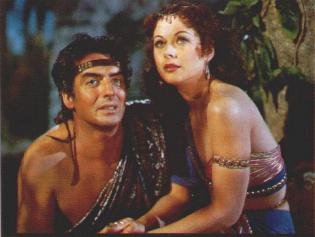 Having covered the Bible Collection of Samson and Delilah yesterday, I thought it would be good to look at the scenes for DeMille's famous 1949 version of the story. This was a highly influential film. After the Hays Production Code had killed off the biblical epic in the early 1930s, this film kick-started the epic film revival that was so prevalent in the 50s and early 60s.
[Introduction]A Few Notes
[Story of Moses recounted]
[Extra-biblical Episode]
Girl from Timnah (Judges 14:1-5)
Samson kills a lion (Judges 14:5-7)
A Wedding Riddle (Judges 14:10-18)
Samson Pays his Guests (Judges 14:19)
Death of Wife and Family (Judges 14:20; 15:6-7)
Burning of Fields (Judges 15:1-5)
[Extra-biblical Episode]
Samson's People Betray Him (Judges 15:9-11)
Jawbone of an Ass (Judges 15:14-17)
[Extra-biblical Episode]
Delilah agrees to trap Samson - (Judges 16:5) (Judges 16:5)
Samson falls for Delilah - (Judges 16:4) (Judges 16:4)
Samson tricks Delilah - (Judges 16:6-12) (Judges 16:6-12)
Delilah betrays Samson - (Judges 16:15-22) (Judges 16:15-22)
[Extra-biblical Episodes]
Death of Samson - (Judges 16:23-30) (Judges 16:23-30)
[Extra-biblical Episode] (Judges 16:31)
 As noted yesterday, DeMille omits chapter 13 of Judges - the angelic visitations announcing Samson's birth. There are a number of interesting points here. Firstly, in DeMille's next and final biblical epic, The Ten Commandments he is at pains to draw as many parallels as possible between his protagonist and Jesus, adding all sorts of flourished, and changing minor details (such as the manner of death of the Israelite infants in Exodus 1:22). Yet here he spurns the most obvious connection between Samson and Jesus. Secondly, DeMille replaces this opening with a more universal introduction, voiced over the image of the earth seen from afar. This demonstrates his intention to give the picture universal resonances. A similar technique is also applied that the start of The Ten Commandments
The other incident missing from this portrayal is that of the prostitute of Gaza, and Samson carrying the gates to Hebron. This puts Samson in a more positive light, he is naive and a little weak, rather than someone who is driven by lust.
 Both the 1996 version and this one have Delilah choose to betray Samson before he has fallen in love with her, whereas the text shows that she is only approached after her and Samson has fallen in love. This has two implications. Firstly, it makes Delilah appear as a calculating, manipulative, sexual predator (women in bible epics tend to fall into one of two categories pious or whore). DeMille's casting of Lammarr enhances this. Lamarr carried a certain notoriety after she appeared nude in Extase (1932). Whilst the film was banned in the US, it gave her a particularly type of fame, and using an actress with such connotations brought something to the role that other actresses, such as Angela Lansbury, could not have. Whilst the text does portray Delilah as manipulative, there is nothing to indicate her initial love wasn't genuine. Secondly re-ordering these scenes in this fashion takes away the parallels between Delilah and the girl from Timnah. In both cases Samson unwisely falls for a Philistine girl, who shows her loyalties are with her people rather than her lover. However, this then leads to Samson being able to rout the Philistines. Interestingly Demille demolishes this point of comparison, but establishes another - than Semador and Delilah are sisters. Over the years, art has perhaps been a little unfair to Delilah.
One of the interesting additions to the text is the role of the boy Saul, who we find out at the end of the film will be Israel's first King. It's probably the most positive portrayal of Saul on film (in contrast to say that of Orson Welles), but it also creates a link between Samson's weaknesses and that of the man who followed him. Additionally it portrays Samson as a prophet as well as leader. Given that Saul was a Benjaminite, and Samson a Danite there is cause to question whether Samson would even have led Saul's people. At the same time it is not inconceivable that he would have, and is a nice touch.
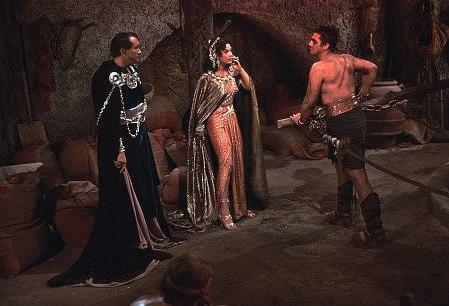 One other contrast with the biblical text is that here Samson burns the Philistine fields because his wife has been killed, whereas in Judges, she, and her father, are killed because Samson burnt the fields after his wife was given to someone else.
 There are a few comments on this film, and portrayals of Samson through the ages at the Samson and Delilah Home Page
Wednesday, September 13, 2006
Samson and Delilah (1996) Scene Guide
 I recently watched Time Life’s Samson and Delilah from the Bible Collection. Curiously it’s the only film in the series to feature two names (that is unless one counts Creation and Flood. Both films are also the only ones that I’ve seen so far to utilise a narrator). Anyway, I’ll review it in a couple of days, but for now here’s the scene guide with a few comments.
 Part 1Notes
[Extra-biblical episodes]
Birth of Samson Predicted - (Judges 13:1-5)
Birth of Samson - (Judges 13:24)
[Extra-biblical episodes]
Samson Kills a lion - (Judges 14:5-6)
[Extra-biblical episodes]
Jawbone of an Ass - (Judges 15:9-17)
[Extra-biblical episodes]
Honey from the Lion - (Judges 14:8-9)
[Extra-biblical episodes]
The Girl from Timnah - (Judges 14:1-19)
Burning if the fields & death of Samson’s Wife & Family - (Judges 15:3-6)
Part 2
[Extra-biblical episodes]
Prostitute of Gaza - (Judges 16:1-3)
Delilah agrees to trap Samson - (Judges 16:5)
Samson falls for Delilah - (Judges 16:4)
Samson tricks Delilah - (Judges 16:6-12)
Delilah betrays Samson - (Judges 16:15-22)
[Extra-biblical episodes]
Death of Samson - (Judges 16:23-30)
Burial of Samson - (Judges 16:31)
 Given that this film shares its name with the famous DeMille film, it is worth asking whther this film is a remake of that film, or simply another, separate, re-telling which just happens to share that title. The evidence is not entirely straightforward. On the one hand, this version of the story contains almost all of the biblical material pertaining to Samson, whereas DeMillee's film omits the events leading up to his birth. It also presents some episodes out of order. That said there are a number of other similarities:
* Both have an Israelite girl who loves Samson but who is too pious, faithful and dull for Samson to love back.So it would appear that this isn't really a remake - given the sparse amount of material available on Samson, the storylines are very different, as is the role of Delilah. But the infuence of DeMille's film on this one is undeniable
* Both Israelite girls have a younger brother who idolises Samson and is to some extent his side kick
* Both have Samson kill the lion in front of Delilah
* Both show that lion-killing out of context
* The actresses playing Delilah both bring with them a certain reputation which enhances her role
* Neither film shows Samson using foxes to burn the Philistine fields
 As noted above, almost all of the biblical material is included in this film. The most notable exception is Manoah’s reaction to his wife’s visitation. The omission of this episode actually emphasises the similarities between the birth of Samson and the birth of Jesus, which is further highlighted by references to Samson as "Saviour of Israel".
There are however, a number of small differences. One notable example is the burning of the Philistine fields following Samson’s aborted wedding. In the text Samson, bizarrely, catches 300 foxes ties them in pairs fastening a torch to each pair and releasing them in the fields. The film ignores this complicated detail, (which would have been difficult to get past the animal cruelty advisors anyway!), and simply has Samson burn the fields himself. This seems a more likely act of passionate vengeance, although the strangeness of the episode itself is perhaps the strongest evidence of its historicity. As a side note I found myself hearing Dan Brown’s voice in my head as I watched this scene, "X wondered how many Christians knew that the Firefox web browser got its name from this story"...
Subscribe to:
Posts (Atom)