I recently re-watched parts of Julian Duvivier's Golgotha and was really struck again by what an impressive film this is visually (see my earlier review of this film). So I thought I'd discuss a couple of the shots in particular, as some of them are more than worthy of note. The picture quality on these isn't brilliant, mainly as I only have a DVD archived copy of this film from VHS, but hopefully they are sufficient to give you the idea. Click on images to enlarge them (as ever).
This first shot is the crucifixion from the disciples point of view. The crosses are only just distinguishable on the horizon, as the camera focuses its attention on the disciples who stick together even though they have deserted their master. There's also significance to their location high up and just outside the city's boundary. They may have deserted Jesus (temporarily), but they have left Jerusalem and that which is related to it.
 One of the most striking scenes in the film is the trial scene in front of a huge crowd. Whilst this scene is arguably problematic from an anti-Semitism point of view, the film's latter association of the Romans with the pre-WWII Nazis (see my review for details) is a significant mitigating factor. There are two particular highlights. The first is this shot of Jesus foregrounded with Pilate washing his hands. The water temporarily obscures our view of Jesus, and there are various association that could be made with this imagery - it implicates us in the action, as well as evoking ideas of cleansing and approach to Jesus through the waters of baptism.
The second shot is the one that ends the scene. Having filmed the action in close up on the stage, the camera reverse swoops back across the crowd - implicating them visually in the scene that has just unfolded. Given that this film was made in 1935, the technical prowess required for such a shot is breathtaking.
 The film also makes very interesting use of point of view shots. Aside from this film, Jesus films tended to avoid taking a shot from Jesus's point of view until the 1970s. Here, however, the road to the cross scene is littered with significant examples of Jesus looking at members of the crowd, the path ahead of him etc. This shot is taken just after he has fallen, and is particularly interesting because of it's low angle, and the dominance of the soldier over Jesus that it suggests.
Another interesting point of view shot occurs on the Emmaus Road at the end of the film. Jesus's approach to the two walking along the road has been shown with varying degrees of success in Jesus films, mainly revolving around the question of where exactly did Jesus come from. Here the issue is circumvented by showing the shadows of the two people on the road, and the gradual approach of a third shadow - that of Jesus.
 The final point of view shot I'd like to discuss is this one taken of the temple as the curtain is torn in two. Here it's not Jesus's point of view that the camera adopts, but that of his father. It's a high angle God-shot, which then cuts to the despair felt by the priests that are present. At least one of them interprets it as a sign of God's judgement, but again this scene gives a somewhat sympathetic portrayal of the Jewish faith.
In addition to this film being the first to included shots from Jesus's point of view, it also appears to be the first to show the nails being hammered through Jesus's wrists rather than his hands. Today this is the more popular approach, particularly since it has been supported by archaeological evidence, but then it's a startling case of going against the text (e.g. John 20:24-27). That said, I think that the case for the nails through the wrists rather than the hands is based on more than that particular archaeological discovery since that was the discovery of an ankle bone rather than a wrist. If memory serves it is more linked to the hands inability to support the body's weight sufficiently.
 Finally, I couldn't help but note the similarity between this shot of Judas hanging himself and that from DeMille's 1927 film The King of Kings. This could of course be due to both directors paying tribute to an earlier painted work (DeMille was particularly keen on this), but I've not been able to find one that this shot mirrors as closely as it mirrors DeMille, so I suspect this is something of a nod to DeMille's film.
If so, it's an interesting choice. These two films are seen very differently by critics today. DeMille is frequently mocked for his excessive, gaudy style, whereas the handful of people who have been lucky enough to see this film usually praise it quite highly. It seems, though, that Duvivier, at least, didn't consider himself to be above DeMille, at least not at this stage in their respective careers. It could, of course, be argued that it was only after The King of Kings that DeMille really moved in that direction.
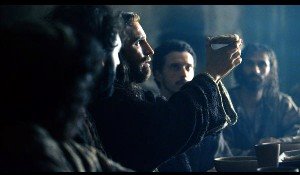
 As an addendum, someone recently contacted me asking how the Last Supper scene was composed. As can hopefully be scene from this screen grab, it's clear that the scene is not meant to reference Da Vinci's famous painting, which is the usual touchstone on this particular moment in the story. I've chosen this shot in particular as it shows Judas outside of the group - shot as if he his hesitating to be certain this is really the decision he wishes to make. It also suggests his exclusion from the party, and hints that this existed prior to his decision to betray his master.