Showing posts with label Jesus (1999). Show all posts

Thursday, September 27, 2007

Podcast: Jesus (1999)


The latest entry in my Jesus film podcast is up, and this month I'm talking about Jesus (1999). That's eleven entries now which means I've been going for a year now (as I didn't do one in December last year. By the way, does anyone know what the podcast equivalent of a blogiversary?).

The other ten talks (Jesus of Nazareth, Il Vangelo Secondo Matteo, The Greatest Story Ever Told, Jesus of Montreal, Jesus Christ Superstar, The Miracle Maker, Il Messia, King of Kings, Last Temptation of Christ and Life and Passion of Jesus Christ are all still available to download.

Friday, April 28, 2006

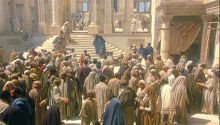
Jesus (1999) - Scene Guide

Having reviewed the Jesus mini series yesterday, I thought I would follow it up as normal with a scene guide. The gospel citations here follow the usual rules. There are actually two different version of this film in circulation. The one I am most familiar with is the International version which concludes with a scene where the modern day Jesus meets some children in Malta (I believe). The US version is the one where Mary recalls Jesus as a child resurrecting a bird, an episode not dissimilar to one from certain versions of the Infancy Gospel of Thomas. There are only a few differences between the two versions, and most of them relate to the incidents not found in scripture. Those changes which do relate to scriptural incidents are minor. Full details of the differences between the two versions can be found at Hollywood Jesus.
Part 1
[Extra-biblical episodes]
Mary and Martha - (Luke 10:38-42)
John the Baptist - (Mark 1:4-8)
Boy Jesus (Luke 2:41-50)
Jesus’ Baptism - (Mark 1:9-11)
Temptation - (Matt 4:1-11)
Andrew & John follow - (John 1:35-40)
Mary tells Joseph she is pregnant - (Matt 1:19-20)
[Extra-Biblical Episode]
Wedding at Cana - (John 2:1-12)
Catch of Fish - (Luke 5:2-11)
[extra-biblical episodes]
Death of John - (Mark 6:17-27)
[Extra-Biblical Episode ]
Woman caught in Adultery - (John 8:2-11)
Clearing the Temple - (Mark 11:15-19)

Part 2
[Extra-Biblical Episode]
Various Teaching
Calling of the 12 - (Mark 3:14-19)
Calming the storm - (Matt 14:22-33)
Canaanite Woman - (Mark 7:24-30)
[Extra-biblical episode]
Lazarus Raised - (John 11:1-44)
Triumphal Entry - (Mark 11:1-11)
[Extra-biblical episode]
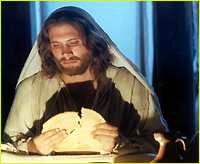
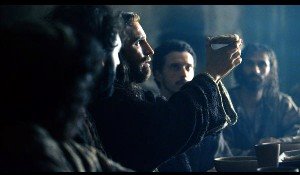
Last Supper - (Mark 14:12-31)
Judas’ Betrayal - (Mark 14:10-11)
Gethsemane - (Mark 14:32-42)
Jesus’s arrest - (Mark 14:43-50)
Peter’s Denial - (Mark 14:66-72))
Sanhedrin Trial - (Mark 14:53-64)
Pilate 1st trial - (Luke 23:1-7)
Before Herod - (Luke 23:8-12)
Pilate 2nd trial - (Luke 23:13-25)
Jesus is Whipped - (Matt 27:26)
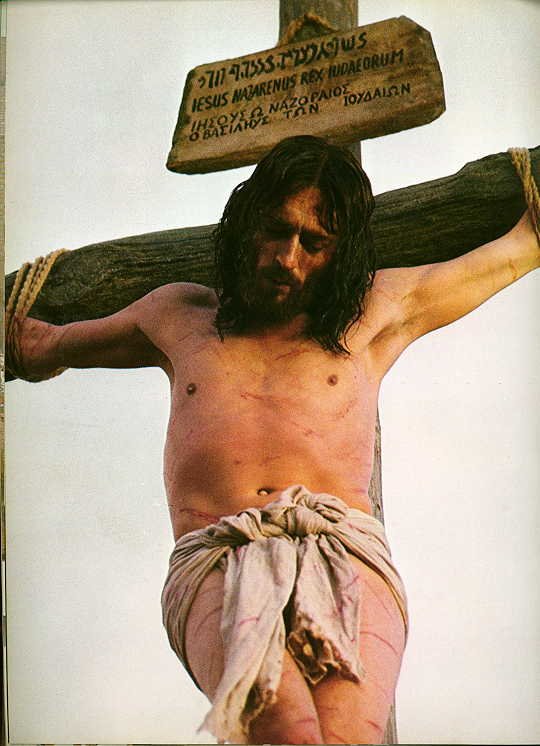
Crucifixion and Death - (Mark 15:22-41)
Judas Hangs himself - (Matt 27:5b)
Burial - (Mark 15:42-47)
Mary M & the Empty Tomb - (John 20:1-2)
Peter & John at Tomb - (John 20:3-10)
Mary M meets Jesus - (John 20:11-16)
Thomas Doubts - (John 20:25)
Appearance to Disciples - (Luke 24:36-40)
[International ending - Extra-Biblical]
A Few Notes

This film is a prime example of the harmonising tradition in Jesus films. Rather than exclusively or primarily following a single gospel it blends all four together. Hence key incidents exclusive to John, such as the wedding at Cana, raising of Lazarus and some of the resurrection stories are included. Whilst this is not uncommon, we also see the script writer Suzette Couture pick and choose the most vivid incidents from each of the synoptic gospels. Hence Luke's version of the call of Simon Peter (where he is only convinced after a miraculous catch of fish) is included in preference to the more mundane version in Matthew and Mark. This is of course only after John the Baptist has dramatically pointed out Jesus to Andrew and John. The interaction with between Jesus and Mary and Martha is only found in Luke's gospel yet included. Similarly only Luke's gospel puts Jesus on trial in front of Herod, and only Matthew has Peter attempt to walk on water and Judas hang himself. As a result of this and my familiarity with the film I've made more effort to locate the exact story where it seems warranted.

It's also noticeable how this film opts neither for the single trip to Jerusalem we find in Mark's gospel (and the other synoptics), nor the threefold trip to Jerusalem unique to John's Gospel. Whilst it is difficult to be precise (and unclear whether this was intentional on the part of the writer) it would appear that both parts of the film start in Galilee, and end in Jerusalem. Hence at the end of part 1, Jesus visits and clears the temple, before returning at the start of part 2 to the Sea of Galilee, to pick his diciples. and meet them across the water.

The other distinctive thing about the screen play is the prominence it gives to women. Many Jesus films have taken a number of different women and boiled them down into one> Usually this is achieved by making Mary Magdalene not only the woman who witnesses Jesus's resurrection but also the woman of sinful life who anoints Jesus, and the woman caught in adultery. Jesus Christ Superstar even portrays her as mothering Jesus as well - in a manner reminiscent of the Virgin Mary.

By contrast this film gives a detailed portrait of a number of many different women around the life of Jesus, being at pains to make them distinct. So, whilst Mary Magdalene is, in keeping with the old western tradition, a reformed prostitute, it is another woman who is caught in adultery. Mary of Bethany is distinct again - shown as the woman Jesus had to leave behind to fulfil his calling. Jesus's mother also has a prominent role, and even Herodias and Salome get an above average quantity of screen time. Furthermore, there is the story of the Syro-Phoenician woman (which appears in no other Jesus film), not to mention Martha. Admittedly, the film excludes the Samaritan women, Jairus's daughter, the haemorrhaging woman, and the crippled woman who was healed on the Sabbath but I imagine screen time was a limiting factor. Nevertheless the prominence of women in this film combined with the way Jesus treats them in particular in this film, make this film particularly appealing to many women.

Finally there is the closing scene in the international version where Jesus appears as a modern man. Interestingly most British viewers I have encountered consider this scene very American, which is ironic since that is one of the few places it was not shown. There is also a difference of opinion as to whether this scene is a plus or a minus. Amongst others, I know that Mark Goodacre considers it a plus point, whereas I would strongly disagree. I'm not sure whether it's the music, or the children that I find grates. Certainly I like the idea of showing Jesus's relevance for today, but this ending just doesn't do it for me.

Thursday, April 27, 2006

Jesus (1999 - mini series)

The most controversial Jesus film of all time, Martin Scorsese's Last Temptation of Christ (1988) opened with the following disclaimer:
This film is not based upon the Gospels but upon this fictional exploration of the eternal spiritual conflict.
Whilst this didn't prevent the protests and objections it was no douby intended to, it did create some space for Scorsese to explore aspects of the life of Jesus which the gospels do not.

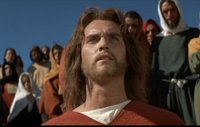
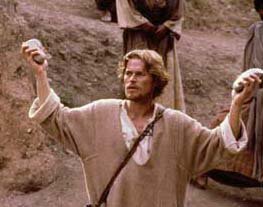
In some ways, then, such a disclaimer wouldn't be out of place at the start of this film. Of course this Jesus mini-series (1999)is neither as theologically dubious or offensive to some as Last Temptation, nor quite as dull as that film is in places. That said, it was certainly not made simply to illustrate the gospels, but to get behind the text of the gospels and try to flesh out their central character. (Of course, essentially art should be exploration of its subject matter, and so no bible film should require such a disclaimer, but that's an issue for another day.)

In order to acheive this Jesus imports a greater proportion of non-biblical episodes into its script than any other Jesus film apart from Last Temptation, and uses the gospel material sparingly. As the film approaches its halfway point, Jesus has only really been baptised, tempted and joined by a few disciples - the events of his birth and childhood are only briefly sketched out in a couple of flashbacks. The second half is not dissimilar. A couple of miracles and a bit of teaching, and the film moves into Holy Week.

Many considered this to be the film's greatest weakness. I would strongly disagree. In contrast to Last Temptation the extra-biblical material this film offers feels like it could reflect what actually happened in the life of the Jesus we find in the gospels. Of course we are not told when Jesus's father died, or if he struggled to find work, or if he ever loved anyone, nor do they tell us how he reacted when he encountered zealots. But, by and large, all of these are certainly possibilities - many of them probablities extraploated from what we know from other historical sources, or from what he said and did that the gospels have recorded.

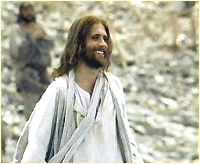
The effect of this is to present a very human Jesus. One of the most powerful scenes in the films comes when Joseph dies, and a cocktail of his grief, aloneness, responsibilities and the cost of him doing God's will cause him to breakdown and weep. This is a Jesus we could relate to, who emptied himself to become fully human.

The other major way the film uses its extra-biblical material is to sketch something of the historical context that surrounded these events. Of course time, and the demands of populist TV allow only a brief impressionistic sketch, rather than a detailed historical portrait, but compared to the lack of historical context surrounding many popular Jesus films, such as The Passion of the Christ, this is a major asset. Perhaps more than any other film this one demonstrates the politics at play, to which Jesus ultimately fell victim. Pilate, (played by Gary Oldman) is undeniably in charge. Caiaphas is shown early on as an heroic figure, risking his neck (quite literally) to preserve vital Jewish religious privileges. Although he still plays a pivotal role in Jesus's death, his actions seem primarily motivated by his desire to quell a potential uprising that history suggests frequently bubbled beneath the surface. Ultimately, Pilate's cunning manipulates Caiaphas in such a way as to leave the high priest taking the blame, while passing himself of as compassionate. It's possibly the most satisfactory visualisation of the almost noble Pilate presented in the records of Jesus's trial and the brutal scheming butcher that history presents us with.

But no Jesus film is perfect - in fact they rely on each other to cover their backs so they can explore certain aspects more thoroughly - and this film is no exception. Perhaps this film's main weakness is that it wants us to like its Jesus too much, and doesn't trust itself as much as it should. Hence, the scenes of him playing around with his disciples, which start out as a breath of fresh air, eventually turn into an unwelcome draught. Whilst it does well at establishing a Jesus we can relate to, and banishing the traditional image of a boring and irrelevant Jesus, it fails to clothe him with any authority, or his actions with much significance.

That said, Jesus remains one of the strongest Jesus films of the last 25 years, and it is pleasing that eventually it has been released on DVD in Britain.

Wednesday, April 12, 2006

Top Ten Jesus Films

Peter T Chattaway has just had his list of Top Ten Jesus Films published by Christianity Today. We chatted a bit about the subject a while back and I've been meaning to post my list for a while. Peter's films are:
The Life and Passion of Jesus Christ (1902-05)
The King of Kings (1927)
The Gospel According to St. Matthew (1964)
The Greatest Story Ever Told (1965)
Godspell (1973)
The Messiah (1976)
Jesus of Nazareth (1977)
Jesus (1999)
The Miracle Maker (2000)
The Passion of the Christ (2004)
Since Peter has now had his list published, and, as this is the last major post before Good Friday I thought it was probably about time I posted mine up as well. We actually agree on 6, although I'd be happy to swap 2 of those 6 for 2 on my list of honourable mentions further below. However, here are my Tope Ten Jesus films in chronological order:

From the Manger to the Cross (1912)
More of a film than The Life and Passion of Jesus Christ, more natural and genuine than DeMille's The King of Kings, This film, for me, stands out as the best Jesus film of the silent era. Controversial in it's day, for its very existence, (not to mention its ommission of the resurrection), Sidney Olcott's film has a quiet dignity about it, which is best captured by turning off the overbearing sountrack which was added later. The film was re-issued with a resurrection scene in 1916 as Jesus of Nazareth, and under that title again in 1932 with sound.

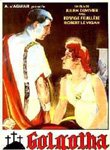
Golgotha (1935)
Golgotha was the first Jesus talkie, and set a high standard for those that were to follow> originally released as Ecce Homo. Julien Duvivier's use of the camera was way ahead of his time and he manages to capture the miraculous events in Jesus's last week as if they were the most natural thing in the world.
My review

King of Kings (1961)
The first Hollywood film about Jesus since the end of the silent era 34 years earlier. King of Kings remains enjoyable even though behind the scenes power stuggles destroyed the films promise. The Sermon on the Mount scene is still wonderful though, even if elsewhere Jesus is squeezed out of the film by the zealots.
My review

Il Vangelo Secondo Matteo (1964 - The Gospel According to St. Matthew)
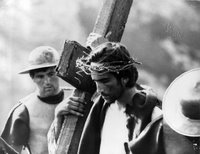
Widely considered the masterpiece of the genre, at least among film critics, Pasolini's neo-realist style gave us a Jesus of the people, who delivers his pithy sayings with revolutionary urgency. The camera work draws the viewer into the story more, whilst the use of ordinary people cuts through the gloss of so many Jesus films both before and afterwards.

Il Messia (1975 - The Messiah)
The Godfather of neo-realism was Roberto Rossellini who ended his career with this film. Like Pasolini's film, Rossellini depicts a peasant Jesus, who continues his carpentry even as he teaches, and whose followers pass on his message at the same time he does. Of all the versions of Jesus in film this one perhaps focusses the most on his teaching. The film is also unusual for it's opening scenes from the time of Samuel.
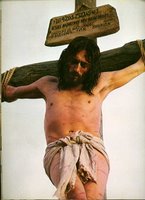
Jesus of Nazareth (1977)
One of my least favourite films in this list, and yet where would the genre be without it? In many people's eyes the definitive film Jesus, and a favourite amongst the faithful, Zefferelli does so much very well. Sadly, his leading character is dreary, and the film drags on without a charismatic compelling lead. That said the other performaces are wonderful and the period detail is impressive.


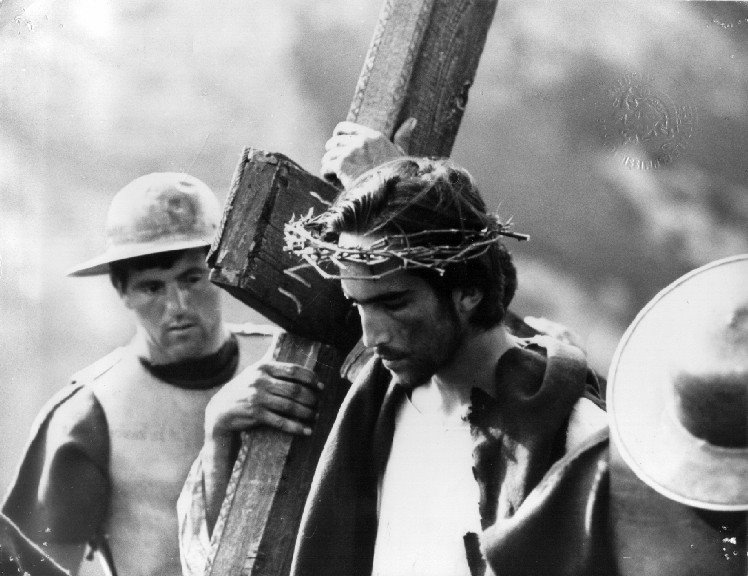
Last Temptation of Christ (1988)
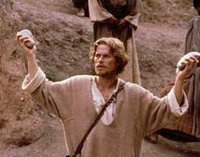
A mixture of the good, the bad, and the dull. In parts Scorsese's film soars breathing new life into the character of Jesus and challenging the viewer about their cosy pre-conceptions. In other places though the film, is just bizarre and has offended many, whilst still other places seem to drag. For those looking for fresh insights and who like to judge films on their merits there is plenty to be mined here. For those who find whole films are spoiled by particular sections stay away, particularly if you are easily offended.
My review

Jesus (1999)
Jesus explores similar territory to Last Temptation, but in a safer more palatable form. Sisto's performance has many strengths, but it slightly spoilt by a few too many scenes of of him goofing around. That said the early scenes are particularly strong. Much of it is speculation, but certainly such that is within reason. It's also one of the few films to clarify that that it was the Romans, not the Jewish leaders that were in charge in Jerusalem in Jesus's time.

The Miracle Maker (1999)
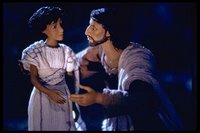
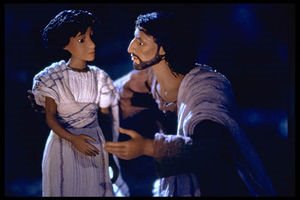
The claymation version of Jesus's life is one of the genre's highs. Whilst clearly less arty than Pasolini's film, it is theologically, and historically strong, and surprisingly moving for a stop motion film. Ralph Fiennes does an excellent job as the voice of Jesus, and Murray Watts's scripts is excellent but the most credit must go to the team of animators who produced a wonderfully realistic and creative film.
My review

Passion of the Christ (2004)
Whilst there are several troubling aspects of this film Mel Gibson did plenty of excellent work with this as well. The film looked incredible, and whilst it starved us of insights into Jesus's earlier life, the few scraps we were allowed certainly aroused our appetites for more. And as filmic meditations on the stations of the cross go, I doubt it will be surpassed.


Honourable mentions
There are a few films which I had to exclude, for various reasons, but which really deserve a mention.

Son of Man (1969)
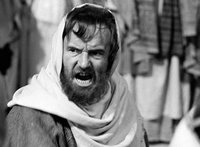
Son of Man isn't really a film, it's the filmed version of a Dennis Potter play. Nevertheless it remains one of the strongest visual portrayals of Jesus to date. Colin Blakely portrays a Jesus with fire in his belly, who speaks in the language of normal people, but in a manner that makes his collision with the authorities inevitable. The Sermon on the Mount scene again is amazing, and deserves repeated viewings.

Life of Brian (1979)
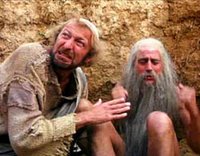
This is excluded form the list becuase it isn't actually a film about Jesus (although he makes a brief cameo at the start). Instead it's about the folibles of religion, and of humanity in general. Life of Brian does what all good films do - be excellent at something. In this film's case its comedy is hilarious hwilst remaining thoughtful. As a result it has gained a dedicated following, and appears time after time in those "best of" programmes.

Jesus of Montreal (1989)
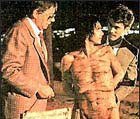
Jesus of Montreal is another satire, only this time the target is modern day Quebec. The film follows five actors as they put on a controversial passion play which and finds the life of the groups leader mirroring that of Jesus whom he plays in the film. Perhaps the strangest scenes at a first viewing, is actually one of the best - where Jesus wanders through the subway proclaiming God's judgement in the style of Mark 13.

Book of Life (1999)
Hal Hartley's film stars Martin Donovan as Jesus returning to earth on the eve of the new Millennium, and finding that his love for humanity conflicts with his mission. Another sharply observed satire which explores form as well as content.