Showing posts with label Jesus Cameos. Show all posts

Wednesday, August 4, 2010

Visual Parallels in Barabbas

I recently bought Barabbas (1961) on DVD. I was scanning through it to find a suitable screen grab to publicise the course I'm running - Rough Guide to the New Testament - and noticed a number of interesting visuals in the first few scenes alone. Some of these are obvious on a first watching - the eerie aura in the crucifixion scene due to it being filmed during an eclipse, the point of view shot as the squinting Barabbas emerges into the light, Barabbas coming face to face with Jesus in a wordless shot. But there were a number of subtler touches that I picked up this time around.

The first is the way that when Barabbas first sees Jesus his head is almost 'eclipsing' the sun. This not only prefigures the celestial oddities that will occur during Jesus' crucifixion, but it also gives Jesus a halo of sorts.
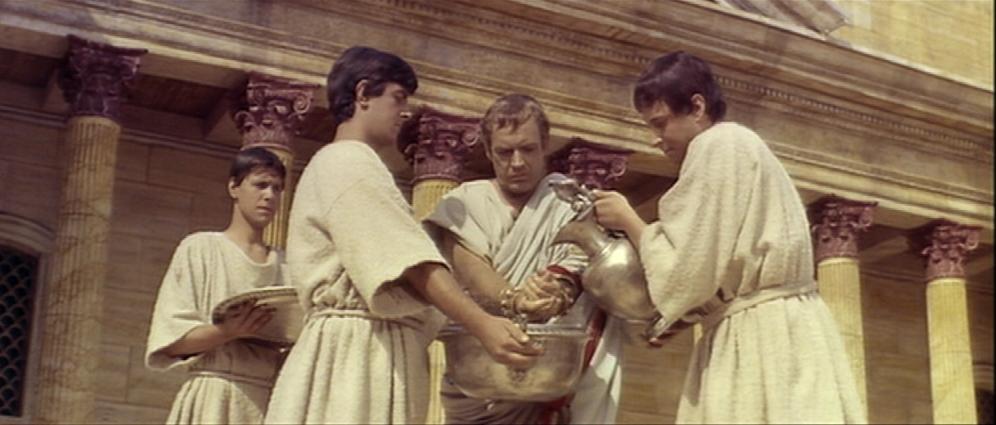
Then there's the way the film pairs its eponymous anti-hero, first with Pilate and then with Jesus. The relationship between Barabbas and Jesus, particularly the concept of Jesus dying in Barabbas' place is on of the film's major themes. It's emphasised in two different visual ways in the first 12 minutes. Initially the film intercuts between Barabbas' pardon and Jesus being scourged and taken to be crucified. But then, as Barabbas returns to his friends, they act out a mock coronation (top picture). This obviously corresponds to the shots of Jesus being mocked with the crown of thorns such as these:But the film also pairs Barabbas off with Pilate: The shot of Pilate washing his hands (below)of the charge against Jesus is immediately followed by one of Barabbas washing his own hands (further below). Barabbas may be about to be substituted for Jesus, but he has as much in common with Pilate, the common soldier who takes other people's death's trivially, than he does with Jesus.
As an aside, the opening shot of this film (below) is a great one, positioning the viewer as if they are in the crowd (which is routing for Barabbas), thus enabling us to associate with Barabbas, and reminding us that we too are complicit in his death.

Monday, August 2, 2010

Ben Hur (2010)

It's been over 50 years since William Wyler's version of Ben Hur galloped to a record-breaking 11 Oscars and earned itself a special place in our affections. Whilst Lew Wallace's novel had been translated into various other art forms (an arena play, a cartoon, a video game and a theme park among them), no-one had dared to remake it for all this time. But given filmmakers' current obsession with recycling old material, and the half century that has passed since our most successful film a consortium of TV channels decided it was time to dust off this particular chariot and take it out for another spin.

Given the accolades poured on the original, it's no surprise that this version does not quite keep shoulder to shoulder with Charlton Heston, nibbling away at his wheels with is hub caps. That said, and against all expectations, the new version is a surprisingly competent effort. Whilst there's the occasional nod to Wyler's film, the 2010 version is content to do it's own thing and at time this works really effectively. Take, for example, the famous chariot scene. Wyler's version, with it's enormous amphitheatre packed to the rafters with an ecstatic crowd, may have been referenced by productions as diverse as The Simpsons and The Phantom Menace, but is pure fantasy from a historical point of view. Here the venue is far less impressive - it's more open plan so that the crowd is far smaller and just stand nervously around the edge of the track - but it feels more realistic. Interestingly it's more reminiscent of the pod race in The Phantom Menace than Wyler's version, which both films draw on.

In contrast to the other versions of the film, the story starts with Judah Ben Hur and a Harry Potter-esque Messala racing carts as teenagers. Messala is the illegitimate son of a Roman senator who has lived with the Ben Hurs since the death of his mother. We're introduced to a stick catching game which predictably reappears throughout the film - the adult Ben Hur always catches it, whereas the adult Messala always drops it, accompanied by a slow-motion shot of it thudding onto the ground. But suddenly Messala's father calls him to Rome, leaving both boys devastated.

Cut to eight years later and Messala's father has arranged for his son to be given the garrison commander position in Jerusalem. Judah now looks like a cross between Charlton Heston and Robert Webb and runs his dead father's business, trying to toe a fine line between the Jewish zealots that work for him and the Romans he relies on to keep his business going. It feels like some kind of metaphor Tony Blair's third way politics, but I doubt that's what the filmmakers had in mind.

Messala's first official task is to arrange Pontius Pilate's entry into the city. He fails to get Judah to inform on his zealot colleague, but nevertheless takes the governor on a more circuitous route through the city, rather than smuggle him in through the back door. Pilate is quickly shown to be incompetent and melodramatic. We first see him struggling to get onto his horse, and then when the tile slips from Judah's roof he scrabbles around feebly rather than brushing it off like a soldier. Pilate is incensed. Messala disgraced. Judah arrested. Pilate sends Judah to be crucified, and on his way to the cross a stranger tells him "forgive them, for they know not what they do".

It soon turns out however that Messala has disobeyed his commander and deferred Judah's sentence to life as galley slave. The ship Judah rows on is owned by prominent Roman Quintus Arrius (Ray Winstone) who is impressed at Judah's suggestion to make the ship more efficient. On a whim, Quintus unchains Judah one evening so that when the ship is sunk a few hours later Judah is able to rescue him. The two return to Rome where Quintus locks horns with Messala's father, Senator Marcellus Agrippa, for the attention of Emperor Tiberius (Ben Cross), who already thinks himself divine. When Quintus credits his survival to "the will of the gods", Tiberius smirks. "We do amuse ourselves in a most peculiar fashion".

Whilst Marcellus is manoeuvring to get Pilate replaced by his son Messala, Quintus is setting things up for Judah. He orders Judah to sleep with Marcellus' slave Athene, gets him pardoned and freed, makes him his heir and then promptly and conveniently dies leaving Judah as a very rich man. All of which suggests that this version of Ben Hur draws on Gladiator and the TV series Rome as much as the William Wyler classic.Part two starts back in Judea with Esther, who had previously been betrothed to Judah, listening to Jesus (Julian Casey) preach. His talk is taking place on a small hill, but the excerpts we hear leave no doubt that this is meant to be the Sermon on the Mount.1 Meanwhile, Judah has returned to Rome seeking revenge on Messala, meeting Pontius Pilate and buying back his old house. Judah's first conversation with Pilate is significant not only because it mentions the local chariot race, but also because of a supposedly off the cuff mention of a Jewish trouble maker.

I've never actually read Wallace's novel, though a copy sits in a box at home somewhere, so I shan't go into too great a detail as to which parts of the book have been omitted. One aspect that was missing however was the presence, or lack of, of Balthasar, one of the magi who visited Jesus after he was born. In the book Balthasar befriends Judah, and it is he who is Judah's doorway to Jesus. But in this version not only is the nativity scene at the start of the film omitted (perhaps because it was so well satirised in Life of Brian, but also Balthasar's presence later on.

Indeed much of the later part of the book is abbreviated. Judah buys back his old house, is gradually reunited with his former acquaintances and wins the aforementioned chariot race, with Messala dying from injuries sustained in the race. There's a sub-plot with one of Judah's former employees attempting to marry Esther, and Judah carries on with Athene. He witnesses Jesus' triumphal entry and subsequent crucifixion, is converted and reunited with his mother and sister and is reunited with Esther. Nevertheless, given all that has gone before everything gets resolved in an overly cheery manner that feels out of step with the rest of the film.

The latter stages of the story are, of course where the narrative focuses in on Jesus and his teaching. I remember back in 2008 hearing producer David Wyler saying both that they wanted "to look at the spirituality within the piece rather than directly relating it to a specific religion" and that it would be based more on the original novel. That seemed like something of a contradiction, but this is actually a fair assessment. In many ways this version of the story has more focus on Jesus than any of the three previous film versions. Rather than Jesus simply passing Judah some water, he instead urges forgiveness.The start of episode two gives a good deal of the heart of Jesus' teaching. This teaching clearly influences Esther and she quotes Jesus several times, again specifically with regard to forgiveness. Then there's a discussion between Pilate and his aide about Jesus' trial. (It's unfortunate that the blame is placed on the Jewish authorities, rather than the Romans, but then I suppose that Pilate might wish to blame someone else). Judah's meeting with Jesus on the road to the cross remains, and, as in 1959, echoes their earlier meeting. But Jesus' admonishment to "forgive them" has a double meaning. It's not just about the soldiers that are crucifying him, but about Judah's attitude to Messala. But the scenes with Jesus on the cross - so critical in the 1959 film - are reduced to a shot of the cross a long way in the distance. And whereas that version saw Judah's mother and sister being healed during, and by implication because of, Jesus' crucifixion, this version can certainly be taken as suggesting the miracle happened some time later, and was perhaps at least as much to do with the reconciliation between Judah and his childhood friend.

So whereas earlier takes on the story had their focus on Jesus, the focus here is more on a critical part of his teaching. The emphasis is primarily on the power of forgiveness itself, rather than the power of the cross. In other words, Wyler was right, Ben Hur (2010) is about forgiveness (the spirituality), rather than about the one in whom, (according to Christianity - a specific religion) forgiveness finds its greatest expression. 1959 closing shot was of tree crosses on a hill: 2010 zoomed out from a close up of the fully reconciled Judah and Esther across a busy marketplace.

That shouldn't be taken as a criticism necessarily. Indeed given the differences between the audiences of the two films, this later version is, in many ways far bolder.

There are however a few moments where the script lets things down. Firstly, and perhaps as should be expected for a Roman-Christian Epic, the dialogue is often overwrought. When Judah sleeps with Athene for the first time she purrs "I did not expect to get virginity along with virility". It's not helped by actress Lucía Jiménez delivering this and other lines as if she's saying "Monsieur! With these Ferrero Rocher's you are really spoiling us". That said there are also some some very clever double meanings, such as when Quintus, unaware that Athene has just poisoned him, says he will be "leaving this accursed place, so, make haste".

Secondly, there's a handful of lazy shortcuts, which would seem unlikely in real life. Why for example, does Ben Hur leave it so late to ask anyone about the fate of his mother and sister. And why does he leave his friend to die with his foot chained to the sinking galley rather than just cut it off? Is it likely that Quintus would be completely unaware of the Hur family given that his son lived with them? We find out that Pilate's regime is more compassionate than even the gospels allow. When Simonides is crucified the day before the Sabbath (a weekly occurrence) he is not enabled to die quickly by having his legs broken, but taken down and allowed to live (albeit with a disability). Likewise, Pilate doesn't just release one prisoner for the Passover, but all of them.

The one thing that mitigates all this is that the plot is well paced, the story is engaging and the film is gripping - even though its outcome is known in advance. There's a chance that Ben Hur might be better than I expected purely because my expectations were so low. Certainly it doesn't match either the 1925 or the 1959 film adaptations. Nevertheless it's entertaining, contains some meaningful shots and whilst its focus on forgiveness may differ from previous adaptations, it's more effective at conveying the freedom that forgiveness can bring.

1 - I may detail these later, but I made these notes - 70 x 7, eye for an eye, turn the other cheek, tunic/cloak, walk 2 miles, love your enemies, beatitudes.

Tuesday, May 18, 2010

Spartacus, Jesus and Moses

I finally got to see Spartacus on the big screen on Friday, which was pretty incredible. Despite being a big fan of the epic films of the 50s and 60s, this was the first time I had ever seen one on the big screen, and what an experience. It was also only the second time I'd seen the film and I'd forgotten so much of it in the meantime, particularly the extent to which Jean Simmons is in the film and Peter Ustinov's hilarious turn as Batiatus. Incidentally, I got a bit of an epic-movie-geek kick out of the scenes between Ustinov and Charles Laughton because they both played Nero in early-Christian Roman epics, Ustinov in 1951's Quo Vadis and Laughton in The Sign of the Cross (1932).

My two favourite scenes were the build up to the final battle scene - the huge Roman army gradually making its way towards the slaves looked very impressive on the big screen - and the scene with Kirk Douglas and Woody Strode waiting to go into the ring together. Most directors would have gone for the action shot here, shooting the first gladiatorial contest with, perhaps, just an occasional glance at those waiting to go out next. But Kubrick reverses this. He stays with the two men who will go out next allowing us only a very occasional glance at the two other men. The tension and build up here is wonderful, made all the more claustrophobic by the two men being penned in to a tiny shed.

The film is well known, of course, for bookending the story with references to Jesus. The opening monologue notes that this is the century before Jesus, and that it would be his teaching that set the wheels in motion for the abolition of slavery. Of course sadly still exists in the world today, but there's much in this film's subtext that suggests it's much about the founding and development of America as it is about 1st century BC Italy. Then, of course, the film closes with the crucifixion of the heroic, freedom-preaching, rebel leader, which whilst based in real historical events is, nevertheless, an allusion to Jesus as well. It does also shed some light on the practice of crucifixion, most notably the scene were Douglas and Tony Curtis fight to try and kill each other because they would prefer their friend to die by their sword than undergo crucifixion. The fact that they didn't think to stab each other simultaneously is one of the film's few weaknesses however.

Having said all that, I think the film is much more of a Moses film than a Jesus film. For most of the film we are with these travelling, newly-freed slaves, as they seek to organise themselves and escape to permanent freedom. In contrast to the real story, Kubrick has Spartacus march is army down to the sea, and then to get them to march back again. Was this just so he could show the freed slaves trapped by the sea against an advancing army wanting to imprison them once again?

Spartacus also does what The Ten Commandments (1956) rarely does; give an idea of what life on the road might look like for such a large community. DeMille does, of course, show the ordinary people as they prepare to leave their homes in a magnificent sequence, but once the new nation is in motion the details are rather brushed over. Spartacus deals with the need to train his new army, plan a route and make allegiances, but it also shows the people relaxing and eating, caring for the vulnerable and progressing through the seasons. I vaguely remember there being a couple of other points I wanted to make about this as well, but, for the moment, they seem to have escaped me.

=====

Incidentally, the 2010 Starz mini-series Spartacus: Blood and Sand premières in the UK on Bravo on May 25th. From the clips on the Bravo website it looks like the new series is influenced much more by Gladiator and Rome than the original, but given that Gladiator was itself heavily influenced by the Kubrick film I imagine that there will be something or other to link it with the original. There was an interview with one of the show stars, John Hannah, in Monday's Guardian.

Friday, March 20, 2009

FFCC Critics on The Robe

I mentioned at the start of the year that The Robe was being released this month on Blu-ray as well as a special edition DVD. The actual release date in the States was Tuesday (17th), and a couple of the other members of the Faith and Film Critics Circle hav posted their reviews.

Over at Decent Films Steven Greydanus gives the film a B-, but steers clear of discussing the extras. In contrast, Past the Popcorn's Greg Wright avoids giving the film a rating, but appends a few comments on the extras to the end of his review. Peter Chattaway has also got a copy of this release, and so I imagine it will be only a matter of time before he posts his own comments on it.

Monday, February 23, 2009

More on The Big Fisherman

Over at FilmChat, Peter Chattaway has made some interesting observations about The Big Fisherman. Like Ron Reed and me, Peter has never actually seen the film in question, but provides an interesting back story to its production, as well as noting some points about its plot and casting. I'm trying to remember whether or not I have a copy of the novel (by the author of "The Robe", Lloyd C. Douglas) on which this film was based - I definitely had the chase to buy it, but given that space is always a premium, and that I had neither seen the film not read "The Robe" yet, I may well have left it for someone else.

One interesting thing about this film is the question of how it relates to the timeline of The Robe, and its sequel Demetrius and the Gladiators. According to one of the comments on IMDB this film involves Salome's dance in front of Herod, which suggests that some of the action pre-figures The Robe, yet I'd always heard it talked of as a sequel, rather than a prequel, perhaps because the last words at the end of "The Robe" are "the big fisherman".

This is confirmed in a detailed and interesting write up of this film by John Hayes - who unlike Ron, Peter and me has actually seen it, albeit so long ago that he barely remembers it - over at his Widescreen Movies site. Incidentally, Hayes quotes from both Derek Elley's book "The Epic Film" and Jon Solomon's "The Ancient World in The Cinema". I have both, and do, in fact, recall Solomon's description of Peter as "piscatorial". I've been meaning to write up my notes from reading Solomon's book in the summer, but I've not yet found the time.

Monday, January 12, 2009

New Version of Johnny Got his Gun

I watched Junebug again last night and appreciated it even more than I had first time I watched it. This time around I was particularly struck by the performance of Ben McKenzie as Johnny. So I looked him up on the IMDB and noticed that he recently worked on a new version of Johnny Got his Gun.

From the official website it seems that this is effectively a one man show filmed and released as a movie, and it looks like a DVD will be released around April. I've never read the book, but I watched and reviewed the 1971 film adaptation about a year ago. That version of the story featured a couple of scenes with an imaginary Jesus, but was also a fairly loose adaptation of the book (despite being directed by the novel's author Dalton Trumbo). The new version claims that about 99% of it is taken from the novel, so, at the very least, it's likely that it will contain the scene with Mary, Joseph and Jesus. I didn't manage to find the scene where Jesus plays cards with a group of soldiers in this set of crib notes on the book, so I guess they were added for the film. That said the shot above perhaps suggests that something about Jesus will fit in somewhere.

Wednesday, January 7, 2009

The Robe Special Edition


Language: English
Subtitles: English, French, Spanish

Number of discs: 1
Studio: 20th Century Fox

Release Date: March 17, 2009
Run Time: 135 minutes

ASIN: B001NSLE5I

Peter Chattaway caught this one over the Christmas period, so I thought I'd post it up now things are back to normal. IGN has new of the new special edition DVD and Blu-Ray releases of The Robe.

There's a whole host of extras, though it's unclear how many of these will only be on the Blu-Ray disc, and Amazon is unable to help. Here's IGN's list:
Introduction by Martin Scorsese
Commentary with Film Composer David Newman and Film Historians Jon Burlingame,
Julie Kirgo and Nick Redman
The Making of The Robe featurette
The Music of The Robe: Alfred Newman's Score isolated music track
Still Galleries
Interactive Pressbook
The CinemaScope Story featurette (Blu-ray only)
From Scripture to Script: The Bible and Hollywood featurette (Blu-ray only)
The Robe Times Two: A Comparison of Widescreen and Standard Versions (Blu-ray only)
A Seamless Faith: The Real-Life Search for The Robe featurette (Blu-ray only)
Vintage Celebrity Introductions by Richard Widmark, Susan Hayworth, Robert Wagner, Clifton Webb and Dan Dailey (Blu-ray only)
Audio Interview with Screenwriter Philip Dunne (1969) (Blu-ray only)
Movietone News (Blu-ray only)
Trailers / TV Spots (Blu-ray only)
Poster Gallery / Lobby Cards (Blu-ray only)
I've read various comments on this film by Martin Scorsese over the years, so I was fully aware that he was a fan, but even so that's a bit of a coup for Fox.

Amazon.co.uk lists the Blu-Ray version as having the same release date, but there doesn't appear to be a corresponding UK DVD release.

Friday, December 19, 2008

DVD Review: Quo Vadis?

Warner Home Video
Run time: 174 mins
Rating: Not Rated
Aspect Ratio: 4:3
Region: Region 1
Audio: English-DD Mono
French-DD Mono
Subtitles: English, French, Spanish, Japanese
Number of discs: 2
Extras: Commentary, Trailers, Featurette,
ASIN: B00005JN8Z
When the post-war film studios realised that their future lay in giving their audiences the kind of visual stunning experience that they couldn't get from their televisions, Warner Brothers' first major effort was Quo Vadis?. Henryk Sienkiewicz's Roman-Christian novel had already spawned two large scale silent epics - the first of which was said to inspire D.W. Griffith's ground-breaking Intolerance. The "new" version would be even more impressive. On-location filming and 30,000 extras offering up the kind of spectacle that would pull people away from their TVs and into the cinema.

So it's kind of ironic to be reviewing a DVD release that seeks to bring that original spectacle and theatrical experience of watching Quo Vadis? into our living rooms. Warner Home Video's new 2-disc release promises a "new ultra-resolution digital transfer" and a restored soundtrack. And for anyone who is happy with their existing DVD or VHS release, there's a selection of extra features to make the new package a little more enticing. I'll start by reviewing the extras, before offering a few comments on the quality of the transfer at the end.
Commentary by F.X. Feeney
Film commentaries are something of a mixed bag. Whilst the best produce a far greater appreciation of a particular film's depth, the worst veer into extreme tedium, or worse still, ego-centric back slapping. Thankfully this is a very much an example of the former. I'm unfamiliar with Feeney's previous work, but his efforts here are far more interesting than his billing as a "film historian" suggests. Feeney has clearly done his homework and manages to pepper his commentary with an intriguing mix of tidbits regarding the movie's creation, through to fascinating interpretations of the film's use of cinematic language. It's this diversity that makes the commentary such a success. Often a lone commentator comes across as somewhat one-dimensional, but Feeney successfully changes gears from talking about the novel, to the issues surrounding the film's long pre-production to analysing the final product. At 174 minutes it hardly surprising that Feeney dries up a little in the second half, which may also be due to his love for the film's climax getting the better of him. I don't think I've ever listened to a DVD commentary twice, but, in this case I think it may well be a possibility.

Trailers
Both the theatrical trailer and the original teaser trailer are included. It's perhaps a testimony of the extent to which Ben Hur subsequently overshadowed Quo Vadis? that there are no later TV trailers as there are with other epic films from this era. The teaser trailer only shows one shot from the film - one of Marcus's army marching into the centre of Rome. As you'd expect there's a bit more in the longer theatrical trailer which shows a couple of long shots but mainly occupies its time by introducing all the main characters and boasting about the movie's "colossal" size. And, as if to force the point home, this version of the trailer runs for over five minutes.Featurette - In the Beginning: Quo Vadis and the Genesis of the Biblical Epic
A lot of DVDs these days tend to break up their documentary content into a number of shorter featurettes, each covering a specific area. It makes it seems like potential purchasers are getting more for their money. So it's nice to see a longer documentary here which eschews such an approach. That said it does appear that this may have been on the cards at one point as in places the documentary feels a little segmented. It start with a look at the background to Sienkiewicz's novel and quickly moves on to look at the two silent film versions of the story from 1913 and 1925. There's some brief footage from both films which is nice to see, but also leaves you wanting more. Given the recent releases of Ben Hur and The Ten Commandments - both of which included their 1920s predecessors as extra features - it would have been nice to see these included as well.

The documentary then looks at the pre-WWII plans for making the film. Whilst Robert Taylor was originally lined up to play Marcus Vinicius, it soon began to look like Gregory Peck would play the Roman commander. Peck was the preferred choice of the director who was originally meant to be making the film - John Huston. But when Peck was forced to drop out, Huston left the picture too. But despite all these setbacks, the project carried on. Mervyn Le Roy was drafted in to direct and Taylor was returned to the role 15 years after it had originally been discussed.

We then move on to hear about various aspects of the production itself: the performance of the leads, the design of sets and costumes, Miklós Rózsa score and so on. This is perhaps the most interesting part if the featurette, and the interview with the son of matte artist Peter Ellenshaw was particularly fascinating.

The final segment of the documentary looks at its marketing, audience reception, and its influence on later biblical epics, the claims here are perhaps a little too grand. Whilst Quo Vadis? was indeed a landmark epic, and certainly influential on the Jesus Cameo films that followed in its footsteps, it was DeMille who really kickstarted the epic craze of the fifties with his 1949 Samson and Delilah, and his second stab at The Ten Commandments. But that said, the tendency for the 50s epics to comment on (the then) modern day America does owe something of a debt to Quo Vadis?, which, the documentary points out, is made fairly explicit throughout the film, most notably at the end.Transfer Quality
Having only previously seen Quo Vadis? on VHS, I personally was impressed by the picture quality, but then, I'm not an expert on such matters and was only watching it on a standard television set. But it appears not everyone shares my opinion and several of the experts (DVD Times, DVD Talk and DVD Review) are fairly critical. However, even having read their criticisms I'm not sure I can see what they see. Perhaps it's one of those half empty/half full things. The aspect ratio is 4:3 as the original film was (it would not be until The Robe two years later that widescreen was introduced) and there are no criticisms about the overly zealous cropping and so on.

Overall
Whilst some have a few quibbles with the quality of the transfer, overall this seems to me to be a strong release. Feeney's commentary is excellent and the featurette is well paced and interesting. Whilst I've not been able to compare this release with the earlier one-disc version, I've been led to believe that the picture quality is a significant improvement, and it's certainly a major improvement to the VHS version. Having said all that, the Blu-Ray edition of this disc is due to come out next year, and, according to DVD Beaver it offers a significant improvement again in picture quality, and manages to fit the film and all of the same extras onto a single disc.

Wednesday, November 19, 2008

Silver Chalice Coming to DVD

Kyle Smith has spotted that The Silver Chalice is being released on DVD next February. This seems a tad cynical given that star actor Paul Newman died less than 2 months ago. Newman hated the film so much that when it aired on TV in 1966 he took out a full page advert apologising for his performance. According to Wikipedia the tactic backfired and the screening brought in higher than expected viewing figures. Peter Chattaway covers this under the heading Bible movie completist alert!, but I can't help feeling that the timing of this DVD's release is targeted more at Paul Newman completists than anyone else.

No word yet on what, if any, extras will be included. My review of the film from last year is here.

Thursday, October 16, 2008

Ferrara on Mary and Herzog's Bad Lieutenant Remake

Filmmaker Magazine has an interview with Mary director Abel Ferrara, presumably to coincide with its forthcoming screening in New York. I've not heard him talk a great deal about the film - which is now 3 years old - so it's interesting to hear some of his thoughts on it (though the language is not for the faint-hearted). He also 'discusses' Werner Herzog's plan to remake Bad Lieutenant - another film with a lot of unconventional things to say about Jesus.

Tuesday, July 22, 2008

Quo Vadis Coming to DVD

Peter Chattaway has the news that 1951's Quo Vadis is finally getting a DVD release. The film, which is the most famous of at least 8 different adaptations of Henry Siekiewicz's novel, is due for release to DVD in November, with a Blu-Ray edition due in time for Easter 2009.

In addition to being the most expensive film ever made at the time of its release, Quo Vadis is famous for Peter Ustinov's startling performance as Nero, and for giving film débuts to two of cinema's most iconic stars - Elizabeth Taylor and Sophia Loren.

A press release from Warner Home Video promises a new documentary on the making of the film and a commentary by filmmaker/writer F.X. Feeney. I'll post more details as I get them.

Thursday, June 26, 2008

Coogan as aTeacher as Jesus Hamlet 2

The last ten years have seen an increasing number of films using Jesus, or our culture's image of Jesus, as a source of humour. So, Will Ferrell, Philip Seymour Hoffman, Justin Theroux, have all starred as a character who, in some way represented Jesus, and he was also portrayed in various South Park episodes and, obviously, a glut of amateur films on YouTube.

Of course the film most people think of when discussing Jesus as a figure of fun is Monty Python's Life of Brian, even though the figure of Jesus is the one thing that the movie treats with some respect; the pre- and post-credit sequences both make it clear that the film is not about Jesus and keep him at arms length. There are of course earlier films which are more directly scathing about Jesus such as The Milky Way (1969) and 1972's Greaser's Palace (although, I should add, I've never seen it), but these films are more obscure and less likely to be an influence on this more recent movement than the Pythons.

What's interesting is the way that these films have grown bolder in their depictions. In Superstar (1999) Ferrell's 'Jesus' is clear he's not the real thing, but a product of the heroine's subconscious. Jesus's appearances in South Park are a little more complex, but ultimately this was about mocking the kitsch Christ of (the Christian) faith rather than the Jesus of history who started it.

The envelope was pushed a little further in last year's The Ten where Justin Theroux plays a modern day character called Jesus who has long hair and a beard and the power to walk across water. He also has the gift of seduction and deflowers a librarian. Is this meant to be the real Jesus? In honesty the film is so surreal and absurd that even the question doesn't make sense.

So Steve Coogan's performance as a drama teacher playing Jesus in the forthcoming Hamlet 2 (official site) is part of a long tradition. Yet if anything it's less daring than it's predecessors, even despite the annoyingly catchy song 'Rock me Sexy Jesus'. The Jesus angle has been played up by articles such as the one at Cinematical, but the trailer suggest this aspect is only a fairly small part of the final film. The movie's main story appears to be about the attempts of Coogan's struggling drama teacher to produce a show that can save his department. His solution is 'Hamlet 2' which uses a time machine to get around the problem of all the leading characters dying in the original, and introduces a host of new characters into the mix including Einstein, Jesus, Satan, and Hillary Clinton.In many ways it sounds like it's more similar to Seymour-Hoffman's role in Along Came Polly. There Hoffman plays an ego-maniacal producer who is playing both Jesus and Judas in a production of Godspell. Given that it was released in 2004 I can't help but wonder if this facet was added while speculation was rife that Mel Gibson might be playing Jesus in The Passion of the Christ. In any case the film's target is self-obsessed actor-directors rather than Jesus himself.

It's fairly obvious there is to be a similar dynamic here. It's not Jesus that is being mocked, but his use as a cultural and political football, and his portrayal by our culture. Jesus Christ, Superstar seems very much at the fore here. Aside from the way the original film portrays Jesus as cool and attractive to women, there is also a visual similarity between Coogan's Jesus (pictured above) and Glen Carter's portrayal in the more recent filmed version of the show, where numerous characters wear similarly tight white vests. It's interesting to see how one generation's attempt to present a fresh image of Jesus becomes the next generations satirised cliché.

Others have made the link between the song 'Rock me Sexy Jesus' and Little Shop of Horrors and there's a certain thematic similarity between this film and The Tall Man which also climaxes in a wonderfully naff and pretentious musical (in that film the musical is about The Elephant Man).

There are some other clips of Hamlet 2 available to those in the US, but unfortunately I've not had the chance to see them. The film played at Sundance and so has already been reviewed by Variety and Hollywood Reporter is due for wider release on August 22, 2008. All five reviews at Rotten Tomatoes are positive so far, although it has only got 5.5 at IMdb at present.

Tuesday, May 27, 2008

James Tembo, Detective (2006)

I've been meaning to post about this for a while now, but as I haven't yet had a chance to review it, I though it would be worth letting people know about it first and then return to it later.

James Tembo, Detective is a Zambian film which "follows the work of a detective in modern Zambia who is hired to look for the missing body of an executed religious figure named 'Joshua'". It seems fairly clear from the official website that Joshua is a modern day equivalent of Jesus (obviously the route of their two names is the same) which means that this film is a sort of modern day version of The Final Inquiry. I guess other comparisons might be films such as Son of Man and, perhaps, Dark City. I'll be very pleased if this film, which started out life as a play, is anything like either of those, or if it manages to capture some kind of film noir feel, but it's ultra low budget so I wouldn't judge it too harshly if it didn't!

The film was made at the end of 2006 which means you can already buy the DVD , and the website also gives you a run down of both the main and the supporting cast and crew as well as a description of the film's history and some hopes for the future. I hope to review it shortly.

Wednesday, May 14, 2008

Bad Lieutenant to be Remade

Abel Ferrara's 1992 film Bad Lieutenant is to be remade by director Werner Herzog featuring Nicholas Cage in the lead role. Variety, Hollywood Reporter and Cinematical are all carrying the story which was announced at Cannes. There have been various cries of dismay over this one, not least Jeffrey Overstreet who, given Herzog's beliefs, wonders what he will do with the original's "profoundly spiritual conclusion". It will be interesting to see how that pans out as the producer of the original, Edward R. Pressman, will be responsible again this time, and star Nicholas Cage has already sabbotaged starred in two remakes of classic 'spiritual' films (Wings of Desire and The Wicker Man).

Wednesday, April 9, 2008

Ben Hur to be Re-made for TV

Just four days after the death of Charlton Heston, Alchemy TV has announced that it is remaking one of his best known works. Ben Hur has, been filmed three times before, as well as being released as a cartoon voiced by Heston, but now according to Variety it's to be made into TV mini-series as well.

Personally I find the timing of this annoucement somewhat distasteful - an unnerving keenness to prize the horse whip from Heston's cold dead hands, but in fairness, producer David Wyler has dedicated the film to both Heston and his father. Wyler's father is, as you may have guessed, the great William Wyler who both directed the 1959 version and worked on the 1925 production.

Wyler also states that the new film will feature a younger Ben Hur, and that he wants the film to "look at the spirituality within the piece rather than directly relating it to a specific religion". At the same time he intends that the series will be more in line with Lew Wallace's original novel than its predecessors.

There's a bit more on this over at FilmChat including some footage from the 1907 version.

Sunday, April 6, 2008

Charlton Heston (1923-2008)

I was sorry to hear of the death of the great Charlton Heston on Saturday. I can still remember, as a boy, rushing back home from playing football in the park in order to watch The Ten Commandments on TV one New Year's Day. As an actor he was champion of the historical epic in general and the Bible Film in particular. People often discuss whose face they picture when they think of Jesus, but when it comes to Moses there's no question: it's Heston.

It was undoubtedly DeMille who made Heston a star, giving him his big break in The Greatest Show on Earth and making him a household name with The Ten Commandments. Today Heston's performance seems a little dated in places, but overall it's still as monumental as it was 50 years ago. As with the film in general, it always seems to play better than I remember it.

Three years later Heston won an Oscar for his role in another Bible Film, of sorts, Ben Hur pictured in this blog's header image). The film won a record number of Oscars, but it was Heston's performance, along with the chariot race scene that really captured the attention. Heston's portrayal captured the inner battle between Ben Hur's heroism and his bitterness.Then in 1965 he turned in a brief role in The Greatest Story Ever Told. The standard complaint about this film was its parade of A-list stars making cameos, not least John Wayne's climatic moment as a centurion. In fairness Heston's performance was no better. It was the only feature film to star both actors.

Heston made numerous other historical films, El Cid, Big Country, The Agony and the Ecstasy, Julius Caesar, Antony and Cleopatra and The Three Musketeers to name just a few. He often joked that his face belonged to another century, but in reality it was as much his charisma and nobility. Michel Mourlet first noted his "eagle's profile" with his "imperious arch of eyebrows", and in that way he embodied America1.

He had plenty of choice roles in the modern era as well. In 1958 he was cast as a Mexican detective in A Touch of Evil and he became one of the few actors to get to choose their director. Chuck chose well, and Orson Welles got to make what is perhaps his second greatest film.

In later life he also ended up fronting a series of documentaries - "Charlton Heston Presents - The Bible" and voicing an animated version of Ben Hur, as well as turning in a handful of smaller roles. Reading stories and obituaries from various news outlets reminded me of one that I had temporarily forgotten - his hilarious cameo in Wayne's World 2.Predictably there are also mentions of his work as head of the NRA. Whilst I disagree with his politics I'm deeply saddened by the vitriol of some of the comments on the BBC website. They seem to forget / are unaware that not only do the majority of Americans favour the right to own a gun, but they also live in a household that actually does.

For Heston, however, this was simply part of his life long fight for civil rights as embodied in his presence at civil rights protests in the early sixties. It's rare for someone cross party agendas in such an extreme way. Rarer still for it to be done in a way that seems to exhibit such logic. As I said disagree, but, it has to be said most respectfully.

It was Heston's role with the NRA that gained him his last memorable screen role - as the bad guy in Bowling for Coumbine (2002). Director Michael Moore put in a lot of hours in the editing room, and Heston came out of it looking pretty bad. Shortly afterwards, however, he announced that he was suffering from Alzheimer's and his apparent discombobulation during Moore's interview suddenly made sense.Following his announcement he retired from public life and it seemed increasingly likely that the next news story about him would be the announcement of his death that came yesterday. Even before he reached 84 he had boasted that he had lived enough for two lives, and one wouldn't be surprised if his arrival at the pearly gates leads one or two of the inmates to exclaim "it's Moses!"

=======

There are a few other pieces on Heston at the BBC, The Guardian, The Times, The Telegraph and The Independent.

1 - Michel Mourlet, "In Defence of Violence" in "Stardom: Industry of Desire" Gledhill (ed). (1991)

Wednesday, March 19, 2008

The Final Inquiry (L'Inchiesta)

For many people, Ridley Scott's Gladiator is the film responsible for the recent resurgence in epic films. Grand battle scenes, larger than life characters, yet at the heart of it, it's about one man's solitary quest. Others point to the influence of Mel Gibson's The Passion of the Christ. Braveheart may have been the film that really set the epic wheels in motion, but it was The Passion which inspired a legion of movies that were linked to the Bible.

There are elements of both films in The Final Inquiry starring Dolph Lundgren and Monica Cruz - two actors who, for very different reasons, it's best not to cross in case you ever met them in person. Like Gladiator the action starts in Germania as a noble Roman soldier (Titus Valerius Taurus) leads his troops into victory against the local scraggy-blond Barbarians. There's a dying and noble emperor, double dealing enemies, and a muscular sidekick all crammed in to a whistle-stop tour of the Roman Empire.The film's link to The Passion is more direct. Set just a few months after the death of Jesus, Emperor Tiberius sends Titus to get to the bottom of what exactly happened on the day when, all over the empire, the sky clouded over. So Titus heads to Jerusalem where he talks with various characters who crop up in the gospels.

The continuity with The Passion is further enhanced by Hristo Shopov reprising his role as Pontius Pilate. Much has changed for Pilate over the last few months - he's gained a few pounds, slipped into something more comfortable and learnt to speak English. But there's also some discontinuity as well. Christo Jivkov played John in The Passion, but here he appears as St. Stephen.

Titus is joined on his mission by an enslaved German called Brixos, played by Dolph Lundgren. Lundgren largely sticks to what he does best - roaring and swinging his axe around as he watches Titus's back. Meanwhile Titus also sparks up a friendship with Tabitha, a beautiful Jewish Christian.If all that sounds rather cliché-ridden, then, this is probably isn't the film for you. From the opening title sequence when a group of galloping Roman soldiers come to a halt just to hear Titus say "Forwards" and ride on; through to Tiberius's informant just managing to squeeze out the last vital bit of information before he dies; through to the slave who stays on as his master's friend even though he has just been freed, there are clichés aplenty.

However, clichés aside, the film is actually fairly watchable. There's enough interest in the first half of the film as Titus turns detective and tries to get to the bottom of the story, and there's sufficient chemistry between him and Tabitha (Cruz) to make the love story believable. And the film's use of flashbacks to tell the story of Jesus through Titus's eyes is an interesting approach to the material. It reflects the situation we find ourselves in today unable to meet Jesus face to face we have to put together the facts about him from the various pieces of evidence.

It's also interesting to see a pre-conversion Saul of Tarsus unashamedly played as the bad guy. Usually films that deal with Paul at this stage of his life portray him as a sort of hero in waiting. He may be misguided, and a little hotheaded, but generally he's noble in his own sort of way. Here, however, he lays into the already prostrate Stephen with such relish that it's easy to see why it required nothing less than a vision of the risen Jesus to cause him to convert. The portrayal of Peter (below) is also unconventional, although in this case it's less satisfying as Peter is shown as still living in Galilee.Overall though, the history's not too bad. There's no reason to believe that the sky turned black as far away as Capri, of course, or that if it did Tiberius would somehow link it to the death of Jesus. But otherwise it is true that Tiberius retired to Capri, where he did become somewhat reclusive, and that, as a result, his people held him in fairly low regard. The film does view him through somewhat rose-tinted spectacles though. It's no surprise when it turns out that the reasonably unhistorical reason for his final voyage to Rome is in order to convert the empire to Christianity. Unsurprisingly when his heir (Caligula) finds out about his uncle's plans, the film reverts back to more widely accepted historical territory.

By then, the elements that made the earlier parts of Final Inquiry work have long since been suffocated by the film's underlying agenda. Attempting to demonstrate the rationality of Christian belief, the second half of the film resorts to far fetched storylines. For example, at one point Caiaphas, Saul and Pilate attempt to persuade Titus that the resurrections of both Lazarus and Jesus were faked by poisoning him.

So overall, Final Inquiry is a mixed bag. Whilst it's never quite as bad as it could have been, a relatively promising start deteriorates rapidly as the story heads towards it's conclusion. The evidence Titus Valerius Taurus may have been enough to convince him, but it's unlikely to cause many people to seriously reconsider their previous conclusions.

Friday, February 8, 2008

Superstar (1999)

No, this post is not about a version of Jesus Christ, Superstar featuring Will Ferrell in the lead role. Instead, it's about a 1999 comedy in which Ferrell co-stars alongside Molly Shannon. Ferrell's main role is as Catholic high school heart throb Sky, who is the object of desire for Shannon's character, Mary Katherine Gallagher. Mary is desperately seeking her first kiss, and has decided that the only way to attain it is to become a superstar. However, like many teens she's a little awkward, both physically and socially, and so has to settle for watching Sky go out with her nemesis Evian (apparently the prettiest girl in the school).

About half an hour into the film Mary drifts off to sleep and is visited by Jesus. There's an obvious similarity, then, between this and films like Johnny Got His Gun which I reviewed last week. Here, however, there's an added twist: Jesus is also played by Ferrell. Mary's somewhat confused by this, but 'Jesus' explains to her that their conversation is all in her head:
Mary Katherine Gallagher: Oh my God!
Jesus: Oh my Me! How are you?
Mary Katherine Gallagher: It's going OK. Are you the Lord?
Jesus: Well, to you I am. See, technically, you're, like, in this REM sleep state, and I'm a mixture of your mind's images of God, some past authority figures, uh, Skye, and your dad. Basically, your subconscious came up with me to help you deal. Dig?
In contrast to Johnny Got His Gun, the explicit denial that this is in any way the 'real Jesus', combined with the humorous nature of the film, mean that this film cannot be read as offering serious commentary on the historical Jesus. It does, however, draw attention to the way in which our subconscious image of Jesus is informed by various sources, which often have little to do with the Bible, or historical probability. It also comments on the social construct of Jesus. Increasingly in our society Jesus has become a hip, new-age type figure. Toothless and benign, he's seen as a man of peace who taught people to love. What's amusing about this film is the way it uses that characterisation to send up the guiding star figure movie cliché that is so prevalent in films such as this. Interestingly, it could be argued that this cliché actually originated in films such as Quo Vadis?, where the original 'guiding star figure' was a vision of Jesus himself. Indeed one scene from the film appears to parody (perhaps unintentionally) the pivotal scene in Quo Vadis?.

It's also interesting that both Superstar and the earlier Jesus cameo films both present Jesus as somehow unreachable and put barriers between the viewer and Jesus. The 50s epics, did this by avoiding showing his face, either filming from a distance, from behind, or just showing his hand etc. In fact The Robe actually uses the cross as a physical barrier in front of Jesus's face. Barriers such as these came out of a spirit of piety, but nevertheless made Jesus more remote.

Superstar, on the other hand, shows its Jesus face on and close up, but makes the point, that this is not the real Jesus. Thus Jesus remains as remote as he was in the earlier films, only this time the barrier is uncertainty about our ability to encounter anything of Jesus apart from our own experiences. It's not, by any means, a cynical portrayal, but it is very much the product of post-modernist understanding on the attainability of truth or otherwise.One final point here is that the figure of Jesus is also represented in this film by statues of him which appear in the background in various scenes.The other thought that occurred to me in watching Superstar is how clearly it demonstrates the importance of the choice of actor to play Jesus. At the time of the film's release Ferrell had already featured in two of the Austin Powers films having made his name on Saturday Night Live. In fact Superstar started life as an SNL skit, so, at least amongst the shows fans he brought numerous character associations with him to the role.

Ferrell has subsequently gone on to find huge success in a range of performance from gross-out college comedies (Wedding Crashers to his role in the more thoughtful Woody Allen film Melinda, Melinda. Despite those roles coming after his performance in Superstar, they continue to inform and alter the film's meaning, albeit perhaps marginally. Viewers who watch Superstar after they have seen Elf or Anchorman cannot help but read this film through those previous performances, in a way that someone unfamiliar with his body of work could not. It's a good example of how stars are no longer able to provide a blank canvas to those they continue to work with. Their face brings to their new roles connotations associated with their previous work.

Overall the Jesus character appears four times in the film (although it depends quite how you count it), and Ferrell's portrayal of Jesus was included in Entertainment Weekly's 12 favourite TV and Movie Jesuses.

Tuesday, January 29, 2008

Johnny Got His Gun

Films in the Jesus Cameo performance sub-genre tend to fall into one of two categories. On the one hand they are films set in or around first century Palestine or Rome, and the words / actions of Jesus are shown as a significant moment in a character's story. Films such as Quo Vadis, The Robe, Ben-Hur and even Life of Brian fall into this category. The other grouping is more set in modern times where Jesus appears in dreams or visions. Again this usually occurs at at critical point in the film, but the films themselves are a little more diverse ranging from Bad Lieutenant to Superstar featuring Will Ferrell as Jesus.

Johnny Got His Gun is perhaps one of the stranger entries in the latter category. Joe Bonham 1 is a soldier horrifically injured in the First World War. His doctors consider him all but dead, but viewers are party to his inner monologue and therefore realise just how concious and active his mind remains. As he lies shut away in various army hospital beds the audience has a unique position. Joe is unable to see and hear and so is oblivious to what is happening in the room he is in. The various doctors, nurses and army officials are likewise oblivious to Joe's thoughts and dreams as he is also unable to speak. We, however, witness both and so the central tension of the film is the journey towards these two sides finally communicating. It's also an interesting testimony to the ability of cinema to give us different angles on things; to witness one story from two perspectives simultaneously, and to portray fantasy as if it were reality.

The "action" such that it is, alternates between Joe's two states of consciousness. When he is fully concious the camera is present and in the room with the medical staff while Joe's inner monologue is brought to the foreground. In between times he drifts out of consciousness and we experience his dreams. Joe dreams are a disorientating combination of his past (the night he spent with his girlfriend before he left for war, his father's funeral incidents from his childhood, the moment he was injured) and his fantasy which encompasses such bizarre episodes as a futuristic military supplies salesman, a rat crawling on him, his parents running a freak sideshow on which he stars, and the two sequences where he talks with Jesus.The first Jesus sequence arrives around the half hour mark, and stars Donald Sutherland as a gambling, drinking, train-driving Christ. Joe, Jesus and a group of others play cards in a waiting room. Jesus flashes a couple of fancy tricks, but is bemused by his inability to hit 21 from 12. As the conversation becomes more serious it becomes apparent that Joe's colleagues all have an imminent date with death. Jesus is vaguely compassionate yet he nevertheless ushers them towards the train that is taking them towards that end, and the section's closing shot is of Jesus yelling out of the cabin window as he drives the train to his destination at full speed.

A short while later Jesus appears in a totally different sequence, and here the image of Jesus the film presents is far more troubling. The preceding sequence ends with a tormented Joe desperate to work out the difference between reality and fantasy, particularly as he is unable to see, hear, touch or say a thing. Suddenly Joe and Jesus are alone in his carpenter's shop and Jesus is trying to offer some advice.

Unfortunately, and for all his good intentions, Jesus's advice is quite useless: he's seemingly unable to grasp quite how desperate Joe's plight is. His only credentials seem to be the fact of his own suffering, which is alluded to in the earlier sequence and symbolised here (by a van driver placing crosses on the back of his vehicle in the background). The implication is that Joe's suffering is beyond even that of Jesus, and it leaves him looking somewhat impotent. Perhaps frustrated by his failure to find a solution, this Jesus becomes increasingly unhelpful ("it would be cruel to pretend that anyone could help you what you need is a miracle"), ultimately becoming downright heartless. "Perhaps it would be better for you to go away now. You're a very unlucky young man and sometimes it rubs off." The dream ends with Jesus even raising questions about his own existence.
Joe: Are you and I really here together or is this just a dream too?
Jesus: It's a dream.
Joe: How do you know?
Jesus: Because I'm a dream.
Joe: I don't believe you.
Jesus: Nobody does. That's why I'm as unreal as every other dream that didn't come true.
It's difficult to work out how seriously we should take the negative image of Jesus that is presented in these dream sequences. Clearly he is not meant to be a representation of the real Jesus, just the product of Joe's troubled and dreaming mind. At the same time it seems fairly likely that the filmmakers are making covert statements about their opinions on Jesus and the religion which has taken his name. The fantasy aspect of this depiction enables the film to say things about Jesus that most films back then couldn't. It raises the point of view that Jesus is unable to relieve some people's torment, and that he is just "as unreal as every other dream that didn't come true".

The interplay between dreams and reality continues elsewhere. Indeed like many dreams vs reality films (The Wizard of Oz, Pleasantville) the "real sequences" are shot in black and white, and it's only once we move into the fantasy world where colour is restored.2

Interestingly, in between the two scenes featuring Jesus we observe the young Joe going to a church service where excerpts are read out from the works of Mary Baker Eddy. The passage in question is:
All is infinite mind and it's infinite manifestation... matter is the unreal and temporal... Spirit is God and man is his image and likeness. Therefore, man is not material; he is spiritual...
(abbreviations theirs)
In many ways these words support the film's use of colour. The unreal matter is shot in black and white whereas the dominion of the mind is filmed in glorious colour. Joe himself embodies this (if you'll pardon the pun). Without the usual array of senses to determine what is real and what isn't he is able to experience life on the spiritual plane.

There's one other religious scene of note which also slots into the section between the two Jesus scenes. The pope, the yet to be born Gandhi and a third man stand on a balcony as the pope prays for "all those in the armed forces who sacrifice their young lives in this just and holy war for everlasting peace" implying religion's complicity in the waging of war.

Reading the comments for Johnny Got His Gun on the IMDb, it's surprising just how many people claim this film turned them into pacifists, particularly as it was released around the time that the draft to the Vietnam war was beginning to bite. Whilst this is certainly not a film that glorifies war, it's far from anti-war propaganda. Sadly it's far more polemical about religion. Christianity = bad, gnostic -esque spirituality = good.

Whilst I disagree with the ideas that the first part of the film seeks to explore, it is nevertheless quite interesting to see these ideas explored so imaginatively. Nevertheless, it's the second half of the film, where Joe gradually begins to regain his connection with the world, that is by far the stronger.

========
Joe is played by Timothy Bottoms who is now best known for playing George W. Bush in no less than three different productions.
2 - I actually watched this film in two parts, and, by sheer chance, I happened to watch Andrei Tarkovsky's Mirror in between the two sittings. Mirror also touched on memories and dreams of the past interwoven with the future in a complex series of flashbacks. Needless to say it made an interesting, if very confusing, combination.